
If you manage a sheet metal fabrication or stamping facility, you have almost certainly asked this question: can I stack two sheet metal rack units on top of each other to double my vertical storage capacity? The short answer is — technically yes, our sheet metal racks are engineered to support a second unit on top. But whether it is safe and efficient in practice depends entirely on the rack configuration you choose.
In this guide, we break down the two most common stacking scenarios, explain why one works and the other does not, and share two proven solutions to help you maximize vertical space without compromising worker safety or operational efficiency.
Why Vertical Space Matters in Sheet Metal Storage
Floor space in metal processing plants is expensive. As production volumes grow, many facility managers look upward — stacking racks, adding mezzanines, or investing in automated vertical storage towers. Sheet metal blanks and formed panels are heavy and awkward to handle, which means that any vertical storage solution must be designed with both load capacity and ergonomic access in mind.
A standard sheet metal rack typically stands between 1.8 m and 2.5 m in height and can hold material loads ranging from 800 kg to over 3,000 kg depending on the model. Stacking two units could theoretically bring your storage height to 4–5 meters — but reaching material at that height safely requires the right access method.
The Two Stacking Scenarios: Safe vs. Unsafe
Scenario 1 — The Safe Combination: Drawer Rack (Bottom) + Forklift Rack (Top)
Placing a drawer-type sheet metal rack on the bottom level and a forklift-access sheet metal rack on the top level is the recommended stacking configuration. Here is why it works:
- Workers access the bottom drawer rack on foot, at ground level — no climbing required.
- The top forklift rack is loaded and unloaded using a forklift or reach truck — again, no worker needs to climb to 4 meters.
- The structural load path is sound: the forklift rack’s base sits directly on the reinforced top frame of the drawer rack.
- Material access is fast and safe — two separate workflows operating at two separate heights with appropriate equipment.
This combination is widely used in automotive stamping plants, HVAC component manufacturers, and progressive die stamping shops where both high-frequency ground-level picking and bulk upper-level storage are needed simultaneously.
Scenario 2 — The Unsafe Combination: Drawer Rack (Bottom) + Drawer Rack (Top)
Stacking two drawer-type sheet metal racks may look like a simple way to double your drawer storage capacity, but it creates a serious safety hazard. Consider what happens in daily operation:
- Workers must climb a lifter or ladder to reach drawers at 4 meters height.
- Sheet metal blanks in upper drawers can weigh 50–200 kg per drawer — pulling a heavy drawer while elevated is a fall risk.
- Drawer slides experience asymmetric load at height, increasing wear and the risk of drawer drop incidents.
- Cycle time increases significantly: workers spend more time climbing and retrieving material than actually processing it.
From a risk management standpoint, this configuration is difficult to justify. Regulatory bodies such as OSHA (US) and the EU Machinery Directive require that workstation design eliminates foreseeable risks at source — and requiring workers to handle heavy sheet metal at 4 m height is a foreseeable risk.
Two Smart Solutions to Maximize Vertical Storage Safely
If your goal is to store more sheet metal in less floor space, here are the two engineered approaches we recommend:
Option 1 — Drawer Rack (Bottom) + Forklift Rack (Top)
As described above, this is the best-of-both-worlds stacking solution. You retain the ergonomic ground-level drawer access for frequently picked materials, while the top forklift rack handles bulk or slow-moving sheet metal stock. Total height typically reaches 4.5–5 m, making efficient use of standard factory ceiling clearances of 6–8 m.
This option is ideal for facilities that already operate forklifts or reach trucks in the storage aisle. No additional capital equipment is required — you simply reorganize the material flow between the two rack levels.
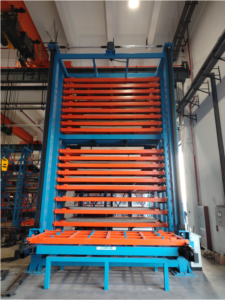
Option 2 — Automated Sheet Metal Tower (Up to 8 Meters, 20 Shelves)
For facilities that need maximum density, full automation, and zero manual climbing, an automated sheet metal storage tower is the premium solution. Key specifications typically include:
- Height: up to 8 meters
- Shelf capacity: up to 20 individual shelves per tower
- Load capacity per shelf: 3,000–5,000 kg depending on configuration
- Material retrieval: fully automated extractor brings each shelf to an ergonomic ground-level access station
The automated tower eliminates all manual handling at height. Workers interact with the machine at a fixed access point at ground level — the tower retrieves the requested shelf automatically. This dramatically reduces handling time, labor cost, and injury r7i4 sk. In facilities where floor space is critically limited, a single automated tower can replace 3–4 rows of conventional horizontal racking.
How to Choose the Right Configuration for Your Facility
The right choice depends on four key factors:
- Available ceiling height: Stacked racks require at least 5.5 m clear height; automated towers require 9–10 m.
- Forklift access: If your aisle width supports forklift operation, the stacked hybrid configuration is cost-effective.
- Material variety and SKU count: High SKU variety (50+ sheet metal grades/sizes) benefits more from the automated tower’s inventory management capability.
- Budget and ROI timeline: The stacked rack solution has a lower upfront cost; the automated tower delivers higher ROI over a 1–3 year horizon through labor savings.
Common Questions from Buyers
Do the racks need to be anchored to the floor when stacked?
Yes. Stacked rack configurations must be anchored to the floor and, where possible, braced to the building structure. This is a non-negotiable safety requirement — especially in regions subject to seismic activity.
Can any drawer rack model be stacked, or only specific models?
Only models with a certified stacking frame and reinforced top structure are rated for this application. Always request the load certificate from your supplier before proceeding.
Conclusion
Stacking sheet metal racks is a viable space optimization strategy — but only when the correct rack types are paired together. The drawer-on-bottom, forklift-rack-on-top configuration is safe, practical, and cost-effective for most plants. For facilities demanding maximum density and full automation, an automated sheet metal tower up to 8 meters with 20 shelves is the definitive solution.
Not sure which setup is right for your space? Our engineers provide free pre-sale consultation. Share a photo or layout drawing of your storage area, and we will recommend the optimal configuration — with no guesswork and no wasted budget.