
OSHA has no standard written only for cantilever racks or bar stock. The OSHA material storage requirements that cover long material come from a few general rules: 29 CFR 1910.176 for storage and aisles, 1910.22 for walking surfaces, 1910.178 for forklifts, and 1910.184 for slings, with the General Duty Clause behind them. On construction sites, 1926.250 adds one line written for pipe and bar stock.
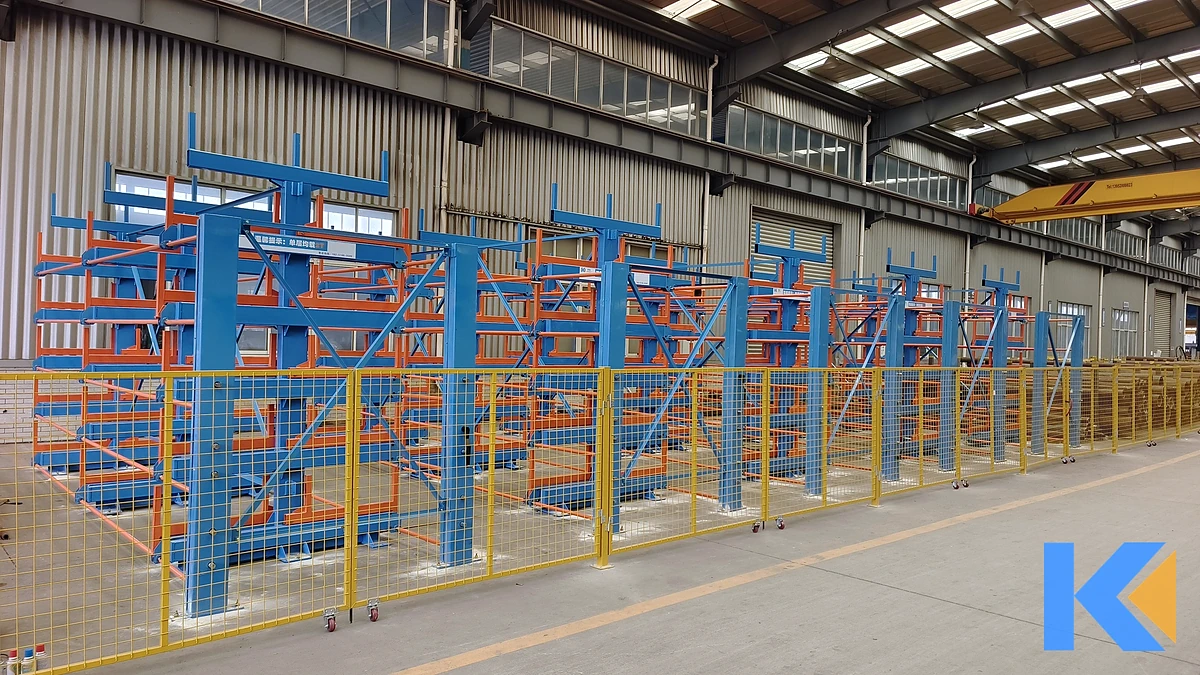
Fenced roll-out cantilever racks with a clear, marked aisle in front.
This article maps each rule to what it means for long material storage, in a bay full of 6 m (20 ft) and 12 m (40 ft) bar, pipe and profiles. It is general information, not legal advice. State-run OSHA plans can be stricter, so check yours too.
Which OSHA material storage requirements apply to long stock?
| Rule | What it requires | Where it shows up in a long-material bay |
| 1910.176(a) | Safe clearances where mechanical handling equipment works; aisles kept clear; permanent aisles marked | Forklift and crane aisles, and the space a roll-out level takes up when it is extended |
| 1910.176(b) | Stored material must not create a hazard; tiers stacked, blocked, interlocked and limited in height | Floor stacks of pipe and round bar, bundles on rack arms |
| 1910.176(c) | Storage areas free of material that creates tripping or fire hazards | Offcuts, steel banding and loose dunnage around the racks |
| 1910.22(a)(3) | Walking surfaces free of sharp or protruding objects | Bar ends sticking out of a rack into the walkway |
| 1910.178(l) and (m)(2) | Trained, evaluated forklift operators; nobody under raised forks | Moving bundles with a forklift or sideloader |
| 1910.184(c)(9) and (d) | People kept clear of suspended loads; slings inspected daily | Lifting bundles from racks with an overhead crane |
| OSH Act 5(a)(1) | A workplace free from recognized serious hazards | Overloaded or unanchored racks, which no specific rule covers |
| 1926.250(a)(1) and (b)(9) | Construction sites: pipe and bar stock racked, or stacked and blocked | Rebar and pipe stored on a job site |
Floor stacks: what 1910.176(b) asks for
The core sentence in 29 CFR 1910.176 is short: storage “shall not create a hazard.” Material stored in tiers has to be stacked, blocked, interlocked and limited in height so it cannot slide or collapse.
Round stock is where floor storage goes wrong. Pipe and round bar want to roll, so every tier needs chocks or blocking at both sides, and the stack has to stay low enough that nobody climbs it to rig a sling. The construction rule, 29 CFR 1926.250(b)(9), says that bar stock and pipe, “unless racked,” must be stacked and blocked to prevent spreading or tilting. Racking is the option the rule itself names.
OSHA gives no maximum stack height for pipe or bar in general industry. The limit is whatever keeps the stack stable, which in practice means the height you can sling from the floor.
Aisles: the part roll-out racks change
1910.176(a) asks for safe clearances wherever mechanical handling equipment works, clear aisles, and marked permanent aisles. With a fixed cantilever rack served by a forklift, the aisle has to fit the truck and a long load turning. Our published guide on aisle width between two roll-out cantilever racks puts a typical roll-out aisle at about 1.6 m (5.2 ft), against 4–5 m (13–16 ft) for forklift aisles.
The catch is that an extended level sits across that narrow aisle. On roll-out cantilever racks from CK Metal Storage Solutions, a crank rolls one level fully out so the crane can lift straight up. Treat the extended level as a temporary obstruction: roll out one level, make the pick, roll it back, and check every day that each level is fully rolled back. We also recommend painting a hatched zone on the floor where the levels extend, so people know where not to stand during a lift.
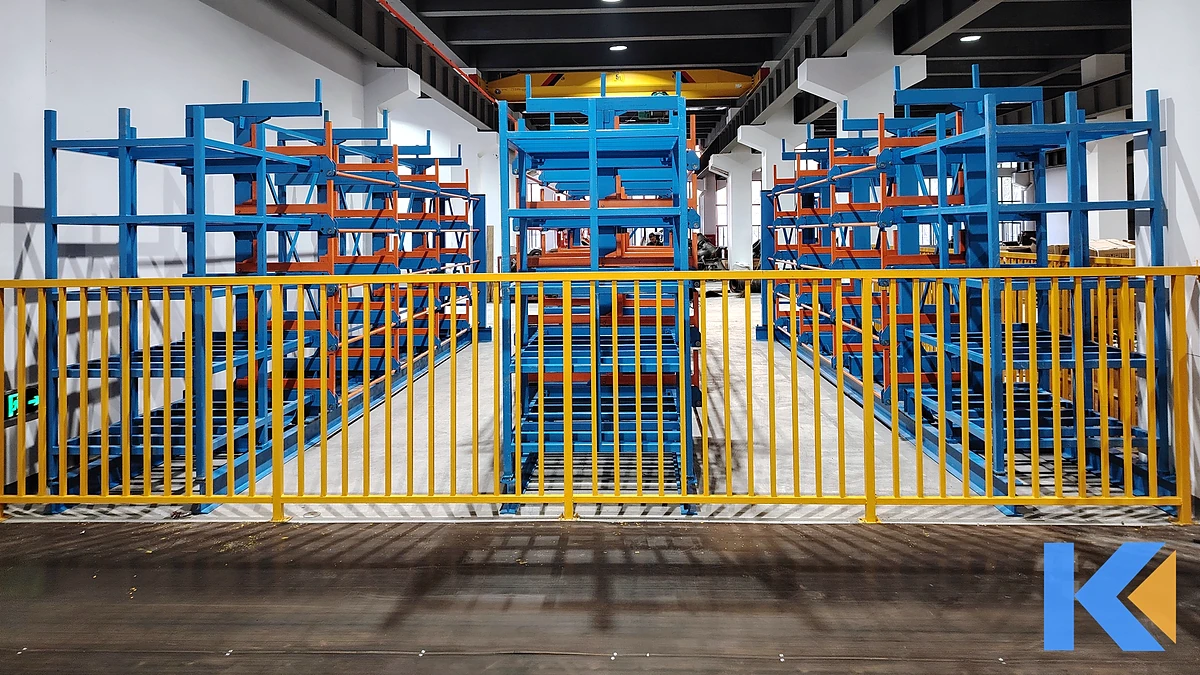
A guardrail keeps foot traffic out of the aisle the rack levels extend into.
Protruding bar ends: the 1910.22 problem nobody plans for
29 CFR 1910.22(a)(3) requires walking-working surfaces to be free of hazards such as “sharp or protruding objects.” In a long-material bay, the usual offender is a bar that is longer than the rack. A 6.4 m bar on a rack built for 6 m pokes into the walkway at shin or head height.
Size the rack to the longest bar you buy, not the most common one. Our standard roll-out cantilever racks are built for 6 m and 12 m material, and our daily checklist includes looking for anything hanging past the end of a level.
Crane picks: keep people out from under the load
The sling standard, 29 CFR 1910.184, is blunt: “All employees shall be kept clear of loads about to be lifted and of suspended loads.” Paragraph (d) adds that slings and their fittings are inspected each day before use by a competent person, and damaged slings come out of service immediately. OSHA’s overhead crane standard, 1910.179, adds operating rules for the crane itself.
On a roll-out rack this works out to a simple order: roll the level out, step back out of the level’s footprint and the crane path, then lift. If two people work the bay, one rigs and one runs the crane; the person who rigged steps clear before the hook takes load.
Forklifts and long loads
29 CFR 1910.178(l)(1)(i) requires every powered industrial truck operator to be competent, shown by completing OSHA’s training and evaluation. Paragraph (m)(2) says no person may stand or pass under the elevated portion of a truck, loaded or empty.
A 6 m bundle on forks sweeps a wide arc when the truck turns and blocks part of the driver’s view. If your long material moves by forklift, the aisle and turning space have to be planned around the longest load, not the truck.
Rack capacity and anchoring: where the General Duty Clause comes in
No OSHA paragraph sets load ratings or anchoring rules for cantilever racks. Hazards without a specific standard fall under Section 5(a)(1) of the OSH Act, which requires a workplace “free from recognized hazards” likely to cause death or serious harm. A rack that tips or drops a bundle is that kind of hazard.
The industry standard for these racks is ANSI MH16.3-2025, published through MHI’s Rack Manufacturers Institute, which covers the design, testing and use of industrial steel cantilevered storage racks. It is a voluntary consensus standard, not an OSHA rule, but it is the reference to ask your supplier about.
Ask for two numbers, because they are not the same: capacity per arm and capacity per level. Our standard roll-out arm is rated at 750 kg (1,650 lbs), while a level on our 12 m model carries 5,000 kg (11,000 lbs) per side. Spread a level’s load across its arms; a full bundle set down on one arm can overload it.
Put the rated load on a label at each level and anchor the rack to the floor with expansion bolts. We don’t recommend free-standing installation for loaded roll-out racks.
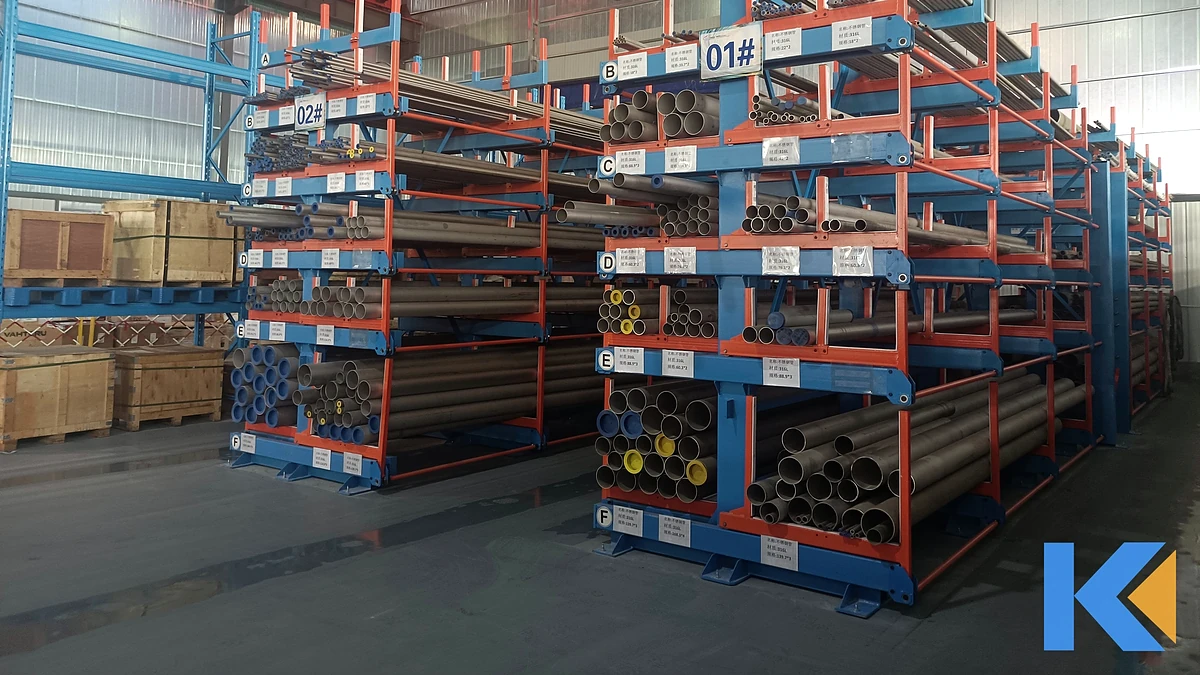
Labels on each level make it easy to post the rated load where operators see it.
Automated systems: keeping people out of the working aisle
On an automated steel profile storage system, the gantry does the lifting, so the main rule is the one in 1910.184: people stay clear while the machine handles a load. An aisle-entry alarm is an available option on our systems; it sounds when someone walks into the aisle while the equipment is working. Pair it with a written rule that nobody enters during operation.
A quick check for your long-material bay
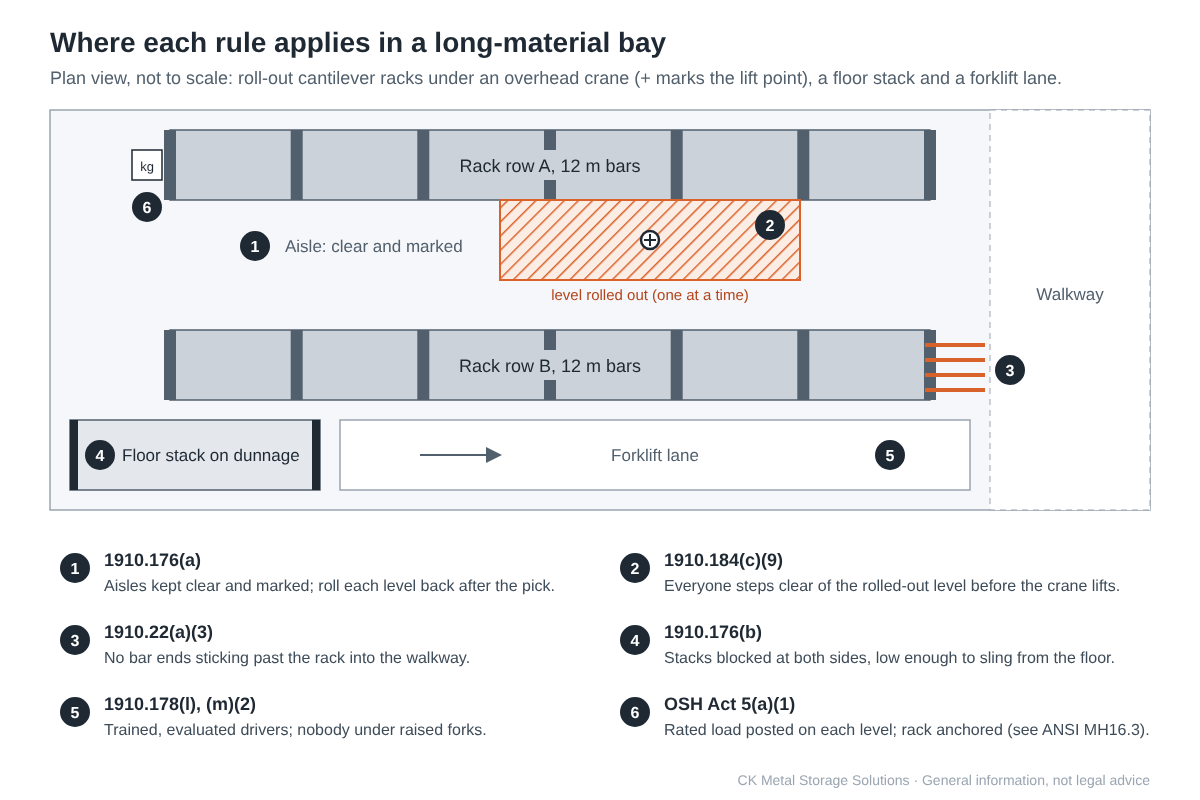
Where each rule applies in a typical bay with roll-out racks, an aisle and a crane.
- Every floor stack of pipe or round bar is chocked or blocked, and low enough to sling from the floor.
- Aisles are clear and marked, and rack levels are rolled back after each pick.
- No bar sticks past the end of a rack into a walkway.
- Each rack level shows its rated load, and the racks are anchored.
- Slings and chains get a daily check, and nobody stands under a lifted bundle.
- Forklift drivers moving long loads are trained and evaluated.
Frequently asked questions
Does OSHA have a specific standard for cantilever racks?
No. Cantilever racks fall under the general storage rule in 29 CFR 1910.176 and the General Duty Clause. The design standard specific to them is ANSI MH16.3, a voluntary industry standard.
Is ANSI MH16.3 mandatory?
It is not an OSHA regulation. It is the consensus standard for designing, testing and using cantilevered storage racks, so it is the reference to ask your rack supplier about.
How high can I stack pipe on the floor under OSHA?
OSHA sets no fixed height for pipe in general industry. 1910.176(b) requires stacks to be blocked and limited in height so they are stable and secure against sliding or collapse.
Do cantilever racks have to be anchored to the floor?
No OSHA paragraph says so directly. We anchor every roll-out cantilever rack with expansion bolts, because a loaded level rolled out shifts the center of gravity forward.
If you are planning a new long-material bay, send us your longest bar length, typical bundle weight and crane hook height. We’ll come back with a rack layout that shows the rated load per arm and per level, If your levels need more than 5,000 kg (11,000 lbs) each, or you would rather extend them with a remote control than a crank, look at our motorized cantilever rack. You can reach us through our contact page.