
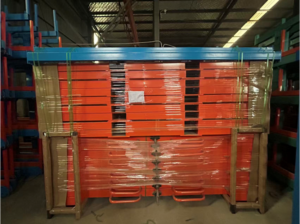
One of the most common questions buyers ask us is whether the sheet metal rack or long material rack is delivered fully assembled or unassembled — and the honest answer is: it depends. The shipping configuration is determined by the rack’s overall dimensions, height, and span length relative to standard container limits. Getting clarity on this before you place your order directly impacts your project timeline, on-site labor planning, and total landed cost.
This guide walks you through the three most common delivery scenarios, explains the manufacturer’s reasoning behind each, and gives you a practical checklist of questions to ask before committing to a purchase.
Why the Assembly Status of Your Rack Matters
When sourcing sheet metal rack or long material rack from an overseas manufacturer, the delivery format is not just a logistics detail — it affects your entire receiving and installation workflow. A rack shipped fully assembled is ready to deploy the moment it arrives, but it occupies significantly more container volume, which increases freight cost. A disassembled rack ships more efficiently and at lower cost, but requires your team to complete assembly on-site.
Neither format is inherently better. What matters is that you know which one applies to your order before shipment, so you can prepare your site, tools, and personnel accordingly. Misunderstanding this at the last minute is one of the most common causes of project delays when importing industrial equipment.
Scenario 1: Rack Fits in the Container — Ships Fully Assembled
When the overall dimensions of your rack fit within the interior clearance of a standard shipping container, the manufacturer will pre-assemble the unit at the factory and load it fully built. This is the simplest and most buyer-friendly delivery scenario.
Example: A sheet metal rack for 3 × 1.5 meters sheet metal and a total height under 2 meters can be fully assembled in the warehouse and loaded directly into a 20- or 40-foot container without issue.
Benefits of receiving a fully assembled rack:
- Zero on-site assembly time — the rack is operational the moment it arrives at your facility
- Reduced risk of incorrect assembly or missing hardware
- Easier pre-delivery quality inspection by the manufacturer before loading
- Ideal for buyers with limited on-site technical staff
This scenario is most common for sheet metal racks where height stays within container limits.
Scenario 2: Rack Exceeds Container Height — Ships Partially Disassembled
If the rack’s total height exceeds the interior clearance of a standard shipping container — typically around 2.3 to 2.4 meters — it cannot be loaded fully assembled. In this case, the rack is delivered partially disassembled.
Example: The same 3 × 1.5 meter sheet metal rack, but with a height of 2.5 meters or more, will need to be broken down for container loading.
“Partially disassembled” does not mean you receive a box of loose parts. A professional manufacturer will:
- Pre-assemble all major structural subcomponents (frames, doors, shelvings) as much as shipping constraints allow
- Pack components systematically with clearly labeled hardware bags
- Include a step-by-step assembly manual
- Provide an assembly video so your on-site team can complete installation without guesswork
For most buyers, assembling a well-documented rack system requires one to two workers and a few hours — not days. The quality of the documentation is what separates a smooth installation from a frustrating one, so always request samples of the assembly manual before finalizing your supplier.
If you have questions about assembly support or installation guidance, feel free to contact our team — we’re happy to walk you through the process before you commit.
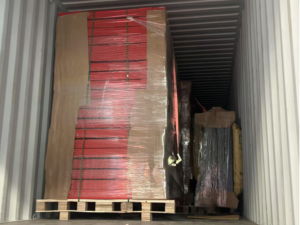
Scenario 3: Long Material Racks — Always Ships Disassembled
Racks designed to store long raw materials — steel tubes, pipes, aluminum profiles, or bar stock — typically have spans of 6 meters to 12 meters. These racks are always delivered disassembled, for two distinct reasons:
- Physical constraint: A 6-meter or 12-meter material rack simply cannot fit inside a standard container in assembled form, regardless of height.
- Cost efficiency: Even if it could physically fit, shipping it assembled would waste a large portion of the container’s usable volume, driving up the freight cost per unit significantly. Shipping disassembled allows components to be nested, stacked, and packed tightly — maximizing container utilization and reducing your per-rack logistics cost, especially on larger orders.
When ordering long material racks, always request:
- A full packing list showing how components are grouped and bundled
- Clearly labeled parts for easy on-site identification
- An assembly guide specific to the span length ordered (6 m and 12 m configurations often differ in cross-member count and base spacing)
- Confirmation of total package dimensions and gross weight for customs and unloading planning
What to Inspect When Your Rack Arrives
Regardless of whether the rack is delivered fully assembled or unassembled, carry out a basic receiving inspection before signing off on the delivery:
- Check the packing list against the actual parts received — count uprights, beams, bolts, and brackets
- Inspect for transit damage — dents, bent uprights, or scratched surfaces that could affect structural integrity
- Verify weld quality on pre-assembled subcomponents before beginning on-site assembly
- Confirm surface finish — powder coating or galvanizing should be intact, with no chips or rust spots from transit
- Cross-reference hardware bags against the assembly manual before starting installation
Documenting any discrepancies with photos immediately upon receipt gives you a clear record when communicating with your supplier.
Questions to Ask Your Supplier Before You Order
Before finalizing any rack purchase, get clear answers to these questions:
- What are the fully assembled dimensions (L × W × H)?
- Will it ship fully assembled or disassembled — and why?
- If disassembled, what is the estimated on-site assembly time with two workers?
- Is a step-by-step assembly manual included? Is there an assembly video?
- Are all fasteners, bolts, and hardware pre-packaged and labeled?
- What is the gross weight and packing dimensions for import/customs planning?
- Can you provide photos of a previously packed shipment of the same rack type?
A reliable manufacturer will answer all of these without hesitation. Vague or evasive answers about shipping and assembly are a red flag worth noting during supplier evaluation.
Summary: Which Delivery Format Should You Expect?
| Rack Type | Typical Size | Delivery Format |
| Standard storage / bin rack | Under 2 m tall | Fully assembled |
| Tall storage rack | Over 2.4 m tall | Partially disassembled |
| Long material rack | 6 m or 12 m span | Always disassembled |
Understanding whether your rack is delivered fully assembled or unassembled before shipment – not after – is one of the simplest ways to avoid costly delays and on-site surprises. The right supplier will make this information clear from the start, back it up with proper documentation, and support you through the installation process if needed.
Have more questions about rack specifications, container loading, or on-site assembly? Contact our team— we’ll give you straight answers before you place your order.
Q&A:
- How to Find the Right Industrial Storage System for Your Workshop
- What We Can Offer Our Overseas Partners
- Manual Roll Out Cantilever Rack vs Motorized Roll Out Cantilever Rack — Which One’s Right for Your Shop?
- When Should You Choose a Forklift Sheet Metal Rack?
- How to Choose Between a Pull-Out Sheet Metal Rack and a Roll-Out Sheet Metal Rack?