
Roll-out sheet metal storage racks improve warehouse efficiency by giving workers direct, slide-out access to individual sheet layers — reducing retrieval time from over 20 minutes to under 1 minute per pick. Each drawer supports up to 5,000 kg (11,000 lbs), fits standard sheet sizes up to 6,200 mm long, and eliminates the need to move surrounding sheets. The result: faster production feed, fewer workplace injuries, and significantly less material damage.
The Real Cost of Disorganized Sheet Metal Storage
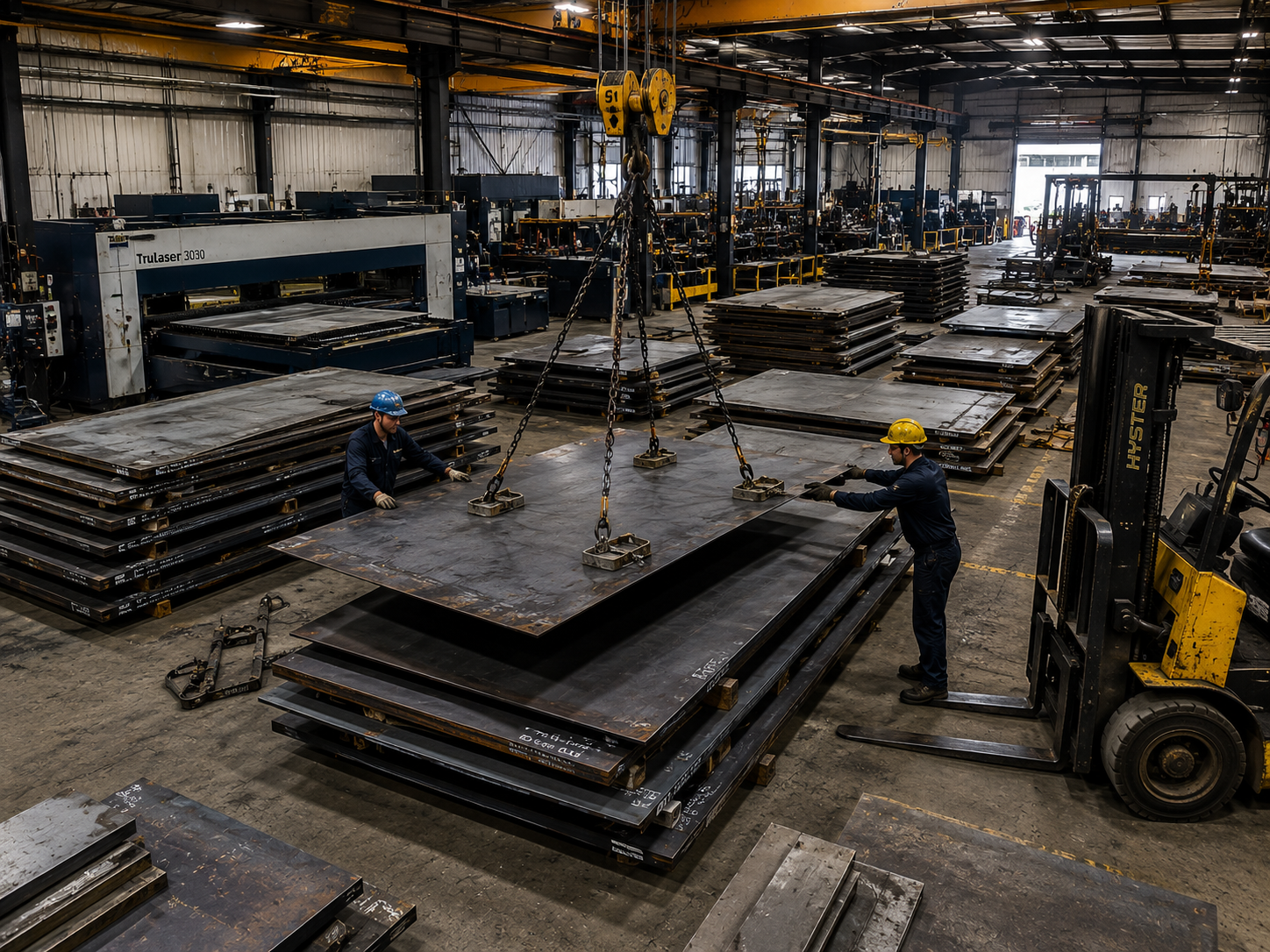
Most fabrication shops and metal processing facilities underestimate how much time is lost to poor storage. When sheets are stacked flat on the floor or leaned against walls, every retrieval becomes a small project.
A worker needs to identify the right sheet by thickness, grade, or batch. Then they need to physically move the sheets on top of it — often with a crane, a colleague, and a fair amount of waiting. In many facilities, this process takes 15 to 20 minutes per retrieval. Multiply that by 10 to 15 picks a day, and you’re looking at 3 to 5 hours of lost productive time daily just on material handling.
Beyond time, there are two other costs that rarely show up on a spreadsheet:
Material damage. Sheets stacked directly on top of each other scratch, dent, and deform at contact points. For industries where surface quality matters — automotive panels, stainless steel for food equipment, aluminum for enclosures — this means scrap rates go up, and rework costs follow.
Safety incidents. The European Agency for Safety and Health at Work (EU-OSHA) consistently identifies manual handling of heavy materials as one of the leading causes of musculoskeletal injuries in manufacturing. A single 3mm steel sheet measuring 1,500 × 3,000 mm weighs roughly 106 kg. Improper handling under time pressure is a risk that is hard to manage without the right storage infrastructure.
How a Roll-Out Sheet Metal Rack Actually Works
A roll-out sheet metal rack is a vertical multi-level storage system where each level is a drawer that can be extended horizontally on a rail-and-roller mechanism. Unlike static shelving, the drawer slides out fully — giving a crane or vacuum lifter unobstructed access to the sheet from above.
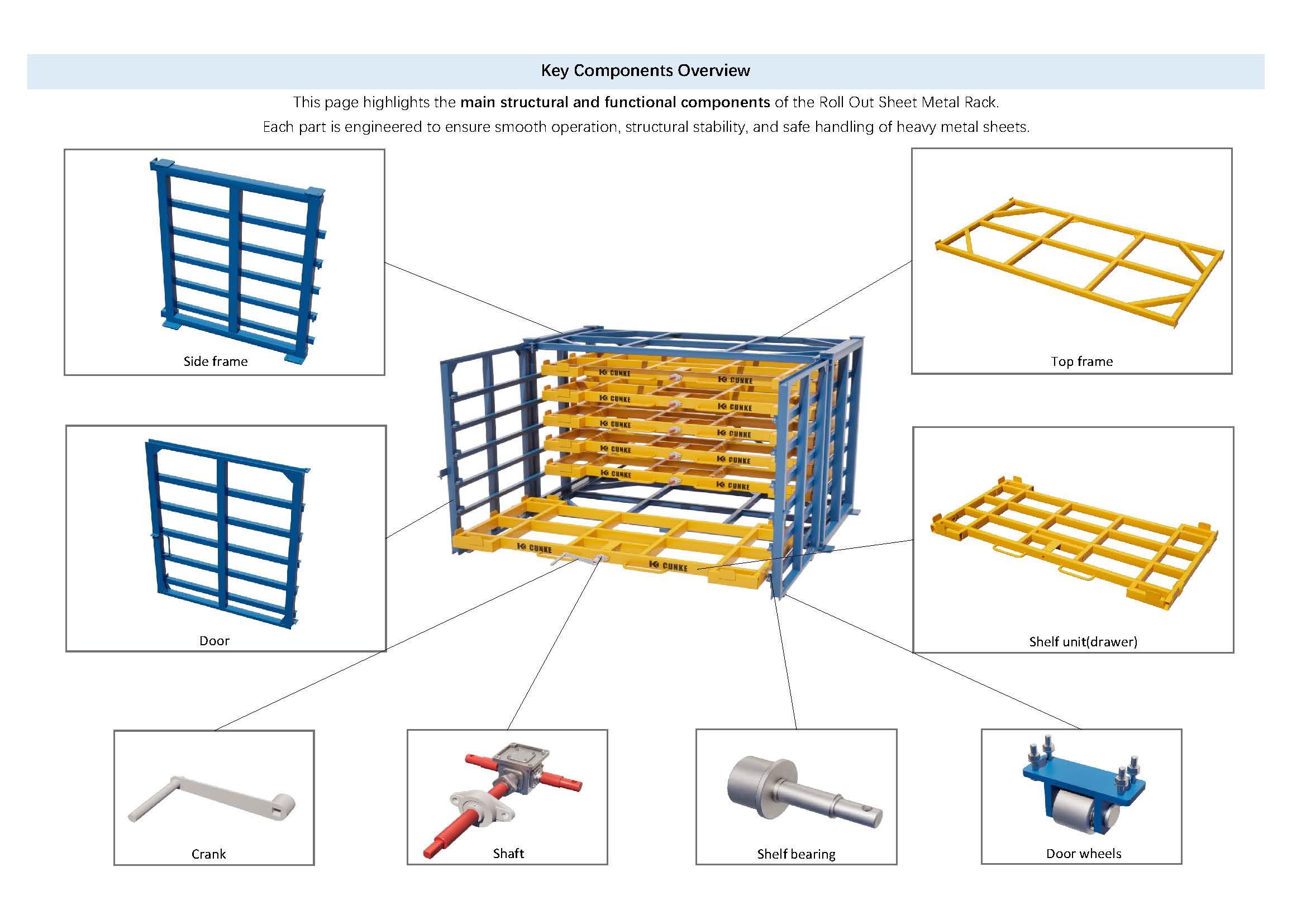
The key components:
The drawer frame. Each level is a rigid steel tray, typically built to fit sheets up to 6,200 mm long and 2,500 mm deep. The frame holds sheets flat and separated, preventing any contact between levels.
The roller rail system. High-load rollers allow the drawer to extend smoothly even under full load. On a manually operated rack, a mechanical crank is used to extend and retract the drawer — one person can operate it without physical strain.
The rack body. A standard configuration holds 5 to 8 levels. The footprint stays compact because storage goes vertical, not horizontal.
CK Metal Storage’s roll-out sheet metal racks are engineered to work directly alongside laser cutting machines and press brakes. The drawer extends to the loading position, the crane places or lifts the sheet, and the drawer retracts — the whole cycle takes less than 60 seconds.
5 Ways Roll-Out Racks Improve Warehouse Efficiency
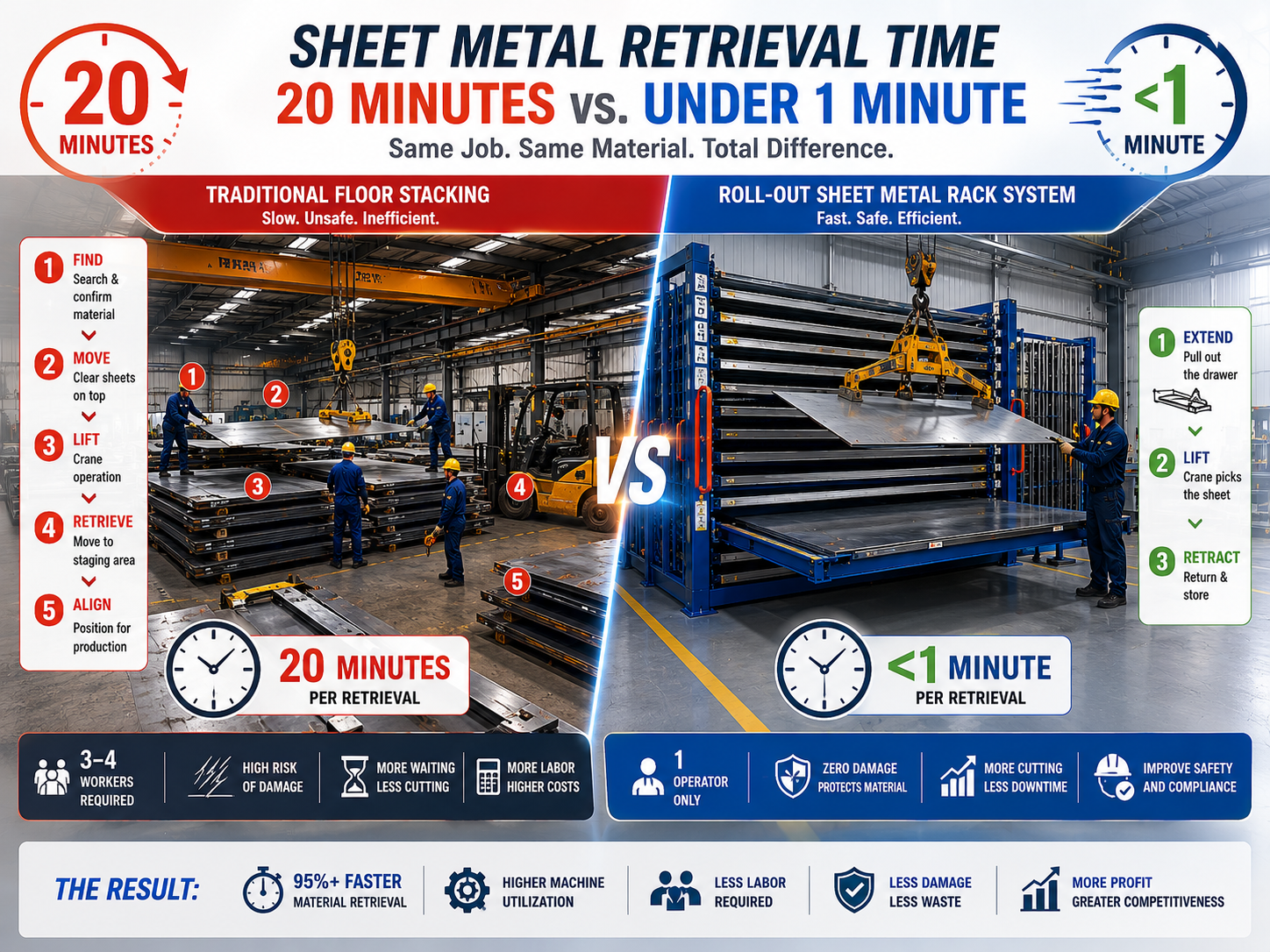
- Retrieval Time Drops from 20 Minutes to Under 1 Minute
This is the most immediate, measurable impact. With a roll-out rack, a worker extends the correct drawer, the overhead crane picks the sheet, and the drawer closes. There is no need to move surrounding materials. In facilities running two or three shifts, this time saving directly translates to higher machine uptime on laser cutters and press brakes.
- Floor Space Is Freed for Production
A single roll-out rack unit with 6 levels and a footprint of roughly 6,500 × 2,800 mm replaces what would otherwise require 3 to 4 times that floor area in conventional flat stacking. In most European fabrication shops where floor space costs between €80 and €150 per square metre annually, reclaiming 40–60 m² of floor space represents a real, recurring financial benefit.
- Material Stays Damage-Free
Each sheet rests on its own level, separated from adjacent sheets by the drawer frame. There is no sheet-on-sheet contact, no edge dragging, and no risk of deformation during retrieval. For shops working with coated steel, mirror-finish stainless, or pre-painted aluminum, this directly reduces scrap rates.
- One Operator Can Handle Everything
With conventional stacking, moving heavy sheets typically requires two people or a dedicated crane operator plus a spotter. A roll-out rack with a mechanical crank lets one person extend the drawer, coordinate with the crane, and complete the pick independently. This matters in facilities dealing with labor shortages — which is a growing reality across manufacturing in Western Europe.
- Compliance with European Safety Standards Becomes Easier
Under EN 15635 (the European standard for static storage systems) and EU-OSHA guidelines on manual handling, facilities have a duty to minimize ergonomic risk in material handling tasks. Roll-out racks remove the need for manual lifting of heavy sheets entirely — the crane does the vertical work, the rack does the horizontal positioning. This makes safety documentation straightforward and reduces liability exposure significantly.
Roll-Out vs. Other Sheet Metal Storage Options
Not every storage solution fits every facility. Here’s how roll-out racks compare to the most common alternatives.
|
Roll-Out Rack (Manual) |
Motorized Sheet Metal Rack |
Pull-Out Rack |
Floor Stacking |
|
|
Capacity per level |
Up to 5,000 kg |
Up to 7,000 kg |
Up to 3,000 kg |
Unlimited (but unstable) |
|
Retrieval time |
Under 1 min |
Under 1 min |
2–3 min |
15–20 min |
|
Operation |
Manual crank (1 person) |
Electric button (1 person) |
Manual pull (1–2 persons) |
Crane + team |
|
Floor space efficiency |
High |
High |
Medium |
Low |
|
Suitable for overhead crane |
Yes |
Yes |
Yes |
Difficult |
|
EU safety compliance |
Easy |
Easy |
Easy |
Risk area |
|
Best for |
Standard loads, budget-conscious |
Heavy loads (>5,000 kg/level) |
Lighter sheets, frequent access |
No budget / temporary |
|
Approx. investment |
Mid-range |
Higher |
Lower |
Near zero |
When to choose roll-out over motorized: If your sheets typically weigh under 5,000 kg per level and your team is comfortable with a manual crank, a roll-out rack delivers the same retrieval speed at a lower upfront cost. If loads regularly exceed 5,000 kg, or if operators need to access racks without any physical effort, the motorized version is the better choice.
See CK Metal Storage’s Motorized Sheet Metal Rack for loads up to 7,000 kg per level.
Is a Roll-Out Sheet Metal Rack Right for Your Facility?
A roll-out sheet metal rack is a strong fit for your operation if most of the following apply:
You run a laser cutting or press brake operation. Roll-out racks are designed to feed these machines directly. The drawer extends to the machine’s infeed height, and the crane transfers the sheet in one move.
You handle sheets up to 5,000 kg per level. This covers the vast majority of standard carbon steel, stainless steel, and aluminum sheet inventories. For reference, a full pallet of 3mm carbon steel sheets (1,500 × 3,000 mm, 20 sheets) weighs approximately 2,120 kg — well within the rack’s rated capacity.
You have an overhead crane or vacuum lifter. Roll-out racks are designed around crane-assisted loading. If your facility doesn’t have one, CK Metal Storage also offers compatible vacuum lifters and jib cranes that can be specified alongside the rack.
Floor space is a constraint. If you’re trying to fit more material into the same building footprint, vertical roll-out storage is one of the most space-efficient options available for flat sheet stock.
You want a manual solution with minimal maintenance. The mechanical crank system has no electrical components and very low maintenance requirements — a practical advantage for facilities where keeping equipment running is a priority.
FAQ: How Roll-Out Sheet Metal Storage Racks
How much does a roll-out sheet metal rack cost? Roll-out sheet metal rack pricing varies based on number of levels, overall dimensions, and load capacity requirements. A standard 6-level unit configured for sheets up to 6,000 mm long typically falls in the mid-range of industrial racking investment. CK Metal Storage provides custom quotations based on your specific sheet sizes, weight requirements, and available floor space. Most facilities recoup the investment within 12 to 24 months through labor savings and reduced material damage.
How long does it take to retrieve a sheet from a roll-out rack? Under normal operating conditions, a trained operator can extend the drawer, load or unload a sheet using an overhead crane, and close the drawer in under 60 seconds. This compares to an average of 15 to 20 minutes for conventional floor stacking, where surrounding sheets must be moved before the target sheet is accessible.
What is the maximum sheet size a roll-out rack can hold? CK Metal Storage’s roll-out racks accommodate sheets up to 6,200 mm in length and 2,500 mm in depth per level. Custom configurations are available for non-standard sheet dimensions. Usable height between levels starts at 70 mm, which is sufficient for storing stacked sheets of varying thicknesses.
What is the difference between a roll-out rack and a pull-out rack? Both use a sliding drawer mechanism, but they operate differently. A pull-out rack is opened manually by pulling the drawer directly — suitable for lighter loads and more frequent picks. A roll-out rack uses a mechanical crank to extend the drawer under heavy load (up to 5,000 kg), which reduces physical effort and makes it safer and more ergonomic for heavy sheet handling. Roll-out racks are generally preferred in high-load environments such as laser cutting facilities.
Does a roll-out sheet metal rack need an overhead crane? A roll-out rack is designed to work most efficiently with an overhead crane or vacuum lifter, which handles the vertical movement of sheets while the drawer handles horizontal positioning. That said, in facilities with a jib crane or even a forklift attachment, the setup can still work. CK Metal Storage recommends specifying the handling equipment together with the rack to ensure compatibility.
Can roll-out racks be customized for non-standard sheet sizes? Yes. While CK Metal Storage offers standard configurations, most installations are customized to match the customer’s specific sheet dimensions, weight requirements, and building constraints. Customization options include number of levels, drawer depth and length, inter-level height, and surface treatments for corrosive environments.
Related reading: