
Sheet metal hand lacerations are among the most common and costly injuries in fabrication shops. A single incident runs $15,000–$46,500 when you account for medical bills, workers’ comp, lost production, and the multi-year hit to your insurance premiums. In most cases, the root cause isn’t the metal itself — it’s how the metal is being stored and accessed. Pull-out sheet metal racks paired with vacuum lifters eliminate direct hand contact with sheet edges entirely, removing the hazard at its source rather than relying on gloves and good intentions.

I came across a photo on Reddit — a sheet metal worker, both hands cut up, raw and bandaged.
His caption: “I hate sheet metal so much.”
If you run an HVAC fabrication shop, a laser cutting operation, or any metal fab floor, you already know this image. You’ve probably seen it in real life, not just online.
Galvanized sheet. Stainless. Cold-rolled steel. The edges come off that laser table or press brake like razors. And every day, your guys dig through a stack with bare hands — pulling sheets, flipping sheets, hunting for the right gauge.
That’s not hard work. That’s a liability you don’t have to carry.
Here’s the thing: it’s not the metal’s fault. It’s how you’re storing it.
It’s Not a Metal Problem. It’s a Storage Problem.
Walk into most fabrication shops and you’ll find sheet metal stored the same way it’s been stored for decades: flat-stacked on the floor, leaned against a wall, or piled on a basic pallet. Workers sort through sheets by hand, one at a time, sliding and lifting to find what they need.
Every one of those interactions is an exposure event.
Sheet metal edges — especially freshly cut laser parts, stainless steel, and galvanized sheets — can slice through a work glove in one motion. The problem isn’t that workers are careless. The problem is that the system forces hand contact with the most dangerous part of the material: the edge.
In occupational safety terms, this is a failure of engineering controls. OSHA’s hierarchy of hazard controls puts “eliminate the hazard” above PPE every time. Gloves are a last resort — not a solution.
The right storage system removes the human hand from the equation entirely.
What One Cut Hand Actually Costs Your Shop
Most shop owners think about hand injuries in terms of the ER bill. The real cost is much bigger — and it keeps compounding long after the wound heals.
| Cost Category | Typical Amount (USD) | Source |
| ER visit & stitches — simple laceration | $1,000 – $2,500 | BetterCare / Vital Urgent Care, 2025 |
| ER + surgery — tendon or nerve repair (severe cases) | $15,000 – $40,000 | NCCI Workers’ Comp Statistical Data 2022–23 |
| Workers’ comp claim — hand laceration (direct cost) | $7,500 – $26,000 | Martor USA; NSC via Atticus, 2024 |
| Lost production & replacement labor | $3,000 – $8,000 | OSHA $afety Pays; NSC 2024 Work Injury Report |
| Insurance premium increase — 3-year EMR impact | $4,000 – $10,000 | OSHA indirect cost multiplier (1.1×–4.5×) |
| Total per incident — simple laceration | $15,000 – $46,500 | Calculated from above |
| Total per incident — severe or surgical | $30,000 – $86,000+ | Calculated from above |
Data sources: National Safety Council 2024 Work Injury Facts; NCCI Workers’ Compensation Statistical Plan 2022–23; OSHA $afety Pays Program; Martor USA Laceration Cost Analysis.
That last line — $86,000 for a severe case — isn’t a worst-case outlier. Tendon repairs, nerve damage, and partial amputations are exactly the kinds of injuries that happen when a worker loses grip on a large, heavy sheet. And large, heavy sheets are what you’re dealing with every day.
Beyond the direct dollars, there’s the EMR effect. Every recordable injury sits on your Experience Modification Rate for three years, raising your workers’ comp premiums across all your policies. One bad incident year can cost you more in elevated premiums than the original claim itself.
Hand Lacerations Are the Most Common — But Not the Only Risk
Cuts and lacerations get the most attention because they’re the most frequent. But improper sheet metal storage creates a wider set of hazards that are worth naming, because they all share the same root cause — and the same fix.
| Hazard | How It Happens | Avg. Workers’ Comp Cost |
| Hand lacerations | Manual sorting through stacked sheets | $7,500 – $26,000 |
| Back & shoulder strain | Bending and lifting heavy sheets from floor level | $16,000 – $34,000 |
| Crush / struck-by injury | Sheets sliding off a floor stack or leaning pile tipping over | $47,000 – $66,000 |
| Material damage | Sheets scratched, bent, or mixed up during manual handling | Not a workers’ comp claim — but a real daily cost |
Sources: NSC; NCCI 2022–23; BLS Musculoskeletal Disorder Data 2023.
Every hazard in that table is a storage problem. Sheets stored flat on the floor require bending to access. Sheets leaned against a wall can tip. Sheets stacked in an unsecured pile can slide. A pull-out rack with a vacuum lifter addresses all of them at once — not just the cuts.
How the Right Storage System Engineers the Hazard Out
The goal isn’t better gloves. The goal is to make it physically impossible for a worker’s hand to contact the sheet edge during normal material retrieval.
Two pieces of equipment make this possible:
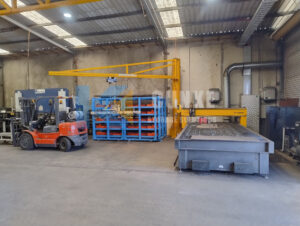
A pull-out sheet metal rack stores sheets horizontally in individual drawers. Each drawer extends 100% outward, so the worker can see and access any single sheet without touching the others.
No digging. No sliding. No lifting a stack to find what’s underneath.
CK Metal Storage’s pull-out racks support up to 3,000 kg per drawer level, with usable lengths up to 6,200 mm and up to 10 levels per unit. Each drawer is independently accessible, which means sheets stay organized by material and gauge — eliminating the hunting time that leads to rushed, careless handling in the first place.
Vacuum Lifter
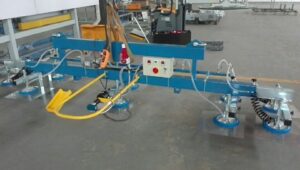
A vacuum lifter attaches to the sheet surface using suction cups. The worker controls it with a simple handle — the sheet lifts, moves, and sets down without a single hand ever touching an edge.
CK Metal Storage vacuum lifters are designed to work directly with pull-out rack drawers, making the retrieval process a one-person operation that takes seconds, not minutes.
The Combination That Eliminates the Risk
The pull-out rack presents the sheet cleanly. The vacuum lifter moves it safely. At no point in the process does a worker’s hand contact the sheet edge.
This is what occupational safety professionals call an engineering control — you’ve changed the system, not the behavior. It works regardless of how tired someone is at the end of a shift, regardless of whether they forgot their cut-resistant gloves, regardless of how rushed the floor gets on a deadline day.
What the Fix Actually Costs vs. What It Saves
A pull-out sheet metal rack system combined with a vacuum lifter is a capital equipment purchase. For most shops, a complete setup runs in the $8,000–$20,000 range depending on the number of units and configuration.
One hand laceration incident, fully accounted for, costs $15,000–$46,500.
The math isn’t complicated.
Most shops that make the switch see the equipment pay for itself within the first year — not from a single prevented injury (which you can’t predict), but from daily efficiency gains: faster material retrieval, less sorting time, fewer damaged sheets from improper stacking, and lower workers’ comp insurance premiums over time as your incident record improves.
Frequently Asked Questions
Q: What type of sheet metal storage causes the most hand injuries?
A: Flat floor stacking and manual pallet storage are the most common causes of sheet metal hand lacerations. When sheets are stacked directly on the floor or a pallet, workers must physically sort through the pile with their hands to find the right sheet — forcing repeated contact with sheet edges, which are the sharpest part of the material. Pull-out rack systems eliminate this exposure by giving each sheet its own accessible drawer.
Q: Do cut-resistant gloves prevent sheet metal lacerations?
A: Cut-resistant gloves reduce the severity of lacerations but do not eliminate the risk. ANSI/ISEA 105 Level A4–A6 gloves offer meaningful protection, but sheet metal edges — especially laser-cut stainless or galvanized steel — can exceed the cut resistance of standard work gloves, particularly under repeated exposure or during awkward handling positions. OSHA’s hierarchy of hazard controls classifies PPE as the least effective control. Engineering controls, such as pull-out racks and vacuum lifters, are always preferred because they remove the hazard rather than relying on worker compliance.
Q: How does a pull-out sheet metal rack prevent worker injuries?
A: A pull-out rack stores sheets individually in horizontal drawers that extend 100% outward. Workers can see and access any single sheet directly without touching the others. When combined with a vacuum lifter, the entire retrieval process — from rack to machine — requires zero direct contact with sheet edges. CK Metal Storage pull-out racks support up to 3,000 kg per level and are compatible with vacuum lifters, cranes, and jib cranes for safe, hands-free material handling.
Q: What is the average cost of a sheet metal laceration workers’ comp claim?
A: According to industry data, the direct workers’ comp cost for a hand laceration ranges from $7,500 to $26,000. When indirect costs are included — lost production, replacement labor, incident investigation, and the multi-year impact on insurance premiums through Experience Modification Rate (EMR) adjustments — the total per incident typically falls between $15,000 and $46,500 for a simple case, and can exceed $86,000 if surgery is required. Shops in high-frequency manufacturing environments often experience multiple incidents per year.
Q: Is a vacuum lifter necessary if I already have a pull-out rack?
A: A pull-out rack alone significantly reduces the need to sort through stacked sheets, which eliminates most of the laceration risk. However, workers still need to transfer the sheet from the drawer to the machine — and that transfer is where the remaining contact risk exists. A vacuum lifter completes the system by handling the sheet during transfer, giving you full engineering control over the entire material-handling process from storage to machine table.
For more on sheet metal storage and handling solutions, see CK Metal Storage’s Pull-Out Sheet Metal Rack and Vacuum Lifter product pages.