An automated long material storage system stores bars, tubes, and profiles in assigned locations and brings a requested load to an access station using powered handling equipment and controls. It can remove the need to drive into storage aisles for each pick. Whether it suits your shop depends on how often you change material, what happens at the picking station, and how much usable space the complete installation needs.
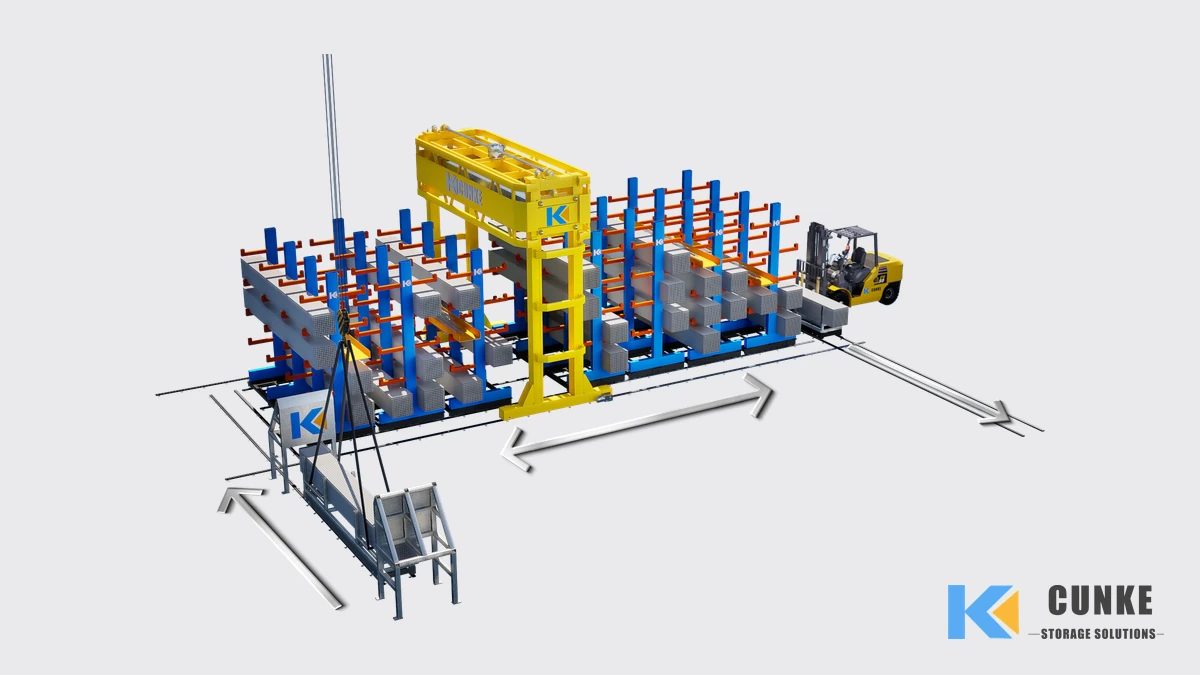
CK gantry storage layout shown as a 3D render. Station and handling arrangements are designed for the project.
What makes a long material store automated
The equipment must do more than move a rack arm. In a long material AS/RS, the controls identify a storage location and direct a machine to put away or retrieve its load. MHI describes AS/RS as equipment and controls working together to handle, store, and retrieve material under a defined degree of automation.
For long goods storage, the load may be a cassette containing one profile size or a supported bundle. A cassette is the carrier that stays with the stock inside the store. Its size and support arrangement have to suit the material, including short remnants that may no longer span the original supports.
The access station is where the automatic storage movement meets your production process. An operator may still need a crane to remove individual bars. Automatic storage does not, by itself, separate tubes or feed a saw.
Which layouts are available
| Layout | How stock moves | What to check |
| Gantry with cantilever racks | A traveling gantry transfers carriers between racks and a station. | Travel envelope, carrier support, and space around the station. |
| Automated cassette or honeycomb store | A storage and retrieval machine extracts a carrier from its assigned location. | Carrier dimensions, stock mix, and access requirements. |
| Compact long goods tower | A lifting and extraction mechanism brings a carrier to an access point. | Available height and demand at the shared access point. |
Those are broad arrangements, rather than interchangeable machines. A supplier must confirm which loads and movements a proposed layout can handle. Ordinary honeycomb racks can also be manually served; the rack shape alone does not establish the level of automation.
Our automated steel profile storage system combines cantilever racks with a traveling gantry and material carriers. We design fixed-rack and mobile-rack arrangements. Mobile racks can reduce the number of permanently open aisles, but the layout must allow for rack movement as well as gantry travel.
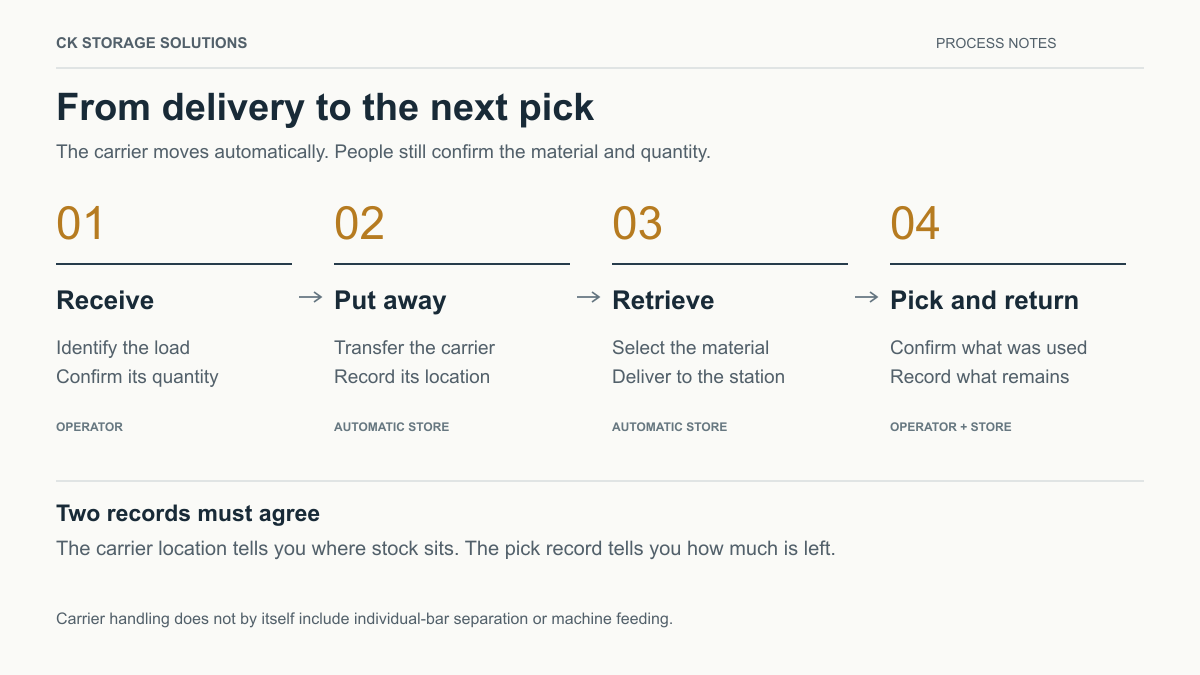
Receipt, putaway, retrieval, and return involve both equipment movements and inventory confirmations.
For CK automated profile stores, maximum load capacity is 5,000 kg (11,023 lbs). A common configuration for 6 m (19.7 ft) material is 3,000 kg (6,614 lbs), while 12 m (39.4 ft) material commonly uses 5,000 kg (11,023 lbs). The final rating must match the carrier and project design; ask whether carrier weight is included in the quoted capacity.
How material moves through the store
Incoming material is placed at the designated loading position using the handling equipment specified for the installation. The material identity and quantity must be recorded before the storage request is completed. The gantry then transfers the carrier to its assigned position and the system records the completed move.
For retrieval, the controls select the required location and the handling machine brings that carrier to the access station. The operator takes the required material, records the remaining quantity, and requests its return. Every handoff needs a clear owner: who identifies the load, who confirms the pick, and who checks a returned remnant.
Storage-location tracking and stock-quantity tracking are different tasks. A controller can know where a carrier sits while the quantity in it is wrong. If someone removes six tubes and records five, automation cannot correct that transaction unless a separate verified measuring process detects the difference.
Size the system for the busiest production period
Start with peak requests, rather than daily tonnage. A day spent cutting one bundle is different from a day with frequent changes between grades and tube sizes. Average demand can hide the queue that stops a saw just after shift change.
Suppose, as a planning example, two cutting machines each request a different carrier every 15 minutes. Together they generate eight retrieval requests per hour. If each retrieved carrier also needs a separate return move before another can be handled, that becomes 16 storage or retrieval moves per hour, before incoming deliveries or other users are added.
Ask the supplier whether its quoted cycle includes a retrieval, a return, station transfer, and the time occupied by picking. Some systems combine movements or use a buffer station. Compare proposals using the same sequence and load, including the most distant location.
Also give the supplier the longest stock and the shortest reusable offcut. For illustration, a 6,000 mm (19.7 ft) bar and a 1,200 mm (3.9 ft) remnant require different support checks even if they share a material code. Do not assume one carrier arrangement handles both.
Count the whole installation in the floor plan
Measure the storage block together with its loading station, machine travel area, maintenance access, and the route used to bring in bundles. A smaller rack footprint is useful only if the resulting process leaves enough room to work.
Our gantry height can reach 10 m (32.8 ft), with rack heights of 7–8 m (23–26.2 ft). Those are equipment capabilities, not a promise that the tallest arrangement fits your building. Roof bracing, services, and the handling travel envelope must be checked against the proposed layout.
The slab assessment also needs the actual reactions at supports and rails. Dividing the total stored weight by the floor area will not show a concentrated load at a column or rail. Ask for the installation loads before agreeing to a position in the factory.
Will the time saving justify the investment
Use a timed sample from your own shop. Record the current handling sequence, including waiting for lifting equipment and putting unused stock away. Compare the same sequence in the proposal; a fast gantry movement is only one part of it.
For a hypothetical calculation, assume 40 picks per day. If the current method takes six minutes per pick and the proposed method takes three, the difference is 120 minutes, or two handling hours per day. At an assumed 250 working days, that is 500 hours per year. These are example inputs, not measured CK results.
Convert those hours into money only where your operation can use the released time. Include maintenance, power, training, and expected downtime in the annual cost. Count machine waiting separately and avoid valuing the same saved time twice. A purchase price divided by an inflated labor saving produces a misleading payback.
When a simpler rack is the better choice
If you keep a small material range and retrieve it infrequently, a crank-operated roll out cantilever rack may provide enough access. It exposes a level for crane lifting without adding a traveling storage machine or warehouse software.
A motorized cantilever rack removes the cranking effort while the crane still handles the stock. That can suit heavy loads when you already have suitable lifting equipment. The manual and motorized rack comparison is useful if your main problem is reaching material rather than managing an automatic store.
A full store also needs a downtime plan. On CK automated equipment, a power failure does not permit operators to push mechanisms by hand. The powered manual mode is controlled jogging; it is not a power-free backup. Agree on recovery procedures and production buffers before purchase.
What to send with an inquiry
Send a stock list showing size, grade, maximum carrier load, quantities, and reusable remnant lengths. Add peak retrieval demand and a marked floor plan showing building clearances, loading routes, and the machines being served. Include how you currently record picks and whether a carrier normally returns partly full.
We can assess connection to mainstream ERP or MES software against the customer system. Specify what information must pass between systems and who confirms each transaction. A statement that integration is possible is only the start of that discussion.
Frequently asked questions
Can an automated store handle both bars and tubes?
Yes, if the carrier dimensions and support arrangement are designed for the material range. Confirm maximum load, bundle shape, and short-remnant support for each stock family.
Does automatic storage include automatic saw feeding?
That depends on the supplied equipment. Delivery of a carrier to a station can still leave separation and machine loading to an operator and crane; direct feeding needs its own agreed scope.
How much weight can one location hold?
CK automated profile stores have a maximum load capacity of 5,000 kg (11,023 lbs). Common configurations are 3,000 kg (6,614 lbs) for 6 m (19.7 ft) material and 5,000 kg for 12 m (39.4 ft) material; confirm the project rating and how carrier weight is counted.
Can the system track partly used bundles?
It can track assigned storage locations and support inventory transactions through the specified software. Remaining quantities still depend on accurate pick and return records or a separately specified measuring process.
Send CK your material list and floor plan with the busiest hour of picking demand. We can use those inputs to compare an automatic store with a crane-served rack and identify what needs a site check.