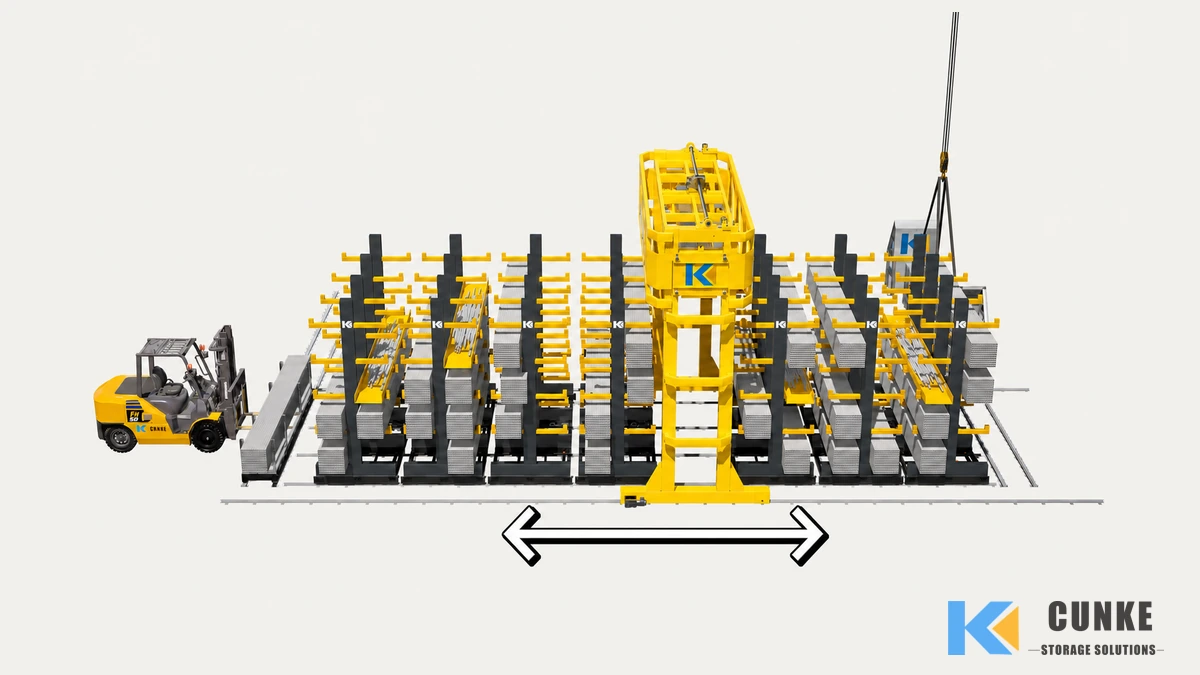
An automated cantilever rack system uses controls and powered handling equipment to store and retrieve long stock supported on cantilever racks. In a gantry-based installation, the gantry transfers a material carrier between a storage location and an access station. A motorized roll-out rack automates arm movement, but still needs a crane or another handling device to lift the material.
CK gantry-served cantilever store shown in a charcoal and yellow color variant. 3D render; colors are illustrative.
First check what the supplier means by automated
The name can describe quite different equipment. Ask who performs the lift after a storage request. If a person still brings the crane over and rigs the bundle, the proposal describes powered access to material. If a handling machine retrieves the carrier and delivers it to a station, the storage and retrieval movement is automated.
| System | Powered movement | Task still to specify |
| Motorized roll-out rack | The selected arm level extends and retracts. | Crane lifting and transfer to the machine. |
| Mobile cantilever racking | Rack rows move to open an access aisle. | How the material is retrieved from that aisle. |
| Gantry-served cantilever store | A gantry moves a carrier between racks and a station. | Picking individual pieces and feeding the next process. |
These functions can be combined, but one does not imply the others. A moving rack base creates access; it does not automatically load a saw. Likewise, a warehouse control screen alone does not turn a crane-served rack into an automatic store.
What a gantry storage system contains
Our automated steel profile storage equipment uses cantilever racks, material carriers, a traveling gantry, transfer equipment, and controls. The rack arms support the carriers at their stored positions. The gantry runs on its travel system and uses a lifting assembly to collect and place a carrier.
In the CK arrangements documented for this system, the lifting assembly supports the load from its ends. The carrier therefore matters as much as the rack: its pickup points and load distribution must match the handling machine. Loose bars cannot simply replace a designed carrier without a handling assessment.
The controller manages machine movements, while the warehouse software manages material and location records. The operator interface is where staff issue requests and see the permitted machine status. Those roles need to agree at every handoff, including the moment a transfer is recorded as complete.
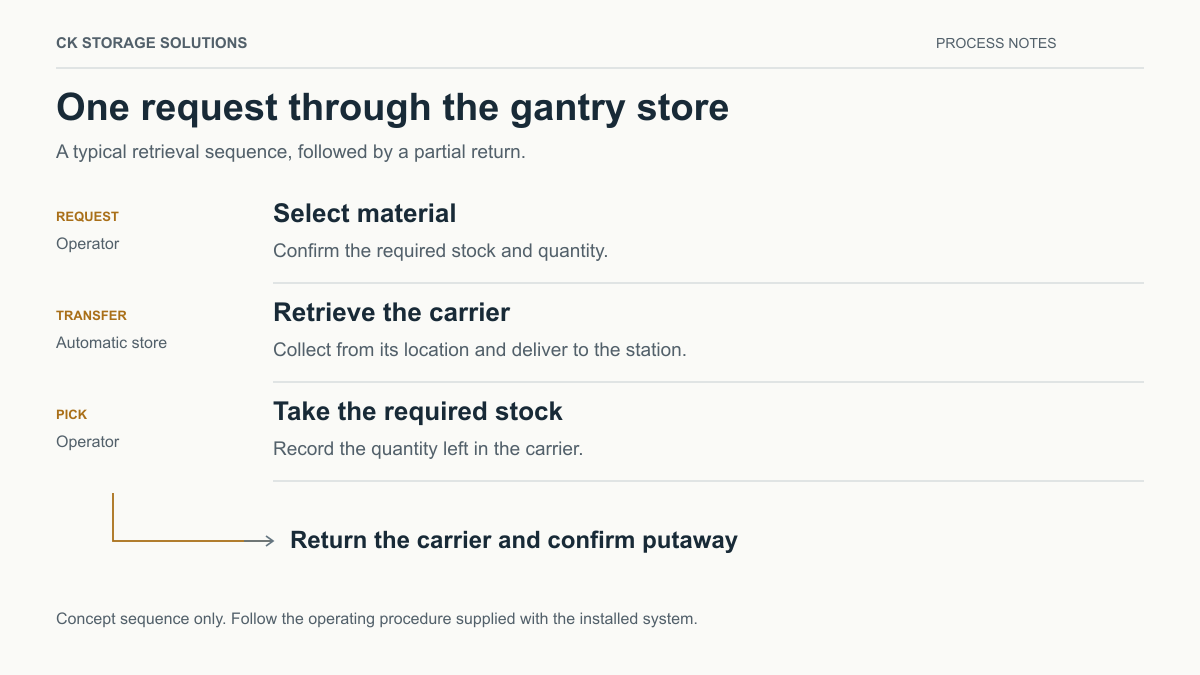
A retrieval request passes between the operator and the automatic store; remaining quantities must be confirmed.
Follow one carrier from receipt to storage
A representative CK storage sequence begins at the designated infeed position. Staff place the loaded carrier using the equipment specified for that station and issue a storage request. The material identity and quantity must correspond to the carrier being presented.
The gantry collects the load, raises it to its specified transfer position, travels to the assigned rack area, and lowers it to the target level. It places the carrier on its supports, withdraws from the transfer, and reports completion. The system then records the finished storage move.
This describes the movement sequence, not an instruction for operating a particular installation. The actual machine must follow its supplied controls and operating procedure. In a mobile-rack arrangement, the required rack positioning is also part of the coordinated sequence.
What happens when production requests material
The operator requests the required stock. The system identifies the assigned position and directs the gantry to collect its carrier. The gantry lifts the carrier clear, transfers it to the outfeed station, places it down, and moves clear of the handoff.
The next step depends on the supply scope. An operator may use an overhead crane to take the required bars, or separate equipment may transfer material onward. If only part of the load is used, the remaining quantity and material identity must be confirmed before the carrier returns to storage.
Ask the supplier to explain what happens if the physical pick and the stock record disagree. For example, retrieving a carrier is not the same transaction as consuming every bar inside it. A useful demonstration follows the stock through a partial pick and return, rather than stopping when the gantry reaches the station.
How it differs from a motorized roll-out rack
On a motorized roll out cantilever rack, an electric drive extends the selected arm level so that a crane can reach the stock from above. The drive removes the cranking task. It does not make the overhead crane unnecessary.
That distinction matters if you are trying to reduce machine waiting. Faster access to a rack level may help, but a shared crane can still be busy elsewhere. Count the complete lift and transfer sequence before choosing between powered arms and a gantry store.
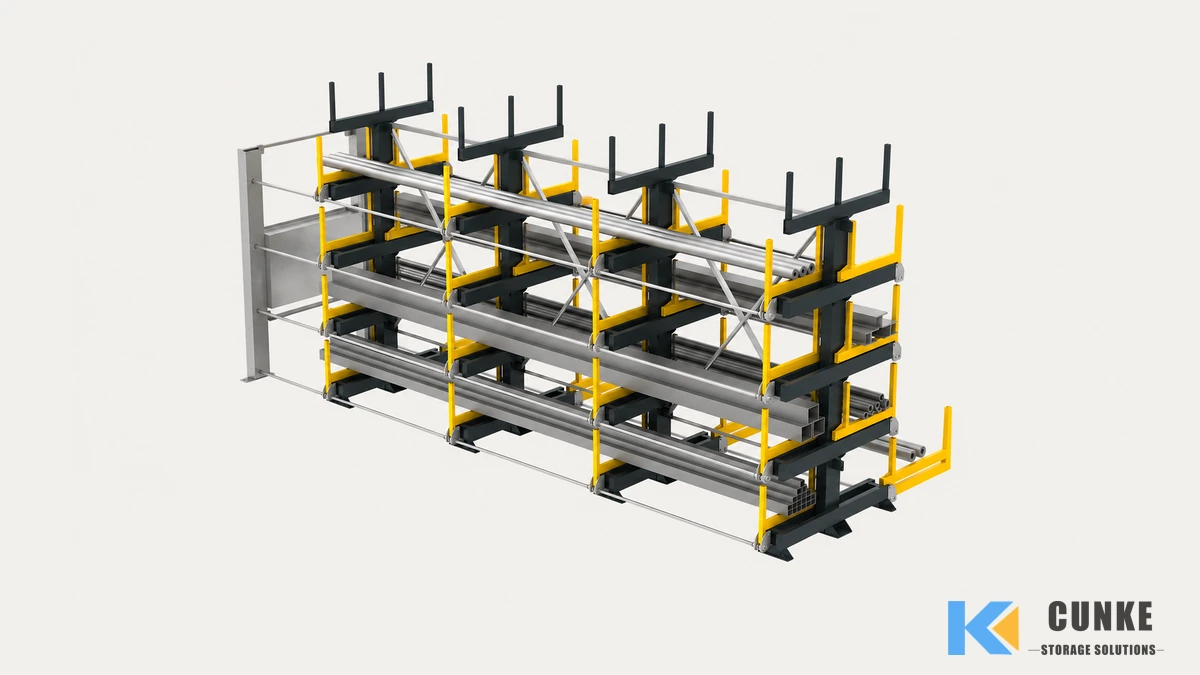
Motorized cantilever rack shown from a different angle in a charcoal and yellow color variant. Material lifting still requires separate handling equipment.
For lighter use, a manual roll out cantilever rack can provide the same general access principle with crank operation. Our comparison of manual and motorized cantilever racks discusses that choice. Neither arrangement should be described as a complete automatic retrieval system unless the separate handling equipment and controls are included.
The controls need to handle exceptions
A normal demonstration shows stock moving smoothly from one point to another. An acceptance test should also show how the system refuses an invalid request and what information the operator receives. Agree on those tests before the equipment is shipped.
| Test to agree | What the buyer should observe |
| A location or station is unavailable | The request is rejected or held with a clear reason. |
| A partial pick is returned | The remaining stock record and carrier location agree. |
| An agreed safety device is activated | Motion responds as specified, and the restart procedure is demonstrated. |
| Power is interrupted under an approved test plan | The supplier explains the safe state and authorized recovery sequence. |
Have the supplier prepare and conduct any fault or interruption test under a controlled plan. These are acceptance questions, not instructions to create faults during production. The tested functions should match the equipment and software actually included in your order.
Check load and clearance at the complete carrier
For CK automated profile stores, maximum load capacity is 5,000 kg (11,023 lbs). A common configuration for 6 m (19.7 ft) material is 3,000 kg (6,614 lbs), while 12 m (39.4 ft) material commonly uses 5,000 kg (11,023 lbs). The final rating must match the carrier and project design; ask whether carrier weight is included in the quoted capacity.
Ask the supplier to identify the rated load at the rack position and at the gantry. Also ask whether the stated capacity includes the carrier. A material-only figure cannot be compared directly with a total suspended or transferred load.
For illustration only, if material weighs 900 kg (1,984 lbs) and its carrier weighs 120 kg (265 lbs), the handling machine moves 1,020 kg (2,249 lbs). That example is not a CK rating. It shows why the carrier tare weight belongs in the specification.
Dimensions need the same care. Check the complete carrier, material overhang, pickup clearance, and the shortest stock that can remain supported. A level that physically accepts a bundle can still be unsuitable for automatic collection if the load blocks the lifting assembly or sits outside the designed envelope.
Safety and maintenance are part of the layout
Aisle-entry sensing with an alarm is an optional CK configuration. Personnel must stay out of the operating aisle; entering it triggers the alarm where this option is installed. Agree on the complete protective arrangement and its operating response in the project specification.
Keep routine picking at the designated station and establish how access to moving equipment is controlled. OSHA 1910.212 addresses guarding of machine hazards. The guard arrangement for a particular installation must follow its risk assessment; the word automated does not establish compliance.
For servicing that falls within its scope, OSHA 1910.147 covers control of hazardous energy. An emergency stop is not an energy-isolation procedure. Agree on maintenance access and isolation points with the supplier, including protection against stored energy.
On CK automated equipment, operators must not push or move mechanisms manually after a power failure or motor fault. Manual mode means powered jogging under the specified controls. Recovery needs the approved procedure and authorized personnel.
Maintenance access must remain usable after the surrounding workshop is filled. Before approving the layout, ask where technicians reach drives and sensors, how a stopped load is handled, and what production can continue while the store is unavailable.
What to ask for in the working demonstration
Choose a carrier and stock mix that represent your work. Include a partial return and the farthest proposed storage position, then time the complete handoff until the station is ready for the next request. If two machines share the store, show how competing requests are queued.
Keep the demonstration record with the agreed layout, rated loads, software scope, and recovery procedure. That gives your production and maintenance teams something concrete to check at acceptance. A video of an unloaded gantry moving quickly cannot establish the performance of your loaded process.
Frequently asked questions
Is every electric cantilever rack an automated storage system?
No. A powered rack may only extend the arms or move rows to create an aisle; another device still retrieves the stock. Confirm which part of the handling sequence is automated.
Do the cantilever arms need to extend in a gantry system?
That depends on the design. CK gantry layouts can serve fixed or mobile cantilever rack arrangements, so a traveling storage machine does not automatically imply telescopic arms.
Can a gantry deliver individual tubes directly to a laser?
Only if the specified equipment includes the necessary separation, transfer, and machine interface. Carrier retrieval alone does not establish single-tube feeding capability.
What happens if the power fails?
On CK automated equipment, manual movement of the mechanisms is not permitted. Follow the approved fault and recovery procedure; powered jogging is different from moving equipment without electricity.
Send CK a sketch of your current picking sequence and tell us which step you want to automate. Include the heaviest complete carrier and the next machine in the process, so we can define the required handoff before proposing equipment.