Window and door shops get the best results from aluminum profile storage that keeps each profile and color in its own lined slot, supports the full bar length, and lets the saw operator take one bar without moving the others. Most shops do this with honeycomb cassettes for loose bars, roll-out cantilever racks for wrapped bundles, or an automated profile storage system once the number of SKUs gets too large to manage by eye. In every case the profiles stay indoors, dry and in their original wrapping until they are cut.
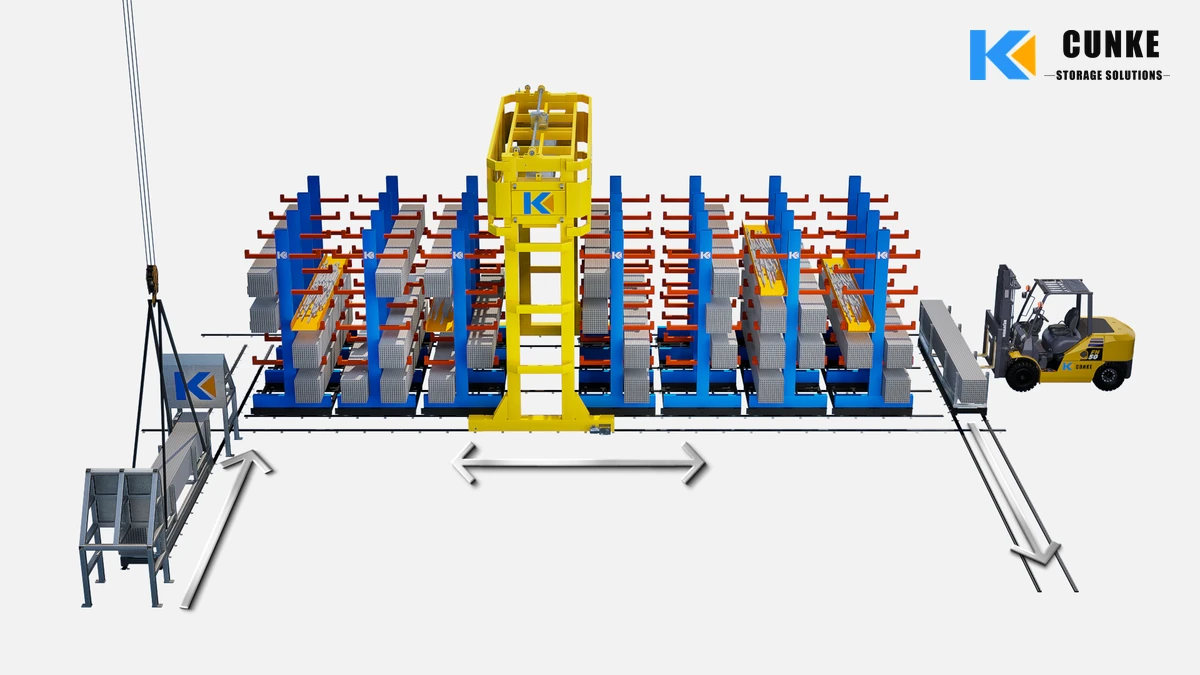
An automated profile store: the gantry brings each cassette to the loading station.
Why aluminum window profiles are hard to store
Window and door profiles are not heavy, but they are awkward in three ways.
They are long. System suppliers ship profiles in long factory lengths; one major European supplier lists a standard length of 6,800 mm (about 22 ft 4 in) for its window and door profiles (Aluprof). Others ship 6 m (19 ft 8 in) bars. The rack has to support the whole bar from end to end.
There are a lot of them. A shop running a few window and door systems stocks frames, sashes, mullions, beads and covers, each in several colors and finishes. The count of SKUs grows fast: three systems with 25 profiles each in four colors is already 300 different bars to keep apart.
The surface is the product. Powder coat, anodizing and wood-grain finishes are what the customer pays for. A scratch from a steel arm or a forklift fork turns a finished bar into scrap or a rework job.
Protect the finish before you think about density
Most damage happens when bars slide against steel or against each other. Three habits prevent most of it.
Line every contact point
Bars should never rest on bare steel. On our cantilever racks, the arms can be fitted with rubber or plastic strips, and we recommend that for every aluminum or stainless job. Bars can also sit in a tray with a solid base, so the whole length is supported.
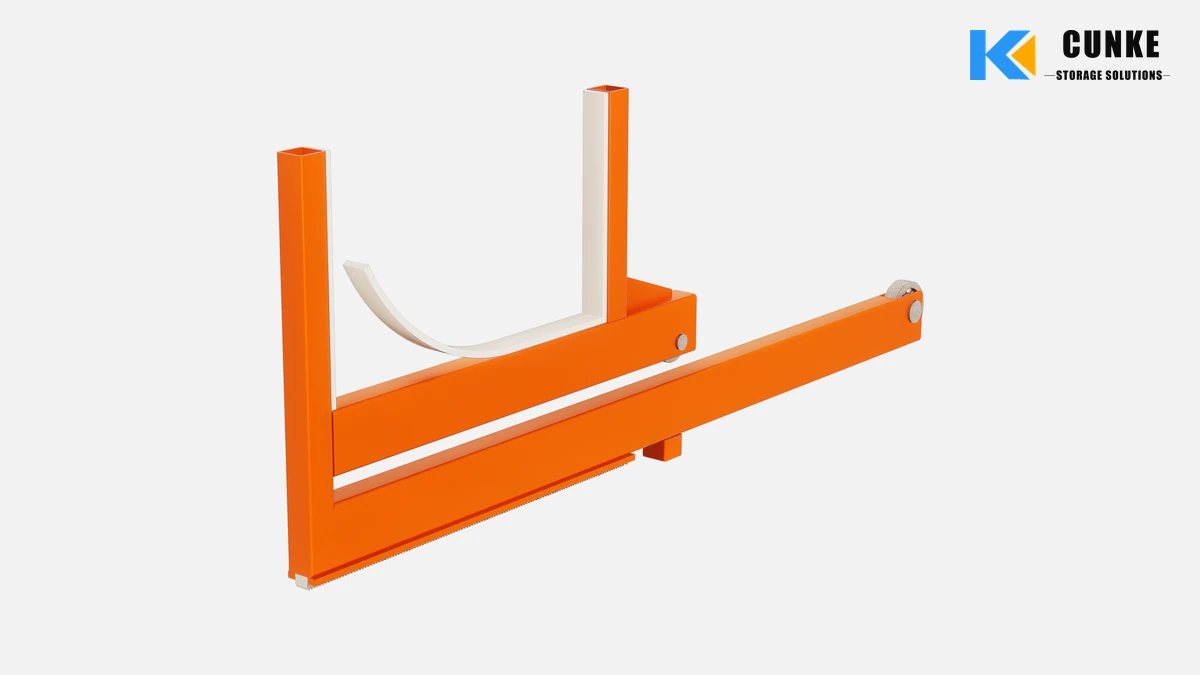
A rubber strip keeps finished profiles off bare steel.
Keep the wrapping on
The Aluminum Association’s water staining guidelines say “Wrapping materials should be left intact (and repaired if torn) until the aluminum is used.” Tearing the film open on arrival to check the color is a common way to start damage.
Keep it dry and away from cold walls
The same guidelines warn that aluminum can stain “when water is trapped between wraps, sheets or other mating surfaces,” and that “storing aluminum near walls, doors, windows, and other cooler areas may provide the conditions for condensation” (The Aluminum Association, TR-3). Keep the profile store inside the building, away from loading doors, and rotate stock so bars don’t sit for months.
Aluminum profile storage options compared
| Option | How bars come out | Best for | Watch out for |
| Floor stacks or fixed racks | Bars dragged out by hand or with a forklift | Very small shops | Scratches, mixed colors, slow picking |
| Honeycomb rack | One cassette pulled out at a time | Many SKUs, single-bar picks | Standard cassettes are 6 m; longer bars need custom cassettes |
| Roll-out cantilever rack | Each level cranks fully out, crane lifts from above | Wrapped bundles, mixed lengths up to 12 m | Needs an overhead crane or jib crane |
| Automated profile storage system | Gantry brings the cassette to a loading station | Hundreds of SKUs, high pick rates | Higher investment, floor and building checks |
Honeycomb racks: one profile per cassette
A honeycomb rack stores bars in steel cassettes arranged in a grid. Each cassette holds one profile in one color. The operator pulls out only the cassette needed, takes a bar or two, and pushes it back. Nothing is stacked on top of the bar being picked.
Our standard cassettes are 6,000 mm (19 ft 8 in) long, 400 to 600 mm (16 to 24 in) wide and 400 mm (16 in) high, and each holds up to 3,000 kg (6,600 lbs). That load rating is far more than a cassette of aluminum profiles weighs, so the real question is how many cassettes you need. A four-level block of ten columns gives 40 cassettes in a rack 3,000 mm (9.8 ft) tall. If your profiles come in 6.8 m lengths, ask for longer cassettes; we have built honeycomb racks up to 9 m (29.5 ft) long.
Our guide to honeycomb racks vs. plug-in racks explains when single-bar cassettes beat bundle storage.
Roll-out cantilever racks: wrapped bundles and crane picking
If profiles arrive in wrapped bundles and you have a crane, a roll out cantilever rack keeps each bundle on its own level. The level cranks fully out, and the crane lifts the bundle with soft slings or a vacuum lifter, so no chain touches the finish.
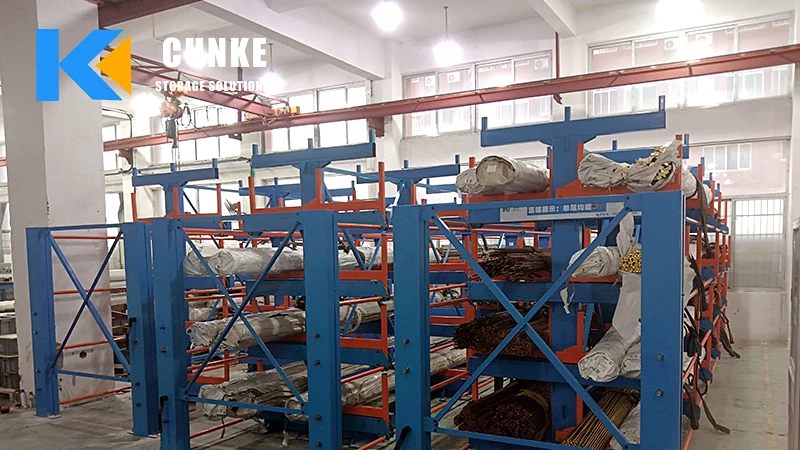
Each wrapped bundle sits on its own level, so nothing rests on top of it.
Arm spacing matters more than usual here. Aluminum bundles are light and bulky, so you run out of height long before you run out of load. Set each level’s height to the bundle it holds. Our article on why most cantilever racks waste vertical space shows how to plan level heights before you order.
Automated profile storage: when the SKU count gets too big
When the SKU count runs into the hundreds, finding the right bar takes longer than storing it. An automated steel profile storage system stores profiles in cassettes on cantilever racks and uses a gantry robot to bring the requested cassette to a loading station. The warehouse software tracks every location and can pick first-in, first-out.
Every system is designed for its site. Cassettes for window profiles are usually around 6 m (20 ft) long, the cassette frames can be built to protect the finish, and the gantry can run up to 10 m (33 ft) high, with racks 7 to 8 m (23 to 26 ft) tall.
Organize the store around the saw
Good racks still fail if bars go back in the wrong place. A few rules keep the store usable:
- Give every cassette or level a fixed SKU: system, profile number and color. Label it at the operator’s eye level.
- Keep finished colors and mill-finish bars in separate zones, so a raw bar is never stacked on a coated one.
- Put the fastest-moving profiles closest to the saw, at the easiest height.
- Set up a separate rack for long offcuts, sorted by profile. Window shops cut many bars to length, and the long drops only get used if someone can find them.
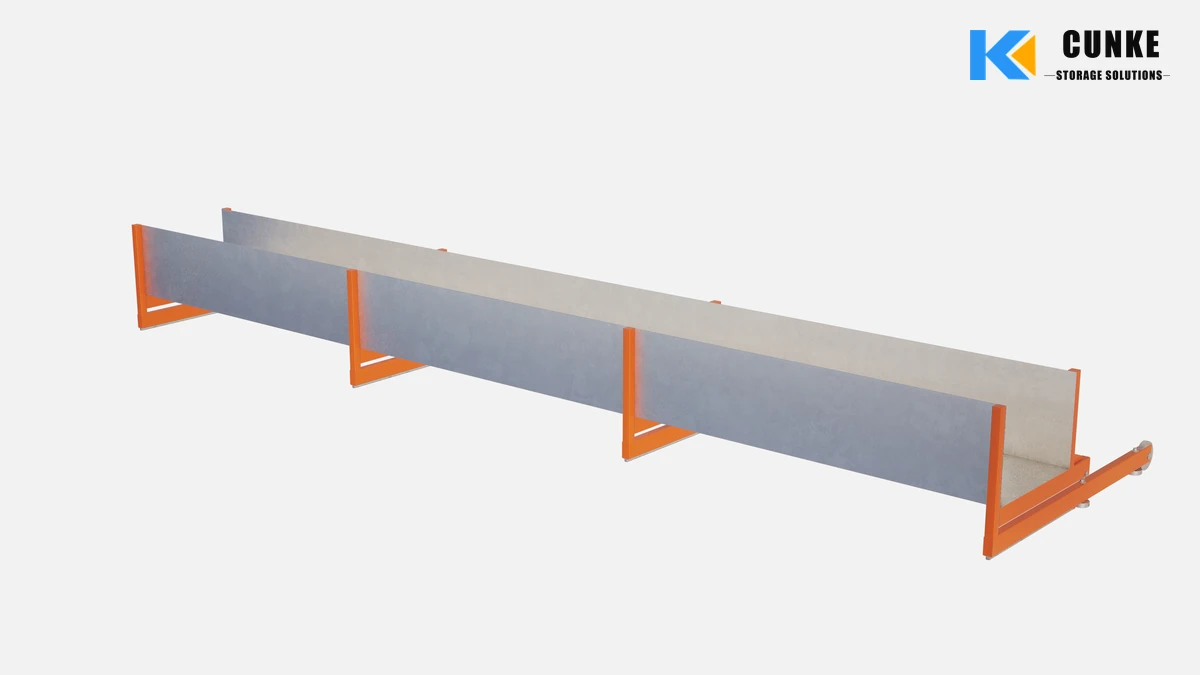
A solid-base tray supports bars along their full length.
FAQ
How should aluminum window profiles be stored?
Store them horizontally, supported along their full length, on lined arms or in cassettes so they never rest on bare steel. Keep the original wrapping intact and the store dry and away from loading doors and cold walls.
Can a honeycomb rack hold 6.8 m window profiles?
Our standard honeycomb cassettes are 6 m long, so 6.8 m profiles need longer custom cassettes. We have built honeycomb racks up to 9 m long.
How do you stop powder-coated profiles from getting scratched?
Line every contact point with rubber or plastic, lift bundles with soft slings or a vacuum lifter instead of chains or forks, and keep bars from sliding over each other. Leave the protective film on until cutting.
When does a window manufacturer need automated profile storage?
When the number of profiles and colors makes manual searching the main delay, and picks are frequent. Smaller shops usually do well with honeycomb or roll-out cantilever racks.
Plan your profile store
Send us your profile lengths, the number of systems and colors you stock, and a sketch of the area near your saws. We’ll suggest a layout and send a free 3D drawing. Contact CK Storage.