Steel service centers use storage towers as a fast-pick buffer between the bulk warehouse and the saws, shears and lasers that cut sheets to size. Each grade and thickness that drives cut-to-size orders gets its own tray, and the tower brings that tray to a loading station in well under a minute, so one operator can pull sheets for the next order without a forklift dig. The tower doesn’t replace the warehouse. It holds the sheets you cut most often, and it keeps a record of what is on each tray.
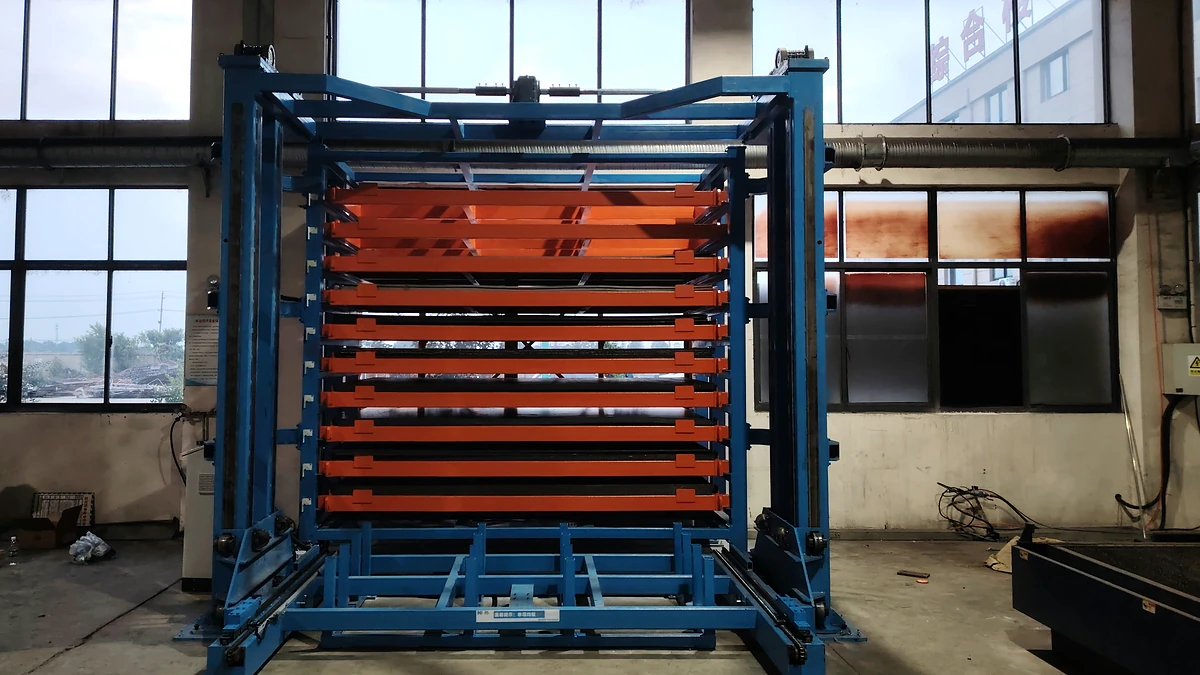
Each tray holds one grade and thickness, so no sheet sits on top of the one you need.
Why cut-to-size orders are hard on sheet storage
A service center buys steel in bulk and sells it in smaller pieces. Worthington Steel describes the business as handling “the processing, distribution, and storage of steel products,” with value-added work like “cutting, slitting, shearing, or coating” (Worthington Steel).
Cut-to-size is where storage gets tested. A mill order is one grade and one thickness by the bundle. A cut-to-size book is the opposite: many grades, many thicknesses, small quantities, and customers who expect a quote and a ship date the same day. Every order means finding a specific sheet, taking a few pieces off it, and putting the rest back.
In a forklift warehouse, that looks like this:
- The forklift driver finds the right bundle, often under other bundles.
- The bundle comes out to an open floor area, and someone counts off the sheets.
- The rest goes back, sometimes to a different spot than the system says.
- The partial sheet left after cutting goes on a remnant pile with a marker label.
Each step is small. Repeated dozens of times a day, they add up to forklift hours, scratched surfaces on stainless and aluminum, and stock records that drift away from what is on the floor.
What a storage tower changes
An automated sheet metal storage tower stores sheets on trays stacked vertically in a steel frame. A lift moves along the front of the tower, pulls the requested tray out of its level and brings it down to a loading station at floor level. The operator never goes into the tower.
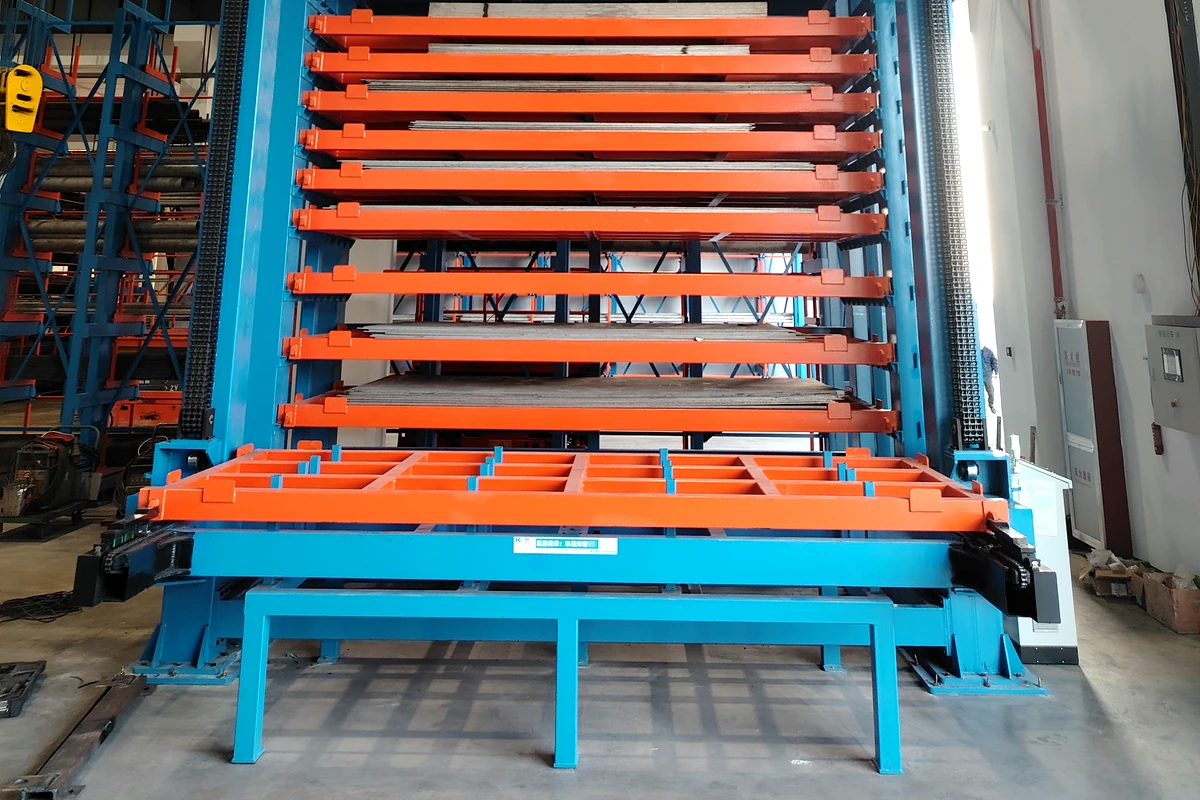
The lift brings the requested tray down to the loading station at floor level.
For a cut-to-size workflow, three things change.
Finding the sheet takes seconds. The operator enters a tray number or scans a code on the touch screen. In a typical 5 m (16 ft) tower, a full retrieval cycle takes about 35 seconds.
Nothing sits on top of the sheet you need. Each tray holds one grade and thickness. No bundle has to be moved to reach another, and sheets don’t slide across each other in the process.
The tower keeps the count. Our control system records the material, thickness and quantity on each tray. When the operator takes sheets out, the pick quantity is entered and the tray record updates. Material can be booked in and out with QR codes, using a main code and a sub code that you define yourself.
A cut-to-size order, step by step
Here is how a typical order moves through a service center with a tower:
- Order entry. Customer service takes the order: grade, thickness, finished size and quantity. If the tower is linked to your ERP, stock can be checked against the tower inventory at this point.
- Tray call. The cutting operator scans the order or enters the tray number. The tray arrives at the loading station.
- Sheet pick. An overhead crane or jib crane with a vacuum lifter takes the sheets off the tray. In more automated setups, a loader takes sheets straight from the tower to the laser.
- Book out. The operator enters the number of sheets taken, and the tray goes back.
- Cut and ship. Parts are cut, labeled and shipped. The drop either goes back into the tower on a remnant tray or into a remnant rack.
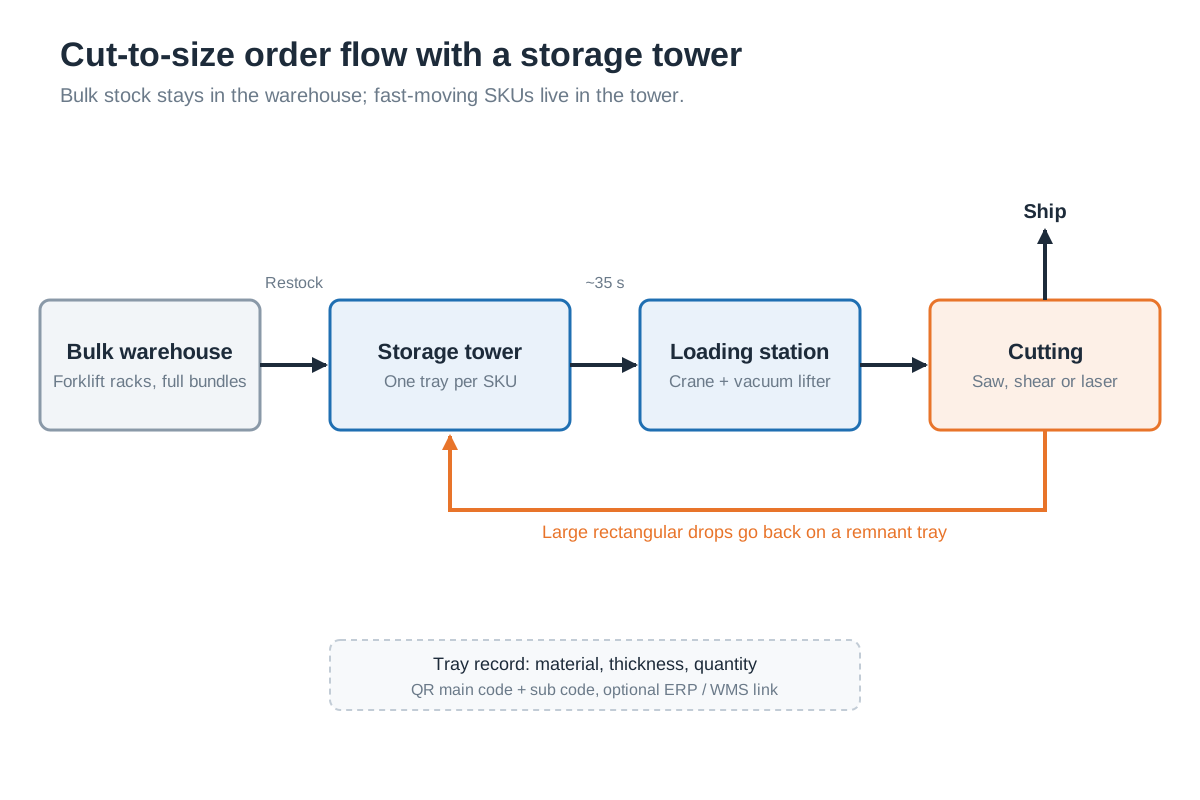
Bulk stock stays in the warehouse; fast-moving SKUs live in the tower.
Connecting the tower to an ERP or WMS is possible, but every system is different. Expect it to be scoped as a separate project, with your IT team or ERP provider involved.
Traceability: keep the heat number with the sheet
Some customers, such as structural fabricators whose contracts call for traceability, need a mill test report (MTR) that matches the heat the material came from. AISC explains that traceability works because the identification mark stays with the piece, and it notes that stock marks “can be abraded or lost in storage” (AISC Steel Solutions Center, FAQ 2.1.3).
A tower helps here in two ways. Sheets aren’t dragged across each other on the way out, so painted or stenciled marks last longer.
And because you define the QR code content, you can carry the heat or lot number in the tray record. The physical mark still has to be transferred to cut pieces according to your quality system. The tower keeps the stock side of the record straight.
How big a storage tower does a steel service center need?
Size the tower around the SKUs that drive cut-to-size orders. A practical way to do it:
- List your active cut-to-size SKUs. One SKU is one grade, thickness and sheet size, for example 304 stainless, 2 mm, 1500 × 3000 mm (5 × 10 ft).
- Rank them by picks per month. The top group goes in the tower. Slow movers and full-bundle sales stay in forklift racks.
- Check the weight per tray. Our towers carry up to 3,000 kg (6,600 lbs) per level. A 1500 × 3000 mm sheet weighs about 35 kg per mm of thickness, so a tray holds about 28 sheets of 3 mm or 14 sheets of 6 mm.
- Check your ceiling. Height decides how many levels fit.
Our sizing table for 3000 × 1500 mm sheets at 3 t per level:
| Clear height | Tower height | Levels | Total capacity |
| About 5.5 m (18 ft) | 5 m (16.4 ft) | 14 | 42 t |
| About 6.5 m (21.3 ft) | 6 m (19.7 ft) | 18 | 54 t |
| About 7.5 m (24.6 ft) | 7 m (23 ft) | 22 | 66 t |
If you have 25 fast-moving SKUs and a 5.5 m (18 ft) clear height, two 14-level towers may suit you better than one tall one. In our experience, two 5 m towers often outperform a single 8 m tower, because two lifts work at the same time. For more on fitting a tower to your building, see our guide to what automated sheet metal rack fits your ceiling height.
Where a tower is the wrong tool
Heavy plate
At 3,000 kg (6,600 lbs) per level, a tray holds only three sheets of 25 mm (1 in) plate in 1500 × 3000 mm. Plate centers usually do better with forklift sheet metal racks or crane-served floor storage.
Whole-bundle sales
If most orders ship as full bundles, a forklift rack is faster and cheaper.
Low ceilings and weak floors
A tower usually needs about 5 m (16.4 ft) of clear height, and the floor needs a structural check before installation because a loaded tower puts high point loads on the slab.
Odd-shaped remnants
Small and irregular drops are easier to manage on edge in a vertical sheet metal rack next to the cutting cell. Keep the tower for full sheets and large rectangular remnants. Our article on the hidden cost of unmanaged offcuts covers how to track remnants so they get used.
FAQ
Can a storage tower hold different grades and thicknesses?
Yes. Each tray holds one grade and thickness, and the level spacing is set for the thickest stack you plan to store. Our minimum level height is 200 mm (7.9 in).
How fast does a sheet tower retrieve a tray?
In a typical 5 m (16 ft) tower, a full cycle takes about 35 seconds. Taller towers take longer, about 55–60 seconds at 8 m (26 ft).
Can a sheet tower connect to our ERP?
It can be connected to ERP, MES or WMS systems, usually through an API or a database link. The scope depends on your ERP version, so it is assessed project by project.
How many people does it take to run a sheet tower?
One operator can run it from the touch screen at the loading station. Sheet handling at the station still needs a crane with a lifter or an automatic loader.
Plan a tower around your order mix
Send us your top SKUs by grade, thickness and sheet size, your monthly cut-to-size order count, and your clear height. We’ll suggest how many levels and towers you need, and what should stay in forklift racks. Contact CK Storage.