
A standard cantilever rack and a roll out cantilever rack are both designed to store long materials like steel bars, pipes, and profiles — but they serve completely different workflows. Standard cantilever racks work with forklifts for bulk, same-SKU loads. Roll out cantilever racks are built for fabrication shop floors where workers need fast, selective access to mixed profiles using an overhead crane. If you don’t have an overhead crane, a roll out cantilever rack is not the right fit for your operation.
What Is a Standard Cantilever Rack — and Who Actually Uses It?
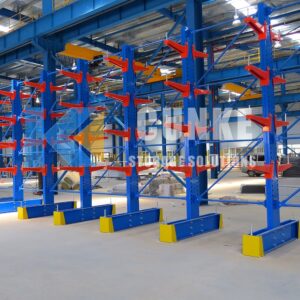
A standard cantilever rack is exactly what it sounds like: fixed arms extending horizontally from a vertical column, creating open shelves with no front obstruction. There are no drawers, no moving parts. You load and unload with a forklift.
The design is simple and proven. It handles long, bulky materials — steel beams, pipes, lumber, aluminum extrusions — that would never fit on a standard pallet rack. And because the arms are open on all sides, a forklift can slide in from either end to pick up an entire bundle in one move.
This is the key point: standard cantilever racks are optimized for bulk, whole-unit operations. You store a full bundle of 6-meter steel tubes on one arm, and when you need it, the forklift takes the whole bundle out. Selective picking of individual pieces is possible, but that’s not what this rack is designed for.
Where standard cantilever racks make sense:
- Steel service centers and metal distribution warehouses
- Construction material yards
- Lumber yards and building supply depots
- Any operation where materials are stored and shipped in bulk, same-SKU batches
If your workflow is “store a full bundle today, ship a full bundle tomorrow,” a standard cantilever rack is a solid, cost-effective solution. It doesn’t need anything more than a forklift to operate.
What Is a Roll Out Cantilever Rack — and Why Does It Need a Crane?
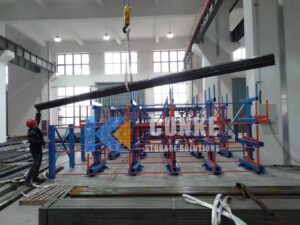
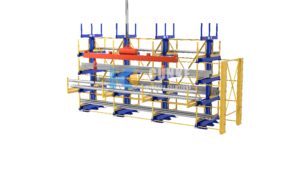
A roll out cantilever rack looks similar from a distance — vertical columns, horizontal levels — but the similarity ends there. Each storage level sits on an industrial roller system and can be cranked out fully using a manual handle (or electric motor), like a drawer. When a level is fully extended, it clears the structure completely and sits in the open aisle, giving an overhead crane unobstructed top-down access to everything on that level.
This changes the entire material handling workflow.
Instead of a forklift driving into the rack aisle to retrieve a bundle, the worker cranks out the relevant level, the overhead crane drops down and lifts whatever is needed — a full bundle or individual pieces — and the level rolls back in. Clean, fast, and completely selective.
CK Roll Out Cantilever Rack — Key Specifications:
- Load capacity per arm: 750 kg
- Maximum usable drawer depth: 900 mm
- Maximum usable drawer height: 700 mm
- Storage levels: up to 8
- Column spacing: up to 1,800 mm
- Supported material length: up to 12 m
- Minimum aisle requirement: 1.4 m
That last number is worth paying attention to. A standard cantilever rack typically needs a forklift aisle of 3.5 to 5 meters to operate safely. A roll out cantilever rack needs just 1.4 meters — because the crane lifts vertically, not horizontally. That’s a significant difference in floor space, especially on a busy fabrication floor where every meter counts.
Where roll out cantilever racks make sense:
- Fabrication shops and metalworking workshops
- Point-of-use storage alongside laser cutters, saws, or bending machines
- Operations storing mixed steel profiles (tubes, angles, flat bars, round bars) that are picked by specification, not by bundle
- Any facility that already has an overhead bridge crane installed
The overhead crane is not optional. It’s the core of how this system works. Without it, the roll out function loses most of its advantage — and you’d be paying a premium for a feature you can’t fully use.
Side by Side: The Real Differences
| Standard Cantilever Rack | Roll Out Cantilever Rack | |
| Primary use | Bulk storage, whole-bundle handling | Point-of-use storage, selective picking |
| Handling equipment | Forklift | Overhead bridge crane |
| Picking method | Full bundle at a time | Individual pieces or full bundles |
| Min. aisle width | ~3.5 – 5 m | 1.4 m |
| Typical setting | Warehouse, distribution center | Fabrication shop floor |
| Storage density | Good | High (up to 50% floor space saving vs. floor stacking) |
| Material types | Any long stock | Bars, tubes, angles, profiles |
| Cost | Lower upfront | Higher upfront, strong ROI for high-frequency picking |
The honest takeaway: neither system is universally better. They’re built for different jobs. The mistake most buyers make is choosing based on price alone, without thinking about the workflow they’re actually running.
Ask yourself two questions:
- Do you have an overhead crane in the building? If no, a roll out cantilever rack is not the right choice.
- Are you picking by specification or by bundle? If your team regularly pulls specific profiles out of mixed inventory — say, “give me six pieces of 80×80 angle iron for this job” — a standard cantilever rack will slow you down every single time.
What If You Don’t Have an Overhead Crane?
Not every workshop has an overhead bridge crane — especially smaller fabrication shops or facilities where crane installation isn’t practical due to building height, structure, or cost.
If that’s your situation but you still need the kind of selective, high-density profile storage that a roll out cantilever rack delivers, there is another path: the CK Automated Steel Profile Storage System.
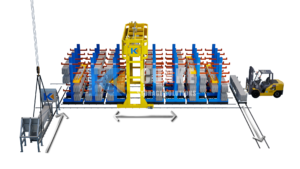
Instead of relying on an existing overhead crane, this system has one built in. An integrated, precision-controlled gantry crane works in tandem with motorized mobile racking to store and retrieve long profiles automatically — without forklift intervention, and without any external crane infrastructure.
What it solves:
- High-density storage of mixed steel profiles (aluminum, steel, copper extrusions)
- Fully automated retrieval — no manual cranking, no forklift aisle needed
- Zero-aisle layout: the system uses every square meter of vertical space
- Compatible with ERP and WMS systems for inventory control
It’s a larger investment than a roll out cantilever rack, but it’s a different category of solution — designed for operations that are scaling up, moving toward lights-out manufacturing, or dealing with serious floor space constraints.
If a roll out cantilever rack is the upgrade from a standard cantilever rack, the automated system is the next step beyond that — and importantly, it removes the crane dependency entirely.
FAQ
Q: Does a roll out cantilever rack require an overhead crane?
Yes. The roll out mechanism extends each storage level fully into the aisle so that an overhead crane can access materials from directly above. Without an overhead crane, the system can still technically function, but you lose the core benefit — fast, safe, vertical lifting of heavy or bundled profiles. If you don’t have a crane, consider a standard cantilever rack or the CK Automated Steel Profile Storage System, which includes an integrated gantry crane.
Q: Can a roll out cantilever rack handle individual piece picking as well as full bundles?
Yes. That’s actually one of its main advantages over a standard cantilever rack. Once a level is fully extended, workers or crane operators have direct top-down access to every piece on that level — whether they need one bar or the entire bundle.
Q: What is the minimum aisle width needed for a roll out cantilever rack?
The minimum aisle width is 1.4 meters. Because materials are retrieved vertically by an overhead crane rather than horizontally by a forklift, you don’t need the wide turning radius that a standard cantilever setup requires. This makes roll out cantilever racks particularly well-suited for tight workshop floors.
Q: What types of materials can a roll out cantilever rack store?
Roll out cantilever racks are designed for long, linear materials: round bars, square bars, flat bars, angle iron, steel tubes, aluminum profiles, copper profiles, and similar stock. CK’s system supports material lengths up to 12 meters and a load capacity of 750 kg per arm.
Q: How does a roll out cantilever rack compare to floor storage for steel profiles?
Floor storage forces wide forklift aisles and makes selective picking extremely difficult — if the profile you need is at the bottom of a stack, you’re moving everything above it first. A roll out cantilever rack organizes profiles by level, supports materials every 1,800 mm to prevent sagging, and gives instant, selective access through the crane. CK Metal Storage estimates shops can reclaim up to 50% of floor space compared to floor-stacked storage.
Q: I don’t have an overhead crane. Is there still a high-density solution for storing mixed steel profiles?
Yes. The CK Automated Steel Profile Storage System is designed exactly for this situation. It integrates a built-in gantry crane with automated mobile racking, so no external crane infrastructure is required. It’s a fully automated storage and retrieval solution suitable for fabrication shops that need the functionality of a roll out system without the crane prerequisite.