
A DIY welded sheet metal rack might look like the cheaper option — you control the materials, you use your own guys, and you skip the supplier markup. But once you factor in the true cost of welder labor, the rework that almost always follows, and the liability of an uncertified rack holding hundreds of pounds of sheet stock next to a laser cutter, the math rarely works in your favor. Here’s what most shops miss when they run the numbers.
The “I’ll Just Weld One” Calculation — What Most Shops Get Wrong
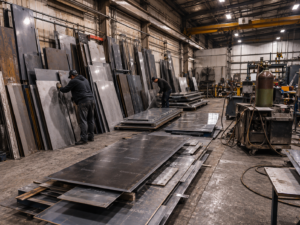
You’ve seen it happen. Sheet metal is piling up against the wall, there’s no real system, and guys are digging through stacks to find the right gauge. Someone looks around and says: “We’ve got steel tube, we’ve got a welder. Let’s just build something.”
It’s a reasonable instinct. You know your material costs. You know what steel tube goes for per foot. On paper it looks like a weekend project and a modest materials bill.
Here’s what that calculation almost always misses.
The Real Cost of Building Your Own Sheet Metal Rack
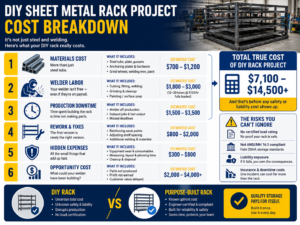
Materials Are Just the Starting Point
A rack that can actually handle full-size sheet metal — 4×8 sheets, real working loads — isn’t just a few pieces of square tube welded together. You need:
- Heavy-gauge uprights and crossbars that won’t flex under load
- Gussets and brackets at every load-bearing joint
- Ground anchoring plates (skipping this is a safety violation)
- Surface treatment to prevent rust in a shop environment
By the time you spec it out properly, the materials bill is already more than most people budget for.
Labor Is Where the Estimate Falls Apart
This is the number that surprises shop owners most.
Your welder isn’t free — even if they’re already on payroll. Every hour they spend cutting, fitting, welding, grinding, and finishing a storage rack is an hour they’re not making parts for customers. In a production shop, that’s not a sunk cost. It’s an opportunity cost with a real dollar value attached.
And building a proper sheet metal rack isn’t an afternoon job. The measuring, the fitting, the welding passes, the cleanup — it takes significantly longer than people expect. Factor in your welder’s fully-loaded cost to the business (wages, benefits, overhead), and the labor bill alone often exceeds what a purpose-built rack would have cost.
Rework: The Budget Item Nobody Plans For
Here’s the part that kills the math on most DIY racks: the first version is rarely the right version.
Sheet metal racks aren’t static furniture. Sheets slide in and out repeatedly. Loads shift. Operators pull from odd angles. A rack that looked solid when you welded it can develop flex, loose joints, or slot spacing problems within months of real use.
Fixing it — adding gussets, adjusting spacing, reinforcing weak points — means pulling your welder back off production work again. That’s not a one-time cost. It’s a recurring one.
What the Comparison Actually Looks Like
| DIY Welded Rack | Purpose-Built Rack | |
| Materials | Underestimated at first | Included |
| Welder labor | Higher than expected | — |
| Rework rounds | Almost always needed | Engineered out |
| Production downtime | Ongoing hidden cost | None |
| Load certification | Not available | Engineer-certified |
| True total cost | Often more than expected | Known upfront |
The Safety Risk Nobody Puts in the Budget
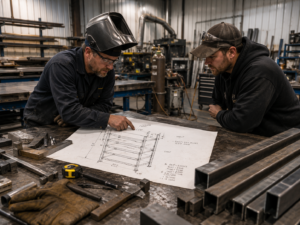
This is the conversation most shop owners would rather skip — but it’s the most important one.
Sheet metal is heavy. A rack storing a working quantity of full-size sheets is holding a serious amount of weight. If that rack wasn’t engineered for the load, and something gives way near your operator or your laser cutter, the consequences go well beyond the cost of the rack itself.
OSHA’s General Duty Clause requires employers to provide a workplace free from recognized hazards. For industrial storage racks, OSHA references ANSI/MH 16.1 — the standard that covers load ratings, anchoring requirements, and structural integrity. A homemade welded rack has none of that documentation. No certified load rating, no engineering record, no compliance trail.
If a rack fails and someone gets hurt, “we built it ourselves” is not a defense. It’s an admission.
Purpose-built racks come with:
- Certified load ratings — documented per slot and per level
- Compliance with ANSI/MH 16.1 — the standard OSHA actually checks against
- Traceable manufacturing records — which matter the moment there’s an incident or an inspection
The question isn’t whether the risk is real. It’s whether you want that liability on your shop floor.
What You’re Actually Paying For With a Purpose-Built Rack
Here’s the analogy worth sitting with for a moment.
You know what it costs to build an iPhone — just the components? Around $400. Apple sells it for over $1,000. That difference isn’t greed. It’s the engineering, the testing, the reliability, and the certainty that it does exactly what it’s supposed to do, every single time.
A purpose-built sheet metal rack works the same way.
You’re not paying for steel tube. You’re paying for:
Engineering designed around how sheet metal actually moves. A pull-out or roll-out rack is built around the real mechanics of pulling a 4×8 sheet from a tight slot — smooth action, controlled travel, no pinch points. A welded rack is built around what your welder thought seemed reasonable.
A known load capacity before you load it. CK Metal Storage racks are rated for specific working loads — so you know what the rack can safely hold before anything goes on it, not after something goes wrong.
Your production floor back. Every hour your welder spends on a rack build is an hour not spent on customer work. For a busy shop, that’s not a minor consideration.
A system that can grow. Purpose-built racks are modular — you can add slots, reconfigure, or expand as your operation changes. A welded rack is fixed the day it’s finished. Changing it means starting over.
FAQ: DIY vs. Purpose-Built Sheet Metal Racks
Is it cheaper to weld your own sheet metal storage rack? It usually isn’t — once you account for the true labor cost of pulling a skilled welder off production work, the materials required to build something that actually handles real loads safely, and the near-certain rework that follows. Most shops find the total cost is comparable to a purpose-built rack, but without the engineering certification or the predictable performance.
Is a homemade welded rack OSHA compliant? Not automatically. OSHA references ANSI/MH 16.1 for industrial storage rack standards, which covers load ratings, anchoring, and structural integrity. A homemade rack typically has no engineering documentation or certified load capacity — which puts your business at risk under OSHA’s General Duty Clause, especially if an incident occurs.
What should I look for in a sheet metal storage rack? The most important factors are load rating per slot, the loading method that fits your workflow (manual pull-out vs. forklift), and compliance documentation. A rack that looks solid but has no certified load rating is a liability, not an asset. CK Metal Storage recommends matching rack type to your actual material flow — how your team pulls and loads sheets day to day — rather than buying for storage capacity alone.
What is the difference between a pull-out and roll-out sheet metal rack? Both allow access to individual sheets without disturbing the rest of the stack. Pull-out racks use sliding drawer-style slots operated by hand — well suited for lighter gauge sheets and manual workflows. Roll-out racks use rolling carriages that handle heavier loads with less effort. The right choice depends on your sheet weights, stack depth, and how frequently your team accesses different material.
Can I add to a purpose-built rack as my shop grows? Yes — this is one of the practical advantages over a welded rack. Purpose-built systems like those from CK Metal Storage are modular, meaning you can add slots, change configurations, or expand capacity without rebuilding from scratch. A welded rack is a fixed structure; any change requires additional fabrication work.
The Bottom Line
Welding your own sheet metal rack isn’t inherently wrong. But going in with an incomplete picture of what it actually costs — in labor, in rework, in compliance risk, and in production time — is how shops end up spending more than they planned for something that still doesn’t perform as well as they needed.
A purpose-built rack doesn’t just store metal. It stores it safely, in a way your team can actually work with every day, with a paper trail that protects your business.
If you’re not sure which rack type fits your operation, CK Metal Storage is happy to help you think it through — no pressure, just practical guidance based on how your shop actually works.