
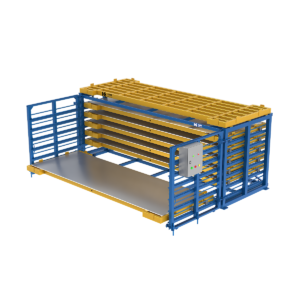
A motorized sheet metal rack is an electric-powered storage system that extends and retracts heavy sheet metal drawers automatically — no manual pulling or cranking required. Each level holds up to 7,000 kg (15,400 lbs), making it one of the highest-capacity sheet metal storage solutions available. For modern manufacturing facilities facing labor costs, safety regulations, and floor space constraints, motorized systems offer a measurable advantage over manual alternatives.
What Is a Motorized Sheet Metal Rack — and How Is It Different from a Manual One?
A motorized sheet metal rack works the same way as a standard roll-out rack in principle: sheet metal is stored in horizontal layers that slide outward for access. The key difference is what powers the movement.
With a manual roll-out rack, a worker turns a hand crank to extend the drawer. It gets the job done, but when you’re dealing with a drawer loaded with 3,000–5,000 kg of steel plate, that’s a real physical effort — and it adds up across a shift.
A motorized rack replaces the crank with an electric drive system. The operator presses a button on a remote control, and the drawer extends smoothly and safely. No physical strain. No risk of the load shifting mid-pull.
Here’s a quick spec comparison:
| Manual Roll-Out Rack | Motorized Sheet Metal Rack | |
| Drive system | Hand crank | Electric motor + remote control |
| Load capacity / level | Up to 5,000 kg (11,000 lbs) | Up to 7,000 kg (15,400 lbs) |
| Operator effort | Moderate to high | Minimal |
| Suitable for | Mid-weight sheet metal | Heavy-gauge plate, large-format sheets |
| EU Directive 90/269 compliance | Risk assessment required | Significantly reduces manual handling risk |
| Lead time (CK Metal Storage) | ~3–4 weeks | ~4–5 weeks |
The Real Cost of Manual Sheet Metal Handling
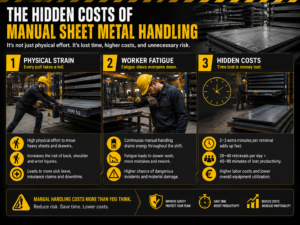
Before we get into the advantages of motorized systems, it’s worth being honest about what manual handling actually costs — because it’s rarely just about the physical effort in the moment.
Workplace injuries are expensive. Sheet metal is one of the heaviest and most awkward materials to handle in a factory environment. A single 3,000 x 1,500 mm steel plate can weigh 350 kg or more. Pulling a loaded drawer, repositioning sheets, or stabilizing a stack during retrieval puts consistent strain on workers’ backs, shoulders, and wrists. According to the European Agency for Safety and Health at Work, musculoskeletal disorders (MSDs) are the most common work-related health problem in Europe — and manual material handling is one of the primary causes.
Time loss adds up faster than you think. In a busy sheet metal shop or laser cutting facility, workers may access the rack 20–40 times per day. Even if each manual retrieval takes 2–3 minutes longer than a motorized one, that’s potentially over an hour of lost productive time per shift, per rack.
Labor costs in Europe and North America are not getting cheaper. Skilled machine operators are expensive to hire and expensive to replace. Using them to manually wrestle with sheet metal drawers is a poor use of their time — and if they get injured, the disruption and cost go well beyond one person.
5 Reasons Motorized Sheet Metal Racks Fit Modern Manufacturing
- They Help You Meet EU Manual Handling Regulations
This one matters more than most suppliers will tell you.
EU Directive 90/269/EEC — the European Council Directive on minimum health and safety requirements for the manual handling of loads — places a clear legal obligation on employers. The directive requires employers to, first, avoid manual handling wherever possible, and second, take organizational measures to reduce risk when it can’t be eliminated entirely.
Sheet metal is heavy. There’s no way around that. But there is a way around the manual handling part: motorize it. Installing a motorized sheet metal rack system is one of the most direct ways a manufacturing facility can demonstrate compliance with this directive — and it’s increasingly what European procurement teams and EHS managers are requiring before signing off on a storage upgrade.
For any EU-based manufacturer, this isn’t a “nice to have.” It’s a compliance strategy.
- Each Level Carries Up to 7,000 kg — Without Asking Anyone to Lift It
The CK Metal Storage motorized sheet metal rack supports up to 7,000 kg (15,400 lbs) per level, across 5 to 8 levels per unit. That’s serious capacity.
What makes this particularly useful is the combination of capacity and accessibility. The electric drive handles the weight — the operator just selects the level and presses a button. There’s no mechanical trade-off where high capacity means difficult access. You get both.
This also means you can consolidate more material into a smaller footprint, which directly reduces the floor space tied up in sheet metal storage.
- It Reduces Retrieval Time Significantly in High-Throughput Environments
For facilities running laser cutting machines, press brakes, or stamping lines, feeding the machine fast enough is critical. If the storage system is the bottleneck — because it takes time and effort to extract a sheet — the machine sits idle. That’s direct revenue loss.
A motorized system eliminates most of the friction in that process. The operator calls up the right level, the drawer extends, and the sheet is ready to pick — often with a vacuum lifter or jib crane right alongside. CK Metal Storage designs these systems to integrate with handling equipment for exactly this reason.
A realistic estimate: in a facility accessing sheet metal 25–30 times per day, a motorized rack can save 45–90 minutes of retrieval time per shift compared to a manual system.
- It Protects Your Most Expensive Investment — Your Workforce
Replacing an injured worker isn’t just an HR problem. In Germany, the Netherlands, and the UK, employer liability for workplace injuries can run to tens of thousands of dollars in medical costs, legal fees, and productivity loss — before you factor in insurance premiums.
Motorized handling reduces the physical demand on operators to near zero for the storage access portion of their work. That means fewer MSDs, fewer lost workdays, and a safer environment that’s genuinely easier to staff and retain people in.
This is also increasingly relevant for workforce demographics. As the average age of manufacturing workers rises across Europe and North America, reducing physical strain isn’t just about compliance — it’s about keeping experienced people on the floor longer.
- The System Scales with Your Operation
A motorized sheet metal rack from CK Metal Storage is configurable at the spec level: usable length up to 6,200 mm, depth up to 2,500 mm, and height per level starting from 70 mm, with 5 to 8 levels standard. That means the system can be sized to match your actual sheet metal dimensions and storage volume — not the other way around.
As your operation grows, you’re not replacing the system. You’re adding to it.
Motorized vs. Manual vs. Automated Tower: Which One Is Right for You?
Not every facility needs a motorized rack. Here’s an honest breakdown to help you figure out which system fits where:
| Manual Roll-Out Rack | Motorized Sheet Metal Rack | Automated Sheet Tower | |
| Best for | Lower-volume shops, budget-conscious buyers | Mid-to-high volume, heavy-gauge material | Very high volume, high SKU count, full automation goal |
| Load per level | Up to 5,000 kg | Up to 7,000 kg | Varies by model |
| Operator involvement | High (manual crank) | Low (remote control) | Near-zero (fully automated) |
| Access speed | Moderate | Fast | Fast |
| Floor footprint | Medium | Medium | Compact (vertical) |
| Capital cost | Lower | Mid-range | Higher |
| EU Directive compliance | Requires risk assessment | Strong compliance case | Strongest compliance case |
| Lead time (CK) | ~3–4 weeks | ~4–5 weeks | Custom, longer |
CK Metal Storage recommends motorized systems for facilities that are handling sheets heavier than 3,000 kg per drawer load, running more than one shift, or operating in jurisdictions with active manual handling enforcement. If you’re not sure which system fits your situation, our team is happy to walk through it with you — get in touch here.
FAQ: Motorized Sheet Metal Rack Systems
What is a motorized sheet metal rack?
A motorized sheet metal rack is an industrial storage system designed to hold large, heavy sheet metal in horizontal layers. Each layer — or drawer — extends outward via an electric motor, controlled by a remote or push-button panel. This eliminates the need for workers to manually pull or crank open loaded drawers, which is particularly important when individual layers are carrying several thousand kilograms of material.
How much weight can a motorized sheet metal rack hold per level?
The CK Metal Storage motorized sheet metal rack supports a maximum load of 7,000 kg (15,400 lbs) per level. A standard unit has 5 to 8 levels, giving a total system capacity that can exceed 40,000 kg depending on configuration.
Is a motorized sheet metal rack compliant with EU manual handling regulations?
Yes. EU Directive 90/269/EEC requires employers to eliminate or reduce manual handling of heavy loads wherever practicable. A motorized sheet metal rack directly addresses this obligation by removing the need for workers to physically pull or push loaded drawers. Many European manufacturing facilities are specifying motorized storage systems specifically to meet this requirement.
How long does it take to manufacture and deliver a motorized sheet metal rack?
CK Metal Storage’s standard manufacturing lead time for motorized sheet metal racks is 4 to 5 weeks. Delivery time depends on destination — your sales contact can provide a shipping estimate based on your location.
Can a motorized sheet metal rack be customized for different sheet sizes?
Yes. CK Metal Storage’s motorized racks are configurable in usable length (up to 6,200 mm), depth (up to 2,500 mm), and height per level (minimum 70 mm), with 5 to 8 levels available. Custom configurations are available for non-standard sheet dimensions or specific facility requirements.
Is a motorized sheet metal rack suitable for laser cutting operations?
It’s one of the most common use cases. Laser cutting machines require fast, precise sheet changeovers to maintain throughput. A motorized rack positioned alongside the cutting area — often paired with a vacuum lifter or jib crane — allows operators to retrieve and load sheets quickly with minimal physical effort. This reduces machine downtime between cuts and keeps the overall workflow moving.
Internal Links