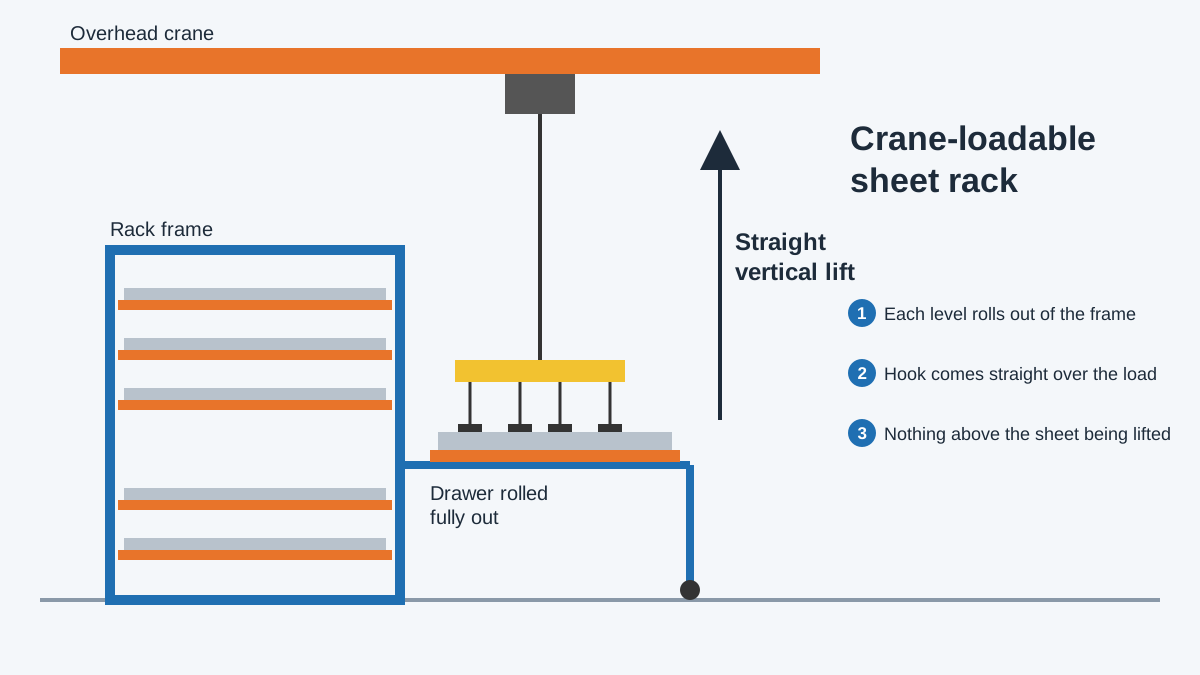
A crane-loadable sheet rack is a sheet metal rack built so an overhead crane or jib crane can lower straight down onto any level, either to load a bundle or to pick a single sheet. Each level rolls completely out of the frame, so nothing sits above the load while it is lifted. Forklift sheet racks work differently: the whole cassette goes in and out on the forks, and you never lift individual sheets inside the rack.
How a crane-loadable sheet rack works
Every level is a drawer on rails. The operator brings one drawer fully out by hand, with a crank or with a motor. On our pull-out and roll-out racks, the doors swing open and their rails line up with the frame rails, so the drawer can travel completely clear of the rack.
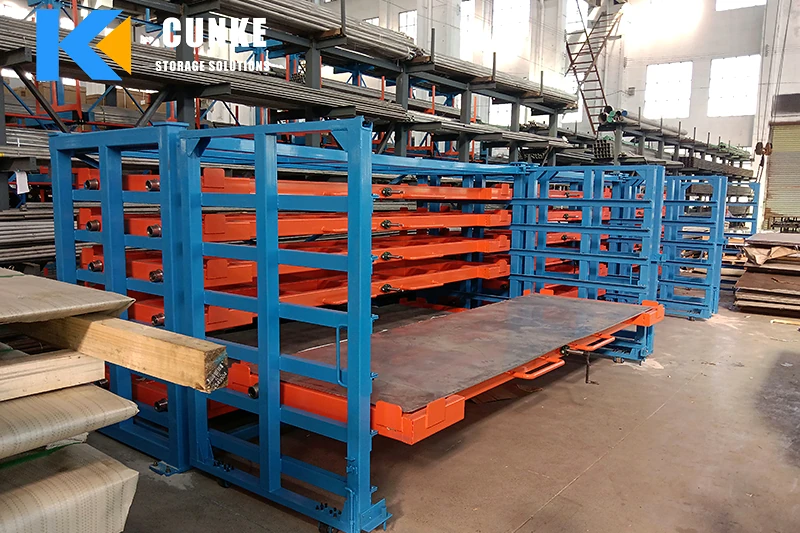
With the drawer out, the crane hook comes down directly over the sheets. What hangs on the hook depends on what you are moving:
- Lifting chains with hooks for whole bundles and thicker plate
- A vacuum lifter for single sheets, and the usual choice for aluminum and stainless steel
- A permanent lifting magnet for carbon steel
A shelf that only slides out halfway leaves part of the stack under the level above, where the crane can’t reach it cleanly.
Why full extension matters: a straight vertical lift
OSHA’s overhead crane rule spells out how a load should be handled. The hook “shall be brought over the load in such a manner as to prevent swinging,” the load must not “contact any obstructions,” and cranes “shall not be used for side pulls” unless a responsible person has approved it (29 CFR 1910.179(n)(3)).
On a fixed rack or a floor stack, the sheet you want is under another sheet or halfway under the level above. Getting it out means dragging it sideways or tilting it, which is the side pull and contact the rule describes.
On a crane-loadable rack, the drawer is out in the open, the hook goes straight over it, and the sheet comes straight up. Nothing above it can catch the load or the rigging.
The same rule also says the operator should “avoid carrying loads over people.” So plan a clear zone in front of the rack where nobody stands while a drawer is out and a load is on the hook.
Crane-loadable vs. forklift-loaded sheet racks
| Crane-loadable sheet rack | Forklift sheet rack | |
| How material goes in | Crane lowers a bundle onto an extended drawer | Forklift puts a full cassette into a level |
| How material comes out | Single sheets lifted from the drawer | Whole cassette taken out on the forks |
| Equipment you need | Overhead crane or jib crane, plus a lifter | Forklift and an aisle for it |
| Best place for it | Next to the laser, press brake or shear | Raw material warehouse |
| Picks single sheets? | Yes | Not inside the rack |
Many shops use both: forklift racks in the warehouse and crane-loadable racks beside the machines.
Types of crane-loadable sheet racks
Most drawer-type sheet racks can be loaded by crane. The difference is how the drawer comes out and how much it carries. These are the ratings for our standard models:
| Rack type | How the drawer comes out | Load per level |
| Pull out sheet metal rack | Pulled by hand | Up to 1,000 kg (2,200 lbs) |
| Roll out sheet metal rack | Removable crank and gear drive | 3,000 kg (6,600 lbs) on 3 m models, 5,000 kg (11,000 lbs) on 6 m models |
| Motorized sheet metal rack | Electric motor, button or remote | Up to 8,000 kg (17,600 lbs) |
| Double-sided sheet rack | Out to either side | Up to 5,000 kg (11,000 lbs) |
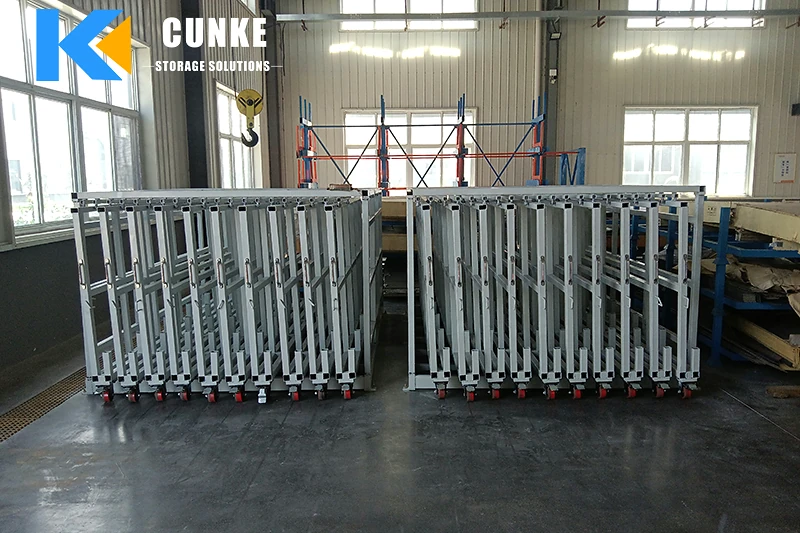
| Vertical sheet rack (for remnants) | Pulled by hand; sheets stand on edge | Up to 400 kg (880 lbs) per drawer |
The vertical rack is the odd one out. Sheets stand on edge in 50 mm (2 in) slots, and the crane lifts them out from the side with a C-hook rather than from above.
What to check before you buy
“Crane compatible” on a spec sheet doesn’t tell you whether the rack will work with your crane. These five checks do.
1. Can the crane reach the extended drawer?
The crane has to cover the zone in front of the rack, including both ends of the extended drawer. With a jib crane, check that the boom radius covers the whole drawer.
2. Is there enough hook height?
The load has to clear the drawer edge and anything in its path:
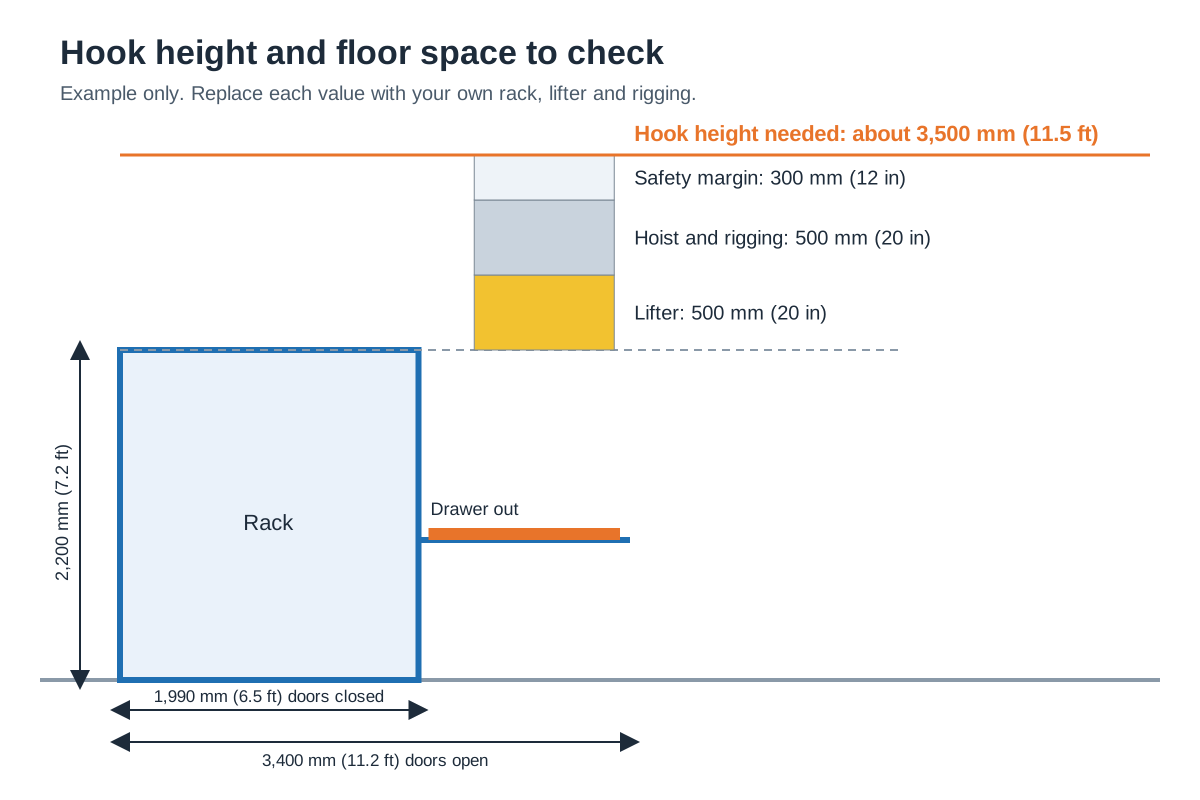
Minimum hook height = height of the top level + stack height + lifter height + rigging + safety margin
Example, with assumptions: our standard pull-out and roll-out racks are about 2,200 mm (7.2 ft) tall overall, which covers the top level and its stack with room to spare. Our 1,000–1,500 kg vacuum lifters are 500 mm (20 in) tall. If your hoist and rigging take another 500 mm and you keep a 300 mm (12 in) margin, you need a hook height of about 3,500 mm (11.5 ft). Replace each number with your own.
[Image: crane-loadable-rack-hook-height.png]
Example only: replace each value with your own rack, lifter and rigging.
3. Is there floor space in front of the rack?
Our standard 3 m roll-out rack is 1,990 mm (6.5 ft) deep with the doors closed and 3,400 mm (11.2 ft) with the doors open. That leaves about 1,410 mm (4.6 ft) in front of the rack for the drawer, plus room for the operator to stand outside the lift zone.
4. Does the drawer suit your lifting gear?
For chains with hooks, our drawers are wider at the ends than in the middle, so the chains can be pulled back out. For straps or wire rope, a 40 mm attached beam leaves room for the strap to slide out from under the bundle.
5. Is the lifter rated for your heaviest sheet?
Check the lifter against your heaviest single sheet, not the drawer rating. A 3,000 kg drawer can hold sheets that a 1,000 kg vacuum lifter can’t pick.
No overhead crane?
A jib crane with a vacuum lifter can serve one or two racks and goes in much faster than a new bridge crane. Our article on loading and unloading sheet metal without a crane walks through that setup. For a wider look at chains, magnets and lifters, see our guide to sheet metal and steel profile handling equipment.
If you won’t add any crane, a forklift rack is the better fit.
FAQ
Can I use a jib crane instead of an overhead crane?
Yes. A jib crane with a vacuum lifter works well for one or two racks beside a machine. Check that the boom radius covers the whole extended drawer.
What lifting device works best with a crane-loadable sheet rack?
Use a vacuum lifter for single sheets and for aluminum or stainless steel. A permanent lifting magnet works for carbon steel, and lifting chains with hooks suit bundles and heavy plate.
How much weight can a crane-loadable sheet rack hold per level?
It depends on the type. Our pull-out racks carry up to 1,000 kg (2,200 lbs) per level, roll-out racks 3,000–5,000 kg (6,600–11,000 lbs), and motorized racks up to 8,000 kg (17,600 lbs).
Find the right rack for your crane
Send us your sheet sizes, the heaviest stack per level, your crane type and hook height, and a photo of the area in front of the machine. We’ll suggest the rack that fits and send a free 3D layout. Contact CK Storage.