
Elevator sheet metal storage has to handle two streams: thin decorative stainless for car walls and doors, often around 2 mm with a brushed, mirror or patterned face, and thicker structural steel for frames and brackets. The stainless is the hard part, because it has to stay flat, keep its film, stay clear of carbon steel and be easy to find among many finishes. A storage tower with one finish per tray, set beside the laser, handles that well, while the structural plate goes in a separate rack.
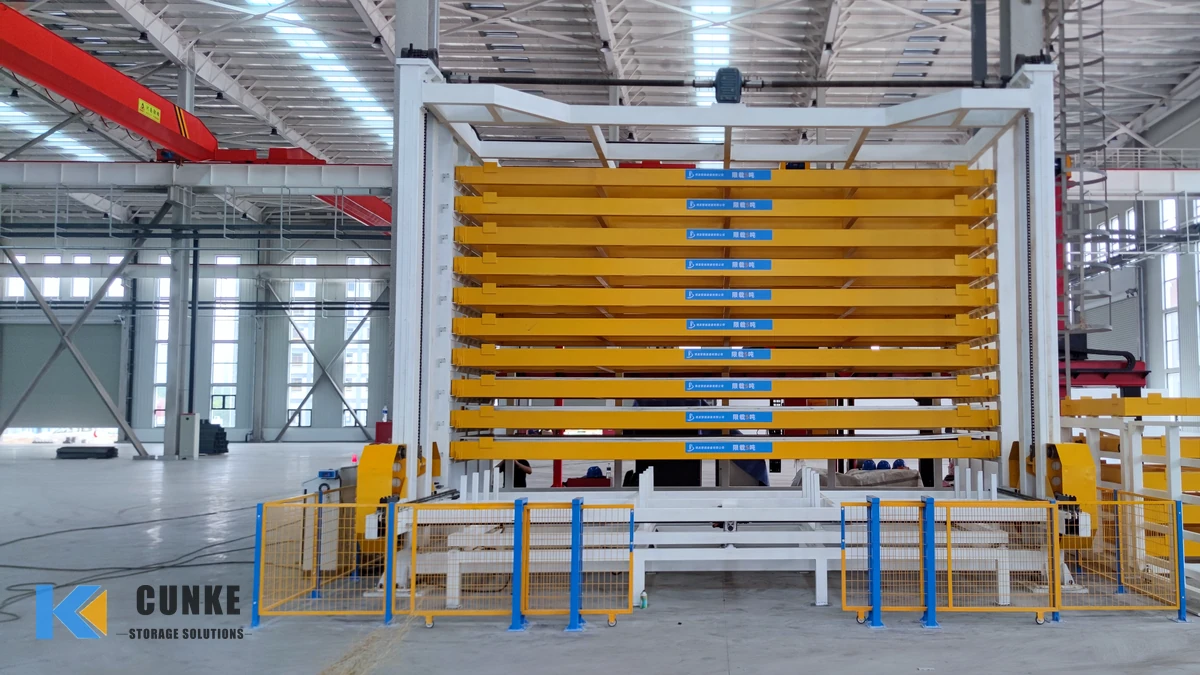
Trays stack in the frame, and the loading station sits behind a fence at floor level.
What sheet an elevator plant runs
A trade report on one elevator builder describes the two-millimeter stainless sheets used in its cabins, alongside about 200 tonnes a year of galvanized steel for frames and fastening parts, some of it up to 25 mm thick (Industrial Production). Other plants differ in detail, but the split is typical.
| Part | Typical material | What storage has to protect |
| Car wall panels, ceilings | Stainless with brushed, mirror, etched or patterned finish; painted or printed steel | The visible face: scratches, fingerprints, film damage |
| Landing and car doors | Stainless or painted steel | Flatness and the visible face |
| Door frames and jambs | Stainless, often long narrow parts | Edges and flatness on long blanks |
| Car frames, slings, brackets | Galvanized or plain structural steel, up to 25 mm | Mostly handling weight |
The finish list is longer than most shops expect. A single elevator maker’s car-interior catalogue can show more than 25 wall finishes across brushed, mirror, etched, textured, painted and printed steel. Every one of them is a separate stock item in each thickness and sheet size you buy.
Elevator sheet metal storage: count finishes, not tonnes
Tonnage is rarely the limit for decorative stainless. A 1500 × 3000 mm (5 × 10 ft) stainless sheet in 1.5 mm (about 16 ga) weighs about 53.5 kg (118 lbs), using 7.93 g/cm³ for 304 stainless.
| Stainless sheet, 1500 × 3000 mm | Weight per sheet | Sheets per 3,000 kg tray | Sheets per 5,000 kg tray | Weight of 20 sheets |
| 1.0 mm | 35.7 kg (79 lbs) | 84 | 140 | 714 kg (1,574 lbs) |
| 1.5 mm | 53.5 kg (118 lbs) | 56 | 93 | 1,071 kg (2,361 lbs) |
| 2.0 mm | 71.4 kg (157 lbs) | 42 | 70 | 1,427 kg (3,146 lbs) |
If you keep 20 sheets of each finish, a tray holds a tonne or so of a single finish and sits well under its rating. You could stack three finishes on one tray. But then the sheet you need sits under another finish, and lifting sheets off a polished face to reach it is how panels get scratched. One finish per tray, film side up, avoids that. So the number of trays you need is close to the number of finish, thickness and size combinations you stock, plus a few for remnants and incoming deliveries.
Do that count first. A list of 30 stock items needs about 30 trays even if the total stock is only 30 tonnes.
Keep stainless away from carbon steel
Free iron from carbon steel tools, racks and slings sticks to a stainless surface and later shows up as rust spots. The Specialty Steel Industry of North America says shops should keep a separate area for stainless work and protect racks against iron contamination (SSINA). It also says to leave protective paper or film on until processing is finished, and it prefers synthetic slings to chains.
The Australian Stainless Steel Development Association adds a few storage points: store stainless separately from carbon steel or wrap it, avoid carbon steel tie-downs and sticky labels, and store indoors, since chlorides can cause rust spotting when relative humidity is above 55% (ASSDA).
In practice, for elevator sheet metal storage that means:
- dedicate trays or drawers to stainless and never put structural plate on them
- lay timber or plastic sheet on those trays so bare tray steel never touches a sheet
- lift film-covered sheets with a vacuum lifter, not chains or a magnet
- mark finishes with tie-on tags or tray labels, not adhesive stickers on the sheet
How a storage tower fits the flow
An automated sheet metal storage tower stacks trays in a steel frame and brings the tray you call to a loading station at floor level. The operator never climbs or digs. For elevator work the main gain is that each finish has its own tray, so pulling one finish never disturbs another.
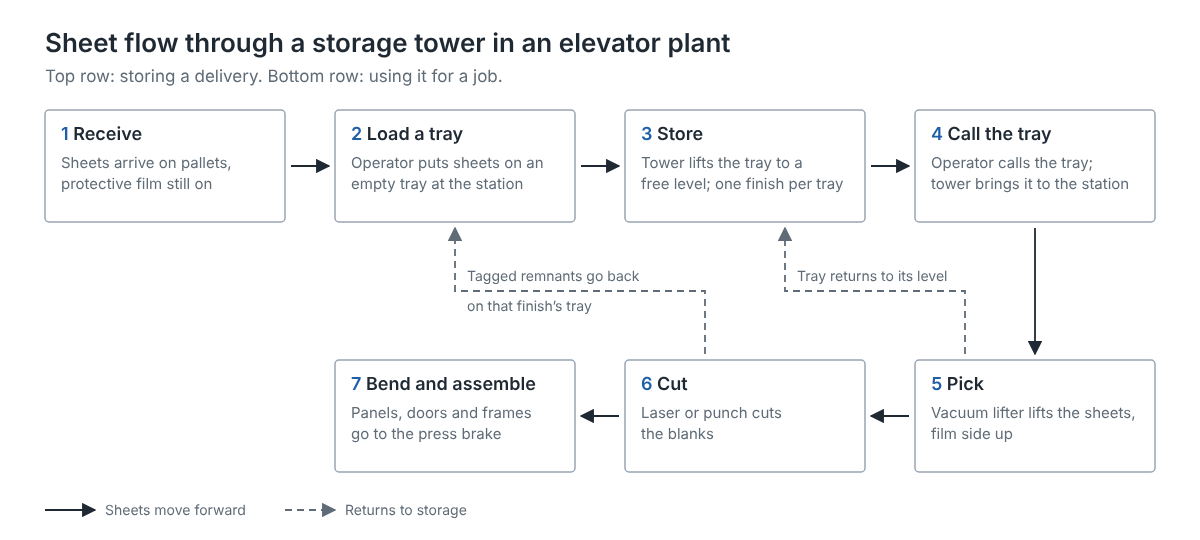
Remnants of a finish go back to that finish’s tray, with a tag, so the next job can use them first.
A typical day runs like this. Deliveries are put onto empty trays at the station and stored by finish. When a job is released, the operator calls the tray, takes the sheets with a vacuum lifter for sheet metal, and sends the tray back up. Remnants of polished or patterned stainless are worth too much to scrap, so they go back to their own tray, tagged, and the next job draws from them first. Towers can also be linked to automatic loading on the laser, which is designed per project.
Sizing the tower
On the towers we build at CK Metal Storage Solutions, each tray is rated up to 5,000 kg (11,000 lbs), and towers go up to 8 m (26 ft) tall. Height sets the tray count. As our article on what fits under your ceiling height explains, rack height is roughly your clear height minus 500 mm (20 in). A 5 m (16 ft) rack for 3000 × 1500 mm sheets holds about 14 trays, and an 8 m rack about 26.
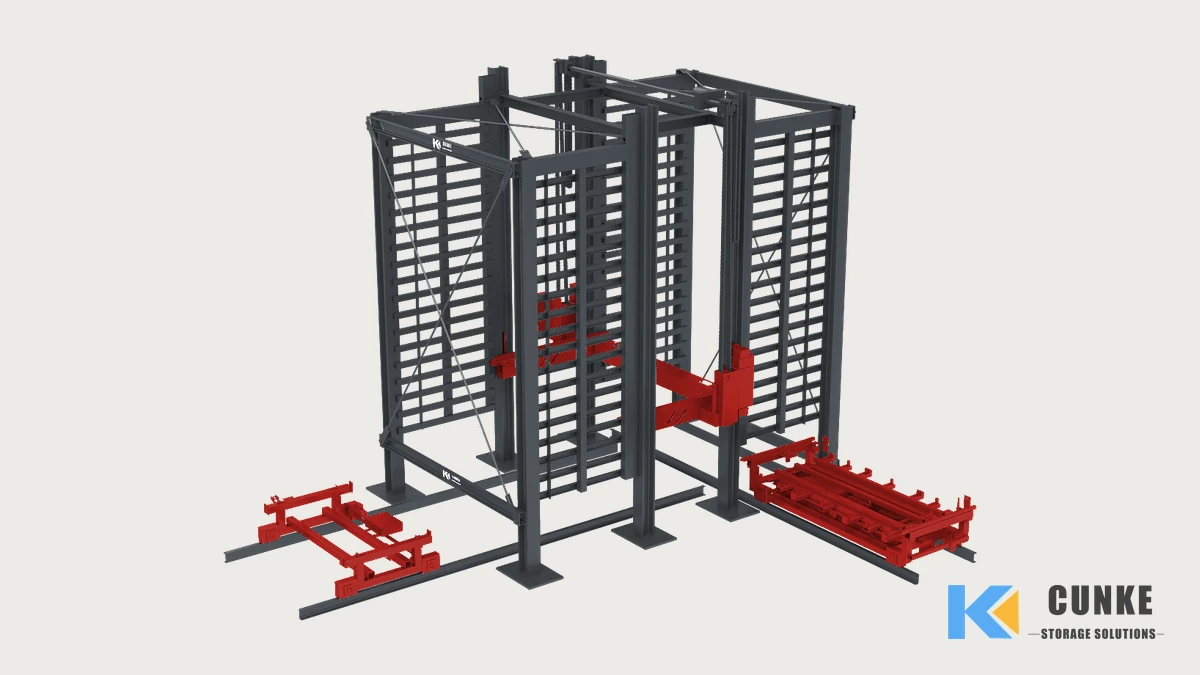
Twin columns share one lift, with a loading cart on each side. Rendering in an alternative color scheme.
Two practical checks follow from the count above:
- If your finish list needs more trays than one tower holds, a twin-column tower or two towers usually beats squeezing finishes onto shared trays.
- If the structural plate also has to go in, size those trays for weight, not count, and keep them on separate levels from the stainless.
A full tower is heavy. Have a structural engineer check the slab, and plan for a three-phase power supply. The comparison of a motorized rack and an automated sheet tower covers when a tower is worth it over a powered drawer rack.
When a tower is not the answer
A tower needs clear height, usually at least 4.5 m (15 ft), and a budget to match. If you stock fewer than a dozen finishes and cut a few panels a day, a roll-out sheet rack with one finish per drawer does the same job at floor level. Its drawers roll fully out, so a vacuum lifter picks from above without touching the sheets in other drawers.
For structural steel up to 25 mm, weight is the issue rather than finish. Heavy-duty roll-out drawers rated at 3,000–5,000 kg (6,600–11,000 lbs) handle it well, and they keep that plate out of the stainless area.
Frequently asked questions
What thickness of stainless steel is used for elevator panels?
One elevator builder’s cabins use 2 mm stainless sheet, and thin decorative stainless around that thickness is common for car walls and doors. Car frames and brackets use thicker galvanized or structural steel, up to 25 mm in that plant.
How should finished stainless sheets be stored?
Store them flat, indoors, with the protective film left on until processing. Keep them away from carbon steel racks, tools and slings, and lift them with a vacuum lifter or synthetic slings.
Can different stainless finishes share one storage tray?
They can, but you then have to lift one finish off another to reach the sheet below, which risks scratches. One finish per tray is the safer default.
Can a storage tower be run by hand during a power cut?
No. Our automated towers are not designed for manual operation without power, so plan stock for urgent jobs accordingly.
Next step
Send us your list of finishes, thicknesses and sheet sizes, with a rough count of sheets per item, and your clear height. We will work out how many trays you need and whether a tower or drawer racks make more sense. You can reach us through our contact page.