
An A-frame sheet metal rack stores sheets on edge, leaning against a central spine, and you take them out by hand. A roll-out sheet rack stores sheets flat in steel drawers that roll fully out of the frame, so a crane or vacuum lifter picks the sheet straight up. The choice comes down to sheet weight: if one person can carry the sheet safely, an A-frame works; if it takes a lifter, you want the sheets lying flat.
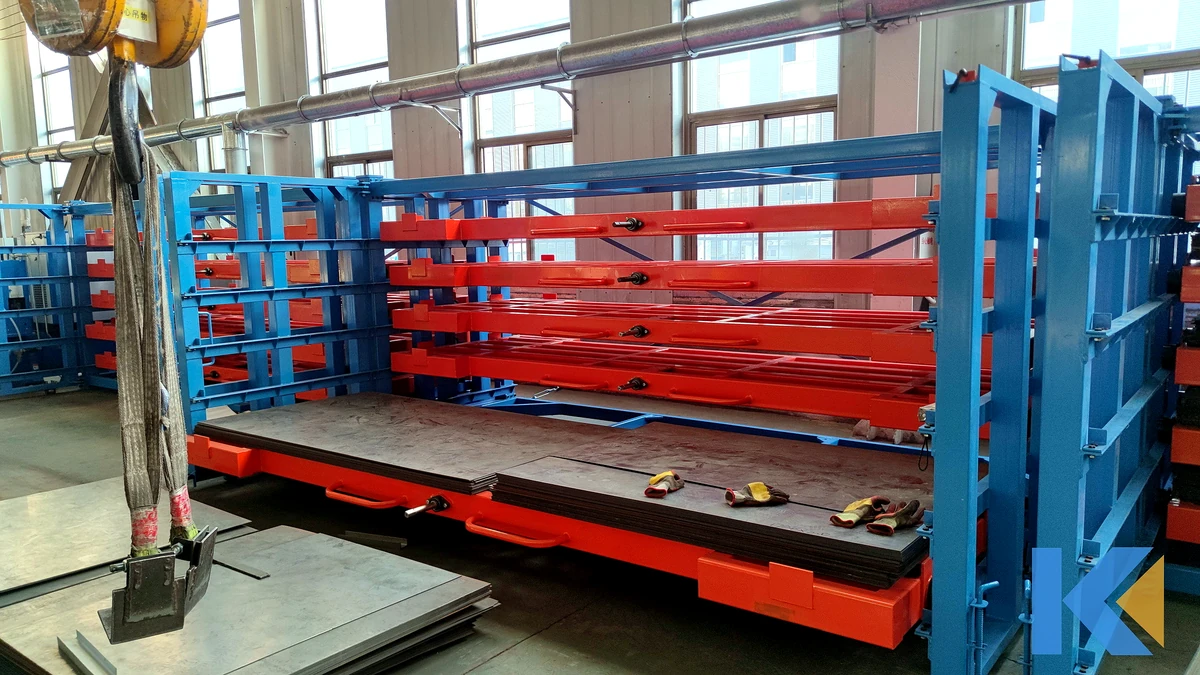
The lowest drawer is fully out, so the crane can reach every plate from above.
How each rack holds the sheet
On an A-frame, sheets stand nearly upright on a base ledge and lean on a center spine, usually with dividers to keep sizes apart. It is a simple welded frame with no moving parts, which is why it costs little and needs almost no upkeep.
A roll-out rack is a frame with horizontal drawers stacked above each other. On the roll-out sheet metal rack we build at CK Metal Storage Solutions, you turn a removable crank and a gear drive rolls the drawer completely out of the frame. Nothing sits above the open drawer, so the crane hook comes straight down onto the sheet you want.
Sheet weight decides most of it
Hand handling is where A-frames work well and where they stop working. The NIOSH lifting equation, used in the US to judge manual lifts, starts from a load constant of 23 kg (51 lb) under ideal conditions. Every less-than-ideal factor lowers that figure. A long sheet held at arm’s length while you tip it off a rack is far from ideal.
Now look at what steel sheets weigh (7.85 g/cm³, so 1 m² at 1 mm thick is 7.85 kg):
| Sheet size and thickness | Weight of one sheet | Handled by |
| 1250 × 2500 mm (4 × 8 ft), 1 mm (19 ga) | 24.5 kg (54 lbs) | One person, at the limit |
| 1250 × 2500 mm (4 × 8 ft), 2 mm (14 ga) | 49 kg (108 lbs) | Two people |
| 1500 × 3000 mm (5 × 10 ft), 1.5 mm (16 ga) | 53 kg (117 lbs) | Two people, awkward size |
| 1500 × 3000 mm (5 × 10 ft), 3 mm (11 ga) | 106 kg (234 lbs) | A lifter |
| 1500 × 3000 mm (5 × 10 ft), 6 mm (1/4 in) | 212 kg (467 lbs) | A crane or vacuum lifter |
| 1500 × 3000 mm (5 × 10 ft), 10 mm (3/8 in) | 353 kg (779 lbs) | A crane |
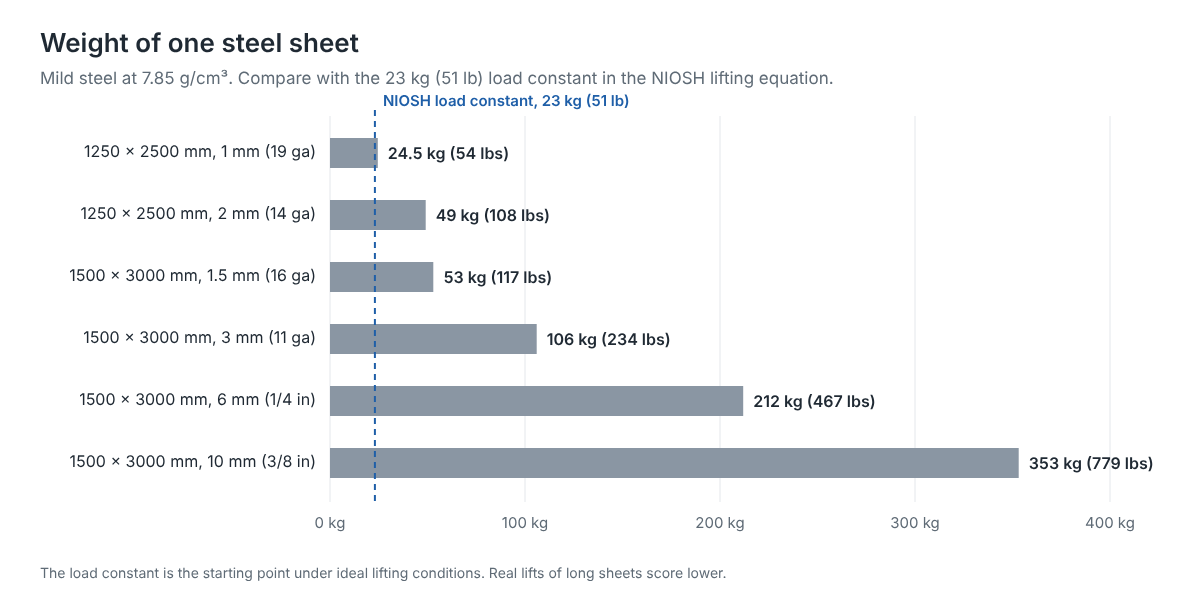
Only the thinnest 4 × 8 ft sheet sits near the 23 kg starting point of the NIOSH lifting equation.
Only the lightest row is a one-person sheet. From 3 mm (11 ga) on a 5 × 10 ft sheet, you need equipment, and that is where the A-frame runs into trouble. Most vacuum lifters and magnets grip a sheet lying flat. To lift a sheet standing on edge, you need a vertical plate clamp, and the sheet still has to be laid flat somewhere before it goes on a cutting table.
Where the time goes on an A-frame
The sheet you want is often behind other sheets of the same size. You lean the front sheets forward, slide yours out, then push the others back. With 1 mm aluminum that takes a minute. With 3 mm steel, it takes two or three people holding a heavy sheet at an angle. The sheets also rub against each other on the way out, which scratches coated or polished surfaces.
On a roll-out rack, the drawer comes out and every sheet on it is visible from above. You still lift from the top of the stack, so it pays to keep one material per drawer. But you never move a whole stack to reach a drawer below it.
Capacity and floor space
A-frames and bay-style upright racks are rated per side or per bay. One common catalogue bay rack, for example, is rated 1,500 lbs (680 kg) per bay. That suits light stock that moves often. A single pallet of 1500 × 3000 mm sheets in 6 mm plate, 20 sheets high, already weighs about 4,240 kg (9,350 lbs).
Our standard roll-out models for 3000 × 1500 mm (10 × 5 ft) sheets carry 3,000 kg (6,600 lbs) per drawer. They have 5 to 8 drawers in a frame 2,200 mm (7.2 ft) tall. The 6 m (20 ft) models carry 5,000 kg (11,000 lbs) per drawer. A 5-drawer model with doors closed takes 3620 × 1990 mm (11.9 × 6.5 ft) of floor, about 7.2 m² (78 sq ft). Fully loaded, that is 15,000 kg (33,000 lbs) on 7.2 m², roughly 2,080 kg per m² (426 lbs per sq ft), so check the slab before you order.
Plan for the drawer stroke too. With a drawer rolled out, the same rack needs 3,400 mm (11.2 ft) of depth, so keep about 1.4 m (4.6 ft) clear in front of it. An A-frame needs open floor on both faces as well, because you walk each sheet out sideways.
A-frame sheet metal rack: when it is the right call
We do not build A-frames, but we still recommend them when they fit. An A-frame sheet metal rack makes sense if:
- most of your stock is 4 × 8 ft or smaller and 1.5 mm (16 ga) or thinner
- you store aluminum, plastic or composite panels that people move by hand or on a cart
- you have no overhead crane or jib crane over the storage area
- you need a low-cost rack next to a press brake for a short list of sizes
If your shop runs 3 mm (11 ga) and thicker on a laser, an A-frame turns every sheet change into a team lift.
Roll-out vs. pull-out: two different racks
Drawer racks come in two types, and the load rating is what separates them. A pull out sheet metal rack has drawers you pull open by hand, rated up to 1,000 kg (2,200 lbs) per drawer. It suits thin sheet next to a laser, with up to 10 drawers and 80 mm (3.1 in) of clear height per drawer.
A roll-out rack uses the crank and gear drive, and that is what lets it handle 3,000–5,000 kg per drawer. With 3 tonnes on a drawer, turning the crank takes about 1.5 kg (3.3 lbs) of hand force. At 5 tonnes it takes about 4.5 kg (10 lbs). Our article on choosing between pull-out and roll-out racks goes through that decision in more detail.
If you still want to store sheets upright
Upright storage saves floor space and suits remnants of many sizes. If your sheets are too heavy to lift by hand, the alternative is a vertical sheet rack with crane-loaded frames. Each sheet stands in its own frame that slides out of the rack, and a crane with a C-hook lifts the whole frame. Our vertical rack takes up to 400 kg (880 lbs) per frame.
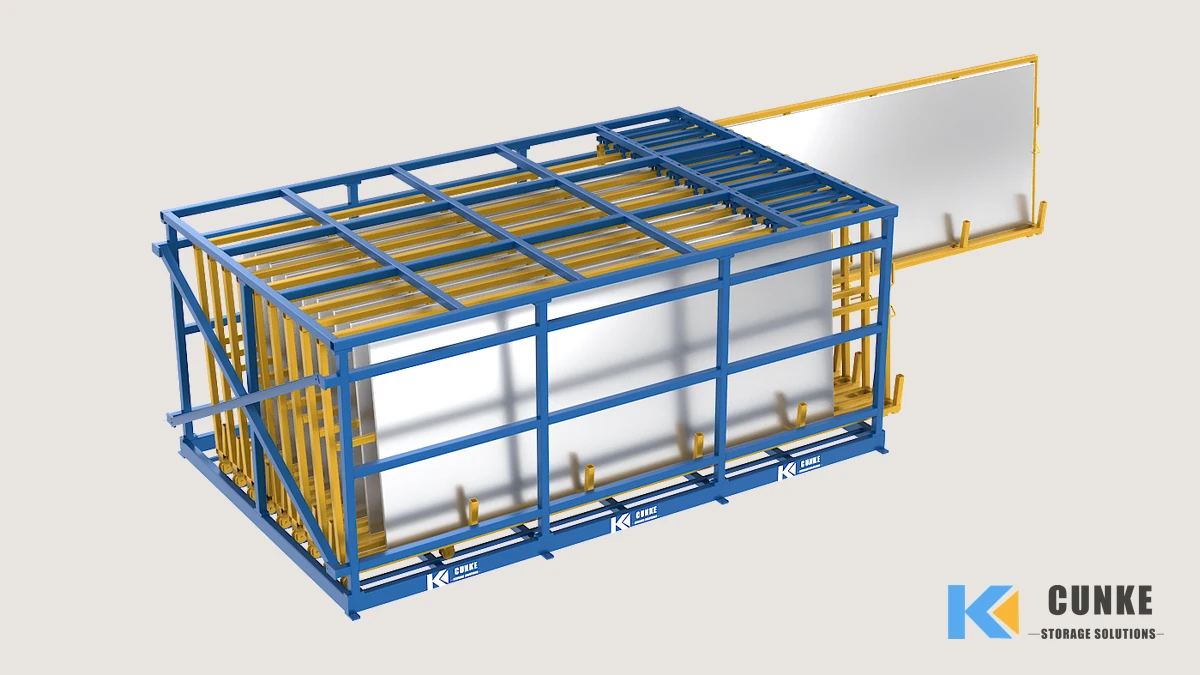
Each sheet stands in its own frame, so you slide out one frame instead of tipping sheets forward.
Sheets do not rub against each other in separate frames, and nobody has to hold a heavy sheet at an angle. For more on keeping stacks and racks stable, see our guide to storing sheet metal safely.
A quick way to decide
Pull your last three months of purchase orders. Count how many sheets were over 25 kg (55 lbs), using the table above. If that is most of them, plan on flat storage in drawers and a lifter. If it is a handful, an A-frame for the light stock plus a few roll-out drawers for the heavy plate is often the cheapest mix.
Frequently asked questions
Is an A-frame rack safe for steel sheets?
It can be for light sheets that people can handle by hand, if the rack is sized for the load and the base keeps sheet edges from sliding. For heavy plate, the risk is in handling, since people end up holding a sheet at an angle while moving others.
How much weight does a roll-out sheet rack hold per drawer?
Our standard models carry 3,000 kg (6,600 lbs) per drawer for 3000 × 1500 mm sheets and 5,000 kg (11,000 lbs) per drawer for 6 m (20 ft) sheets. A pull-out rack, opened by hand, is rated up to 1,000 kg (2,200 lbs) per drawer.
Can I use a vacuum lifter with an A-frame rack?
Usually not directly, because most vacuum lifters are built to pick sheets lying flat. Sheets on edge need a vertical plate clamp or must be laid flat first.
Does a roll-out rack take more floor space than an A-frame?
The roll-out frame itself is compact for the weight it holds, but you need about 1.4 m (4.6 ft) clear in front for the extended drawer. An A-frame also needs open floor on both faces to walk sheets out.
Sizing it for your stock
If you send us your sheet sizes, thicknesses and the number of sheets per size, we will tell you how many drawers you need and what the rack will weigh fully loaded. A photo of the floor area and the crane helps us check the drawer clearance and the hook reach.