
You handle long materials with fewer workers by cutting out the steps that need extra people, and in most shops that means the digging: a forklift driver and a helper moving three bundles to reach the fourth. Storage that brings the right bundle to the crane removes that work. Start with a roll-out cantilever rack, move to motorized levels when the loads or the number of picks go up, and go to an automated steel profile storage system when you no longer have the people to run the crane at all.
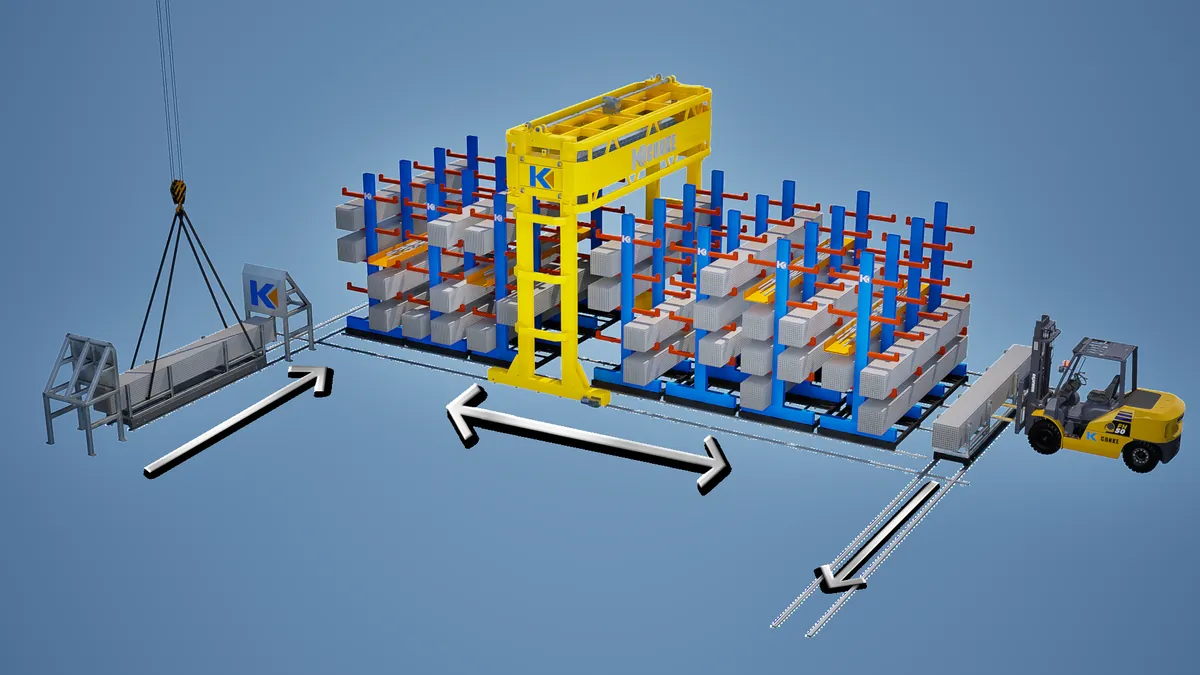
An automated steel profile storage system: the gantry brings each cassette to the loading station.
Why long materials eat so many labor hours
A 6 m (20 ft) bundle of tube can’t be carried by hand, and it can’t be picked from the middle of a pile. So every pick in a floor-stacked area turns into a small project. Someone finds the bundle, a forklift or crane moves whatever is on top of it, a second person guides and rigs the load, and then the pile gets rebuilt. One worker cuts parts while two others spend a quarter of an hour getting the material to the saw.
This is getting harder to staff. Deloitte and The Manufacturing Institute estimate that US manufacturing may need 3.8 million new workers between 2024 and 2033, and that about 1.9 million of those jobs could go unfilled if the skills gap isn’t closed (Deloitte Insights). If material handling depends on two of them being free at the same time, the saw or tube laser waits.
There is also a safety cost. OSHA requires stored material to be “stable and secure against sliding or collapse” (29 CFR 1910.176(b)). A pile of round bar that gets dug into and restacked several times a day is hard to keep that way, and short-staffed crews take more shortcuts.
Do the labor math for your own shop
Before you buy anything, work out how many person-hours your material handling takes each week. The formula is simple:
Weekly person-hours = picks per day × people per pick × minutes per pick × working days ÷ 60
Most shops estimate the minutes and forget the people. “People per pick” is the hidden multiplier. A 15-minute pick that ties up a forklift driver and a helper costs 30 minutes of labor.
Here is a worked example for a shop that pulls material 40 times a day, 5 days a week. The minutes are estimates from our own project experience. Replace them with numbers you time in your shop.
| Storage method | People per pick | Minutes per pick | Person-hours per week |
| Floor stack or fixed rack, forklift | 2 (driver + helper) | 15 | 100 |
| Manual roll-out cantilever rack, crane | 2 (one cranks, one rigs) | 4 | 27 |
| Motorized roll-out cantilever rack, crane | 1 | 1.5 | 5 |
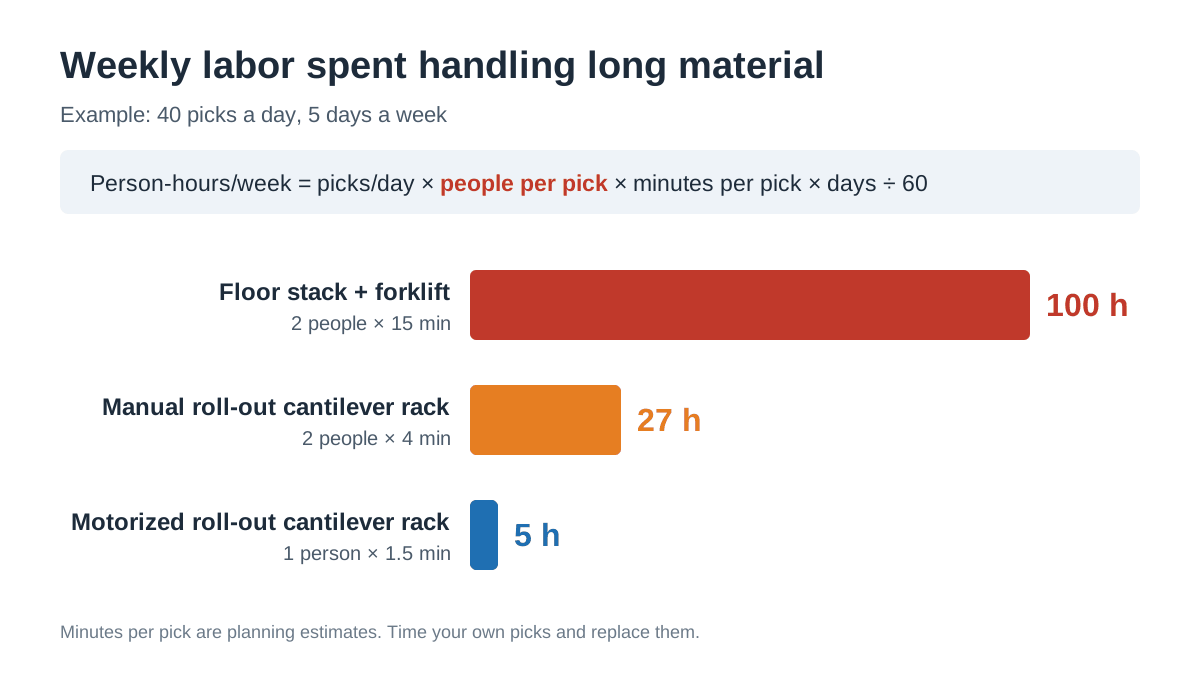
Example only: replace the minutes with times from your own shop.
Two things stand out. First, most of the saving comes from removing the digging, which happens at the first step up, before any motors are involved. Second, at 100 person-hours a week, the floor stack is using more than two full-time people just to move steel. In a shop that can’t hire, that is two people you can move to cutting, welding or assembly.
Step 1: Bring each level to the crane
A roll out cantilever rack stores each size of tube, bar or profile on its own level. The operator turns a crank, the level rolls fully out into the aisle, and the overhead crane lifts the bundle straight up. Nothing sits on top of anything else, so nothing has to be moved out of the way.
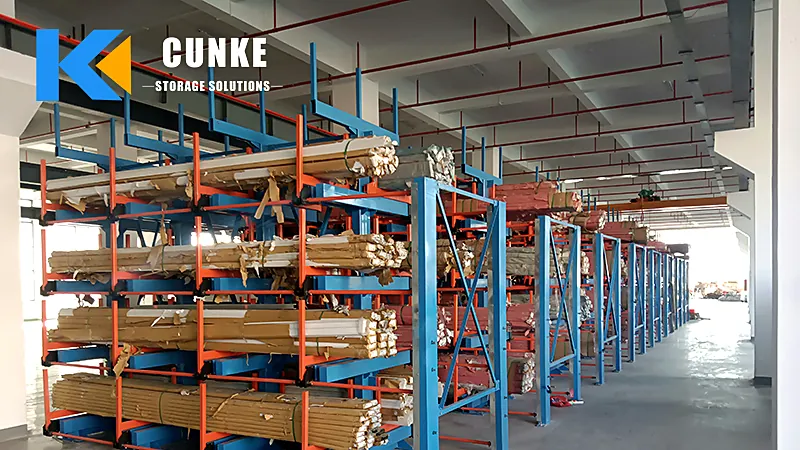
One size per level, so no bundle sits on top of the one you need.
What changes for your crew:
- No forklift in the rack. The crane does the lifting. Our racks need an overhead crane or a jib crane; without one, the level comes out but nothing lifts the material off it.
- Single-length picks. With the level fully out, the operator can take a single length and leave the rest in place.
- Labeled levels. Each level carries a label with the section, material, length and quantity, so nobody spends time searching.
Our standard roll-out cantilever racks take material up to 12 m (39 ft) long, at up to 750 kg (1,650 lbs) per arm. Data-sheet models are rated from 1,000 kg (2,200 lbs) per level on the light 6 m version up to 5,000 kg (11,000 lbs) per level on the 12 m version. The rack goes together with bolts, and installation usually takes one to three working days.
If you’re not sure whether you need a roll-out rack or a standard cantilever rack, our guide to cantilever rack vs. roll out cantilever rack starts with the one question that decides it: what you lift with.
Step 2: Motorize when the loads or the picks go up
A hand crank is easy on a light level. It gets slow and tiring when the levels are heavy and the picks are frequent. A motorized cantilever rack puts a motor and gearbox on each level, and the operator extends any level from a remote.
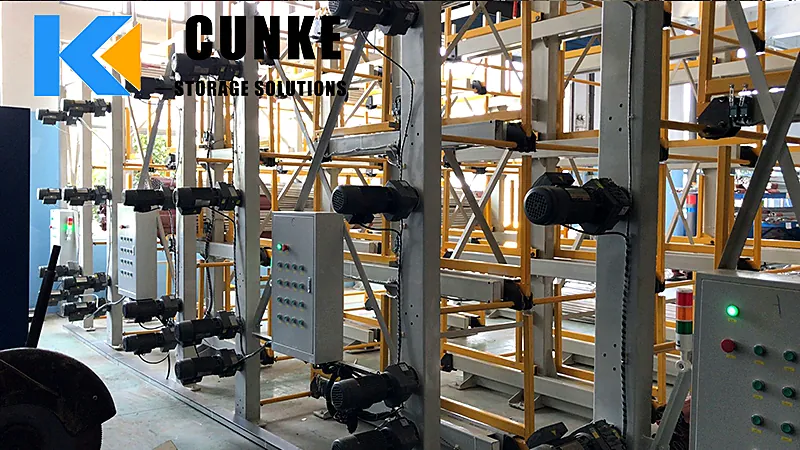
Each level of a motorized rack has its own motor and gearbox.
We recommend the motorized version when:
- a level carries more than about 3,000 kg (6,600 lbs), and especially at 5,000 kg (11,000 lbs) and up
- you pull material more than about 20 times a shift
- the rack feeds a tube laser or saw that you plan to load semi-automatically later
Below about 15 pulls a shift and under 3,000 kg per level, the manual rack usually does the job for less money. Our article on manual vs. motorized roll out cantilever racks goes through the trade-offs in more detail.
The labor benefit is that one person can run the rack from a safe distance, using the remote for the level and the pendant for the crane. Plan for power cuts, though. On the standard version, a level that is out when the power goes has to be pushed back by hand.
Step 3: Automate when nobody is free to run the crane
Roll-out racks still need someone at the crane for every pick. If your problem is that you don’t have that person on every shift, the next step takes the crane operator out of the loop.
An automated steel profile storage system combines cantilever racks with a gantry robot that runs on rails above them. Profiles are stored in cassettes. When an order comes in, the gantry finds the cassette, lifts it clear of the racks, carries it to the loading station and sets it down. The operator takes what the job needs, and the gantry returns the cassette.
What this changes for labor:
- One person at the loading station instead of a crane operator and a rigger in the aisles.
- The software does the searching. The warehouse management system (WMS) assigns locations, tracks stock and can pick first-in, first-out, so nobody walks the rows looking for a size.
- People stay out of the storage area. Light curtains and aisle sensors stop the system when someone enters the working zone.
Every system is designed for the site. In typical projects we’ve built, the gantry travels at up to 25 m/min (82 ft/min) and lifts at 6–8 m/min (20–26 ft/min), cassettes are around 6 m (20 ft) long and hold 500–1,000 kg (1,100–2,200 lbs), and a system holds around 190 to 200 storage positions. The racks can be fixed, or mounted on motorized mobile bases that open a single aisle where it is needed, which saves more floor space.
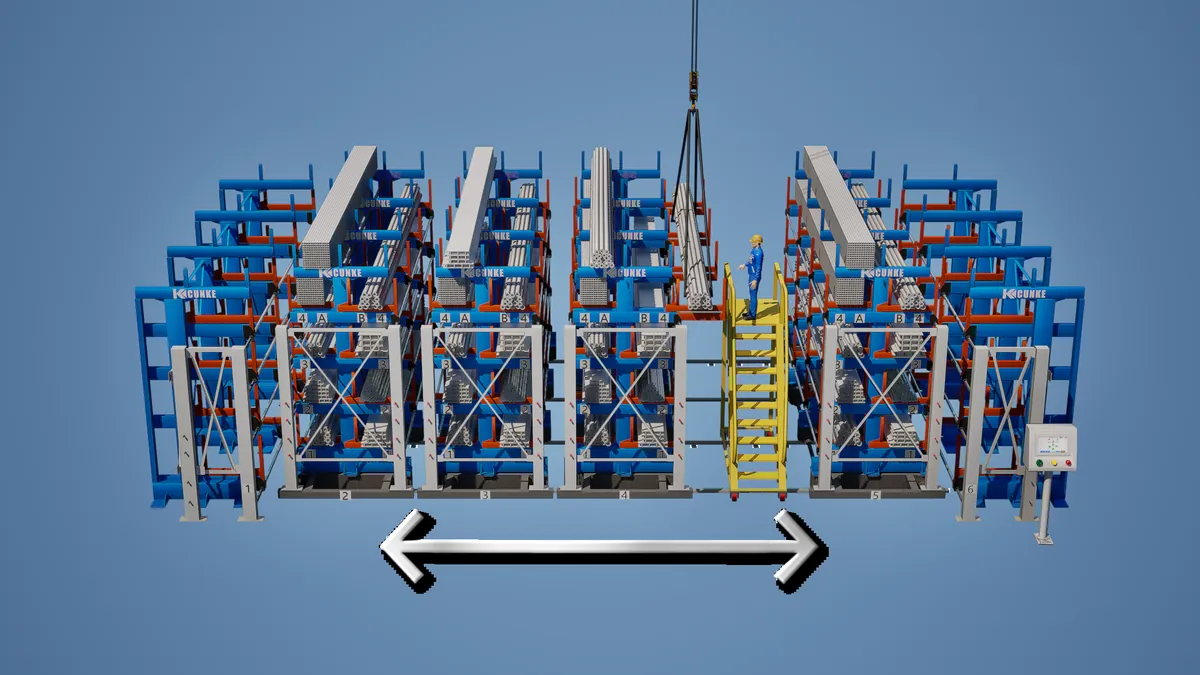
Racks on motorized mobile bases open one aisle where it is needed.
It is a bigger investment than a rack. The floor has to carry the rail and rack loads, and the layout has to be planned around your crane bays and loading points. It makes sense when you are short of people every week, and the gap isn’t going to close with the next hire.
Which step fits your shop?
| Your situation | Where to start |
| Floor stacks, a crane, fewer than about 15 pulls a shift, levels under 3,000 kg | Manual roll-out cantilever rack |
| Heavy bundles over 3,000 kg per level, or more than about 20 pulls a shift | Motorized roll-out cantilever rack |
| No crane operator on some shifts, many sizes, frequent small picks | Automated steel profile storage system |
| You only move full bundles in and out with a forklift | A fixed cantilever rack may be enough |
What doesn’t fix a labor shortage
Overtime moves the same wasted hours to a more expensive time of day. A second forklift needs a second driver, which is the person you couldn’t hire in the first place. And pushing people to work faster with long, heavy loads is how bundles get dropped and hands get caught. The hours come back when each pick has fewer steps.
FAQ
How many people does it take to pick long material from a roll-out cantilever rack?
Plan for one person to crank the level out and one to rig the load, with the overhead crane doing the lifting. On a motorized rack, one operator can extend the level with a remote and run the crane.
Do I need an overhead crane to reduce handling labor?
For roll-out cantilever racks, yes, or a jib crane. Without a crane, the level comes out but nothing lifts the material off it. An automated steel profile storage system has its own gantry, so it doesn’t depend on a shop crane for storage and retrieval.
When is a motorized rack worth it over a manual one?
When a level carries more than about 3,000 kg (6,600 lbs), or when you pull material more than about 20 times a shift. Below about 15 pulls a shift and 3,000 kg per level, a manual rack is usually enough.
How long does it take to install a roll-out cantilever rack?
Usually one to three working days. The rack is bolted together, no welding is needed, and it must be anchored to the floor.
How do I estimate the labor I could save?
Multiply picks per day by people per pick and minutes per pick, then by working days, and divide by 60. Do it for your current method and for the new one. Time a week of real picks rather than guessing.
Work out your own numbers
Send us your material lengths, the heaviest bundle per size, how many times a day you pull material, and whether you have an overhead crane. We’ll tell you which step fits, and send a free 3D layout of your storage area. Contact CK Storage.