
Here is how to store rebar so it stays straight, clean and easy to find: keep it off the ground on timber dunnage or racks, sort it by size, grade and length, and keep every bundle tag at the same end. For a yard that picks single sizes every day, a roll-out cantilever rack under an overhead crane lets you lift one size without moving the others. Floor stacks on dunnage still make sense for full bundles that ship out within days.
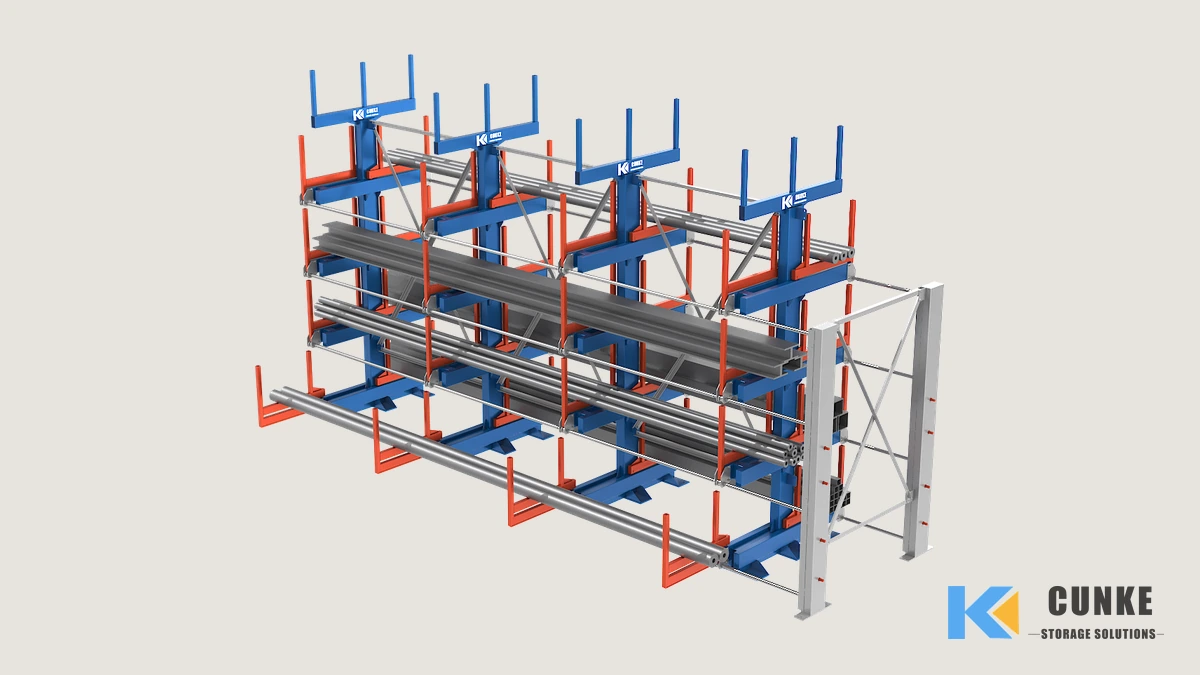
Rendering of a roll-out cantilever rack with different stock on each level.
The basics every rebar yard should follow
The Concrete Reinforcing Steel Institute’s handling and storage guidance comes down to a few habits:
- Put bundles on timbers, not on the ground, and keep them out of mud and standing water.
- Store straight bar by size and by length so it is easy to identify.
- Keep similar bent bars together.
- Keep all bar tags at the same end, and leave the tag with the bundle.
UK site guidance on protecting and storing rebar adds a number: keep bars at least 150 mm (6 in) above ground level, with enough support that they do not sag or bend. It also suggests a tarp or sheeting over bar that sits outside for a long time.
Sag is the one people underestimate. A long, thin bar laid across two widely spaced timbers droops between them, and a bar that has taken a set is hard to place. More support points along the length keep bars straight, which is one reason a rack, with an arm at every upright along the bar, works better than two pieces of dunnage.
Keep coated and stainless bar apart
Epoxy-coated, galvanized and stainless bar each need their own space, away from plain carbon-steel bar.
| Bar type | Storage and handling notes |
| Epoxy-coated | Use synthetic slings, never bare chains or cables; use spreader bars for long bundles; foam between layers protects the coating; avoid dragging bars. Do not flame-cut it; saw it and patch the cut ends. |
| Galvanized | Keep it away from uncoated bar and out of prolonged contact with wood, which can stain it. |
| Stainless | Keep it away from carbon steel; if space is tight, store it above other bar, never under it. Cover it when stored outside. |
The epoxy handling list comes from TheConstructor’s guide to handling reinforcing bars; the cutting advice is CRSI’s. Separate levels on a rack make this segregation easy, because each grade gets its own level and nothing rests on top of a different material.
How much does a rack level of rebar weigh?
Rebar fills a rack level by weight long before it fills it by volume. That changes how you plan the rack: work out the weight per level first, then the number of levels.
The nominal masses below are from the EN 10080 table for ribbed bar (US sizes are close: #4 is 0.668 lb/ft, #8 is 2.670 lb/ft). We used a 12 m (39 ft) bar and a level rated at 5,000 kg (11,000 lbs), which is what each side of a level on our 12 m roll-out cantilever rack carries.
| Bar diameter | Mass per meter | One 12 m bar | Bars per 5,000 kg level |
| 12 mm | 0.888 kg/m | 10.7 kg (23.5 lbs) | about 469 |
| 16 mm | 1.58 kg/m | 19.0 kg (41.8 lbs) | about 263 |
| 20 mm | 2.47 kg/m | 29.6 kg (65.3 lbs) | about 168 |
| 25 mm | 3.85 kg/m | 46.2 kg (101.9 lbs) | about 108 |
| 32 mm | 6.31 kg/m | 75.7 kg (166.9 lbs) | about 66 |
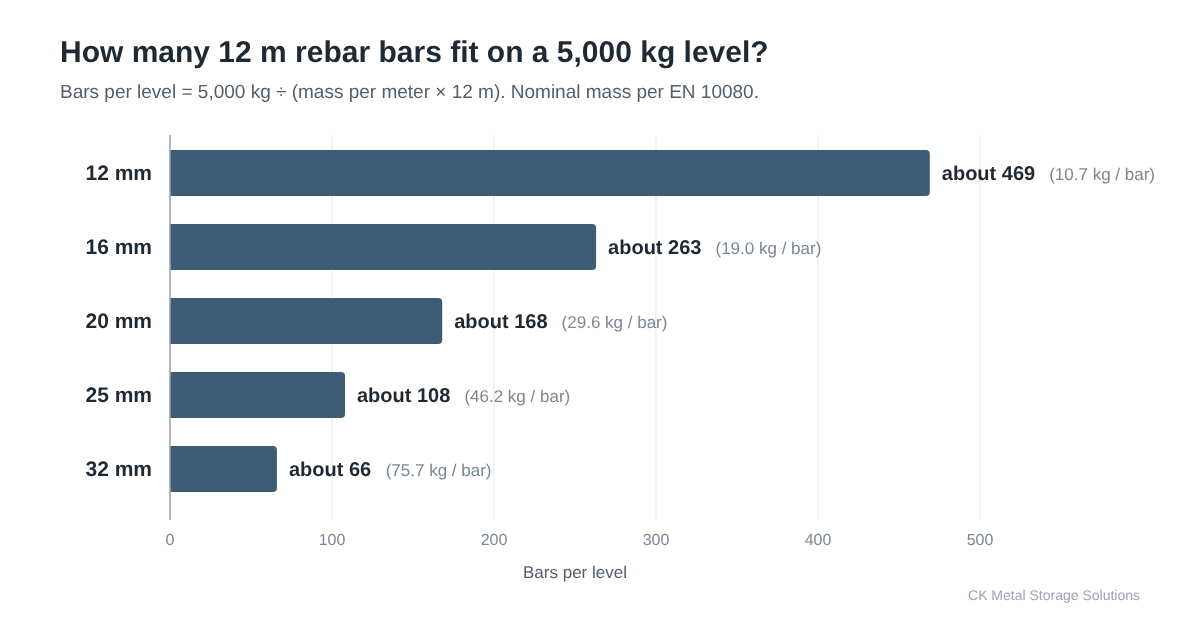
Bars per level at 5,000 kg, 12 m length. Weight, not space, sets the limit.
A level on our 12 m model is 600 mm wide and 400 mm high inside. Even loosely packed, sixty-six 32 mm bars take up less than a third of that space. That is why a “full” level can look half-empty, and why someone will always want to add one more bundle. Post the rated load on each level and weigh bundles against it, not against how much room is left.
To use your own numbers: bars per level = level rating ÷ (mass per meter × bar length). For 20 mm bar in 6 m lengths on a 2,000 kg level, that is 2,000 ÷ (2.47 × 6) = about 135 bars.
Floor stacks, fixed racks or roll-out racks?
Choosing a rebar storage rack comes down to how you lift bundles and how often you pick single sizes.
| Method | Works well for | Watch out for |
| Floor stacks on dunnage | Full bundles that ship within days | Digging out a bundle at the bottom; sag between timbers; crews climbing stacks to rig slings |
| Fixed cantilever rack with forklift or sideloader | Yards with long outdoor runs and wide aisles | Wide aisles for long loads; the forklift has to reach every arm |
| Roll-out cantilever rack with overhead crane | Indoor yards and fabrication shops that pick single sizes daily | Needs a crane or jib crane; not a fit for yards without one |
| Honeycomb rack | Many sizes of 6 m bar in a compact block | Cassettes are standard at 6 m; the longest we have built is 9 m, so it does not suit 12 m bar |
A roll-out cantilever rack from CK Metal Storage Solutions rolls one level fully out with a crank, so the crane lifts straight up without reaching past other material. Our standard models come in 6 m versions rated at 1,000–3,000 kg (2,200–6,600 lbs) per level and a 12 m version rated at 5,000 kg (11,000 lbs) per level on each side. Arms reach up to 900 mm (35 in) deep. If you don’t have an overhead crane, we don’t recommend this rack; a fixed rack served by a forklift is the better choice.
For short bar and many sizes, a honeycomb storage rack packs more SKUs into the floor area: each 6 m cassette holds 3,000 kg (6,600 lbs) and pulls out on its own. Our comparison of honeycomb racks and plug-in racks covers that choice in more detail.
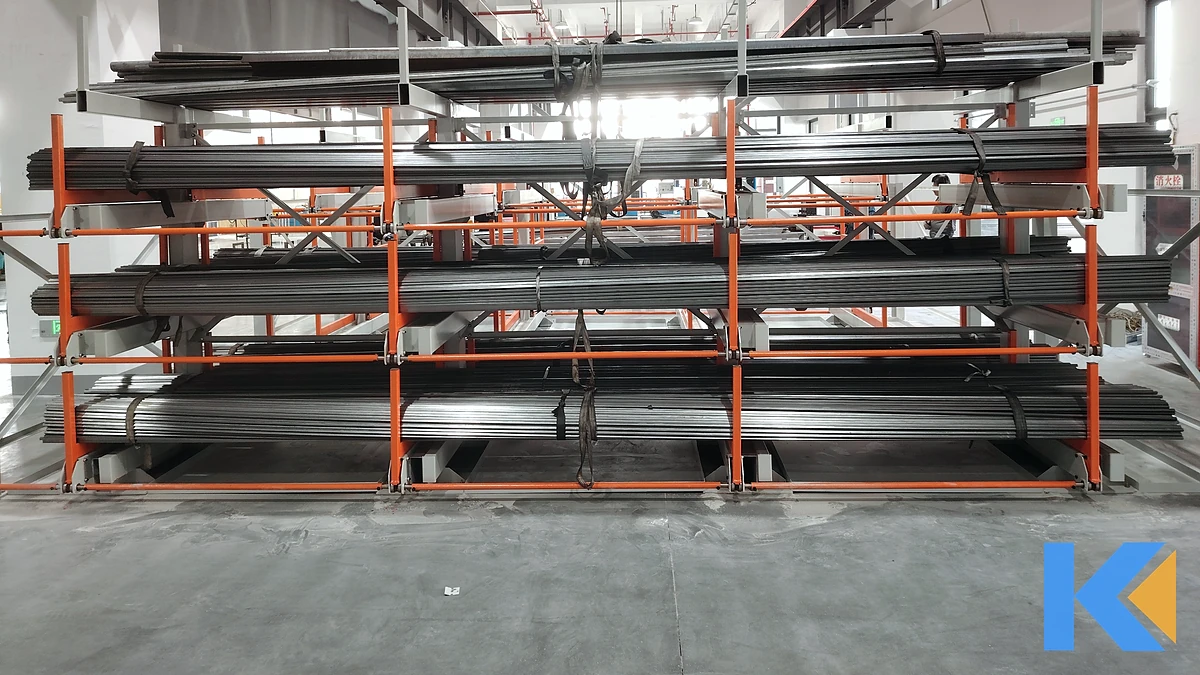
Long steel bar stored on separate levels of a roll-out cantilever rack.
How to store rebar outdoors
Most of the roll-out racks we build go indoors, under a crane. They can also go outside, with a galvanized finish instead of paint. Painted racks break down under rain, sun and salt air, which is why we recommend galvanized roll-out cantilever racking for outdoor storage, down to the bolts.
A galvanized rack protects the rack, not the bar. Rebar on an outdoor rack still needs sheeting if it will sit for a long time, and coated bar needs the same care outside as inside.
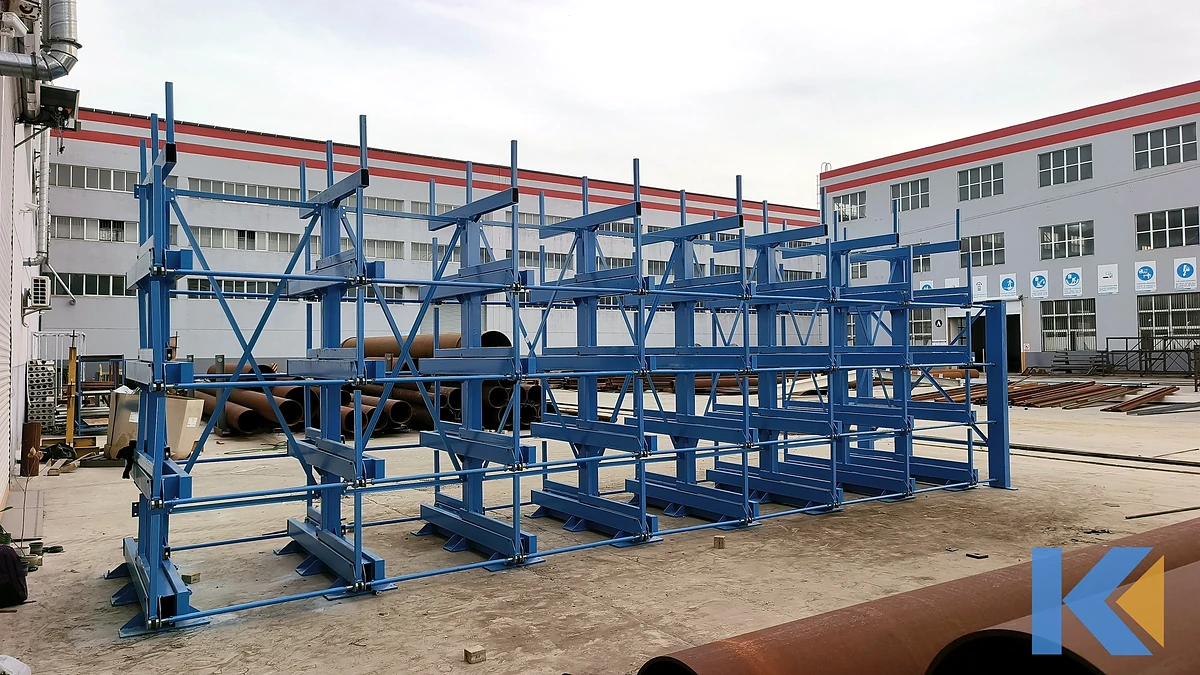
Roll-out cantilever racks installed in an outdoor yard.
Lifting rebar from the rack
Uncoated bar can be lifted with chains; lifting chains with hooks rigged at two points keep a 12 m bundle level. Coated bar goes on synthetic slings with a spreader bar. Either way, roll out one level at a time, step clear of the level and the crane path before the lift, and roll the level back once the bundle is up.
Frequently asked questions
How high off the ground should rebar be stored?
UK site guidance says at least 150 mm (6 in), on timbers or another non-metallic support. CRSI’s guidance is to keep bundles on timbers and away from mud and standing water.
Can rebar be stored outside?
Yes, on dunnage or a galvanized rack, but cover it if it will sit for a long time. Keep epoxy-coated and stainless bar covered and apart from plain bar.
How do you keep rebar from bending in storage?
Support it at more points along its length. Two timbers under a long bar let it sag between them; a rack supports it at every upright and keeps it straight.
How much rebar can one rack level hold?
Divide the level’s rated load by the weight of one bar. On a 5,000 kg level, that is about 108 bars of 25 mm in 12 m lengths.
If you’re planning rebar storage for a yard or fab shop, send us your bar sizes, lengths, tonnage per size and crane hook height. We’ll work out how many levels you need and send a layout with the rated load for each one through our contact page.