
A properly powder-coated industrial storage rack should pass five quality checks before it ships: dry film thickness (minimum 60 microns), cross-cut adhesion (Grade 0), impact resistance, oven cure tracking, and color consistency verification. These tests follow international standards and directly determine how long your rack’s finish will hold up in a real warehouse environment.
Why Powder Coating Quality Actually Matters
If you’re sourcing a pull-out sheet metal rack or a roll-out cantilever rack, the steel structure is only part of the story. The powder coating is what protects that steel every single day — from forklift scrapes, humidity, cleaning chemicals, and the general wear that comes with a working factory floor.
A coating that’s too thin will start to chip within months. One that wasn’t cured properly will fail at the first sign of impact. And if you can’t see the QC data, you have no way to know which one you got until it’s already on your floor.
This is why coating QC isn’t optional — it’s the last line of defense between a rack that lasts 10 years and one that starts rusting in two.
At CK Metal Storage, we run five tests on every batch before any unit ships. Here’s exactly what we check, and why each one matters.
The 5 Tests We Run Before Any Rack Leaves the Factory
Test 1 — Dry Film Thickness
The first thing we check is how thick the cured coating actually is.
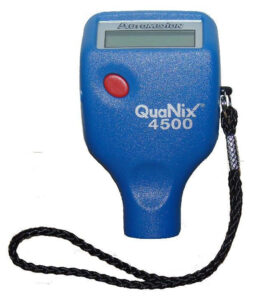
We use a digital dry film thickness (DFT) gauge, pressed directly against the coated surface. For our industrial sheet metal storage racks and cantilever racking systems, our internal standard is a minimum of 60 microns (2.4 mils). Most of our product batches land between 60–80 microns, which aligns with the international benchmark for industrial powder coating (ASTM D7091 / ISO 2178).
Why does this number matter? Below 50 microns, the corrosion barrier is genuinely compromised — moisture finds its way through, and rust can start forming from the inside out. At 60+ microns, you’ve got a coating thick enough to handle daily industrial contact and still protect the substrate underneath.
We measure multiple points on each part — not just the flat surfaces, but edges and corners too, where coating tends to be thinner.
Test 2 — Adhesion (Cross-Cut Test)
Thickness tells you how much coating is there. Adhesion tells you whether it’s actually holding on.
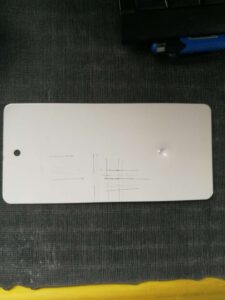
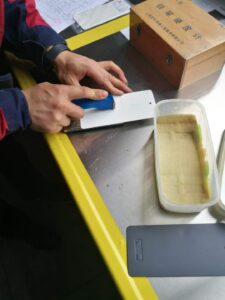
The cross-cut test (ISO 2409) is the industry standard method. We score a precise grid of 100 squares into the coating using a cross-cut tool, apply a standardized adhesive tape, press it firmly, then pull it off in one clean motion.
The result is graded on a 0–5 scale. Grade 0 means zero squares lifted — the coating is fully bonded to the metal surface. That’s our required pass standard on every batch.
If any squares peel, that’s a sign of inadequate surface prep, wrong powder chemistry, or a curing issue — and that batch doesn’t ship.
Test 3 — Impact Resistance
Even a perfectly thick, well-adhered coating can crack if it’s too brittle. That’s what the impact test catches.
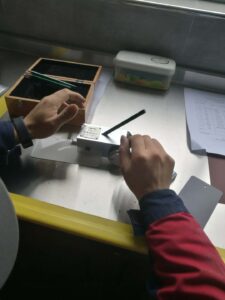
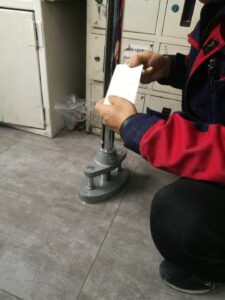
We use an impact tester (following ASTM D2794) to deliver a controlled, direct blow to the coated surface — simulating the kind of accidental knock a rack might take during loading or unloading. After the impact, we inspect the coating under magnification: no cracking, no peeling, no delamination at the impact point.
This test is especially relevant for our roll-out sheet metal racks and motorized cantilever racks, where loading and unloading creates repeated mechanical stress on the coated surfaces. A coating that looks fine on the line but shatters under impact is a quality problem that only shows up in the field — and by then it’s too late.
Test 4 — Cure Tracking
This one runs during production, not after it — and it might be the most critical test of all.
Powder coating only reaches its full mechanical and chemical properties when it’s cured at the right temperature for the right amount of time. Too cool or too short, and the coating stays under-crosslinked — it’ll look fine but won’t perform. Too hot or too long, and you get overbake: the coating becomes brittle and loses adhesion.
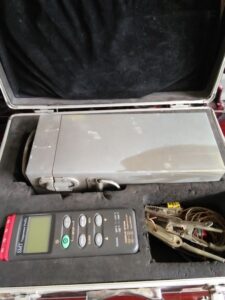
We run a cure tracker — a data logger that travels through the oven with the parts — on every single batch. It records the full temperature curve across the oven cycle and confirms that every part hit the target cure window.
This is something a lot of manufacturers skip because it adds time. We do it on every run because a failed cure is invisible to the eye and only shows up later as early coating failure.
Test 5 — Color Consistency
The last test is about consistency across batches.
We use a calibrated colorimeter alongside a standard light booth to measure the color of each batch against the approved reference. This matters more than it might seem: if you’re ordering 50 pull-out sheet metal racks across two production runs, any visible color drift between units will show up immediately on your floor and look unprofessional.
The colorimeter gives us precise ΔE (Delta E) readings — a numerical measure of color difference. We hold our batches to a tight ΔE tolerance so that your order looks uniform, regardless of when each unit was produced.

What These Numbers Mean for You as a Buyer
Here’s how to translate the test results into practical terms when you’re evaluating a supplier:
| Test | What to Ask For | Red Flag |
| Dry Film Thickness | Minimum 60 microns (2.4 mils) on industrial racks | No DFT data available, or results below 50μm |
| Adhesion | Grade 0 (ISO 2409) | Grade 2 or below, or no cross-cut test done |
| Impact Resistance | No cracking at test load (ASTM D2794) | Visual cracking visible after impact |
| Cure Tracking | Temperature curve records available per batch | “We monitor the oven” with no data to show |
| Color Consistency | ΔE within specified tolerance | No colorimeter used, visual-only check |
Any reputable manufacturer should be able to share QC data for these five points. If they can’t, that’s a meaningful signal about how their production is run.
FAQ
Q: What’s the minimum powder coating thickness for an industrial storage rack?
For industrial racking in a typical factory environment, 60 microns (2.4 mils) is the accepted minimum. Below that, the corrosion barrier isn’t reliable for daily industrial use. CK Metal Storage targets 60–80 microns across all products, including our sheet metal storage racks and cantilever racking systems.
Q: What does Grade 0 mean in the cross-cut adhesion test?
Grade 0 is the best possible result. It means zero coating squares lifted when the tape was removed — the coating is fully bonded to the metal with no delamination at all. Any result worse than Grade 0 (Grade 1 or above) indicates a bonding issue that should disqualify the batch.
Q: How does curing temperature affect powder coating quality?
If the oven temperature is too low or the cure time too short, the powder doesn’t fully crosslink — it looks fine but has poor adhesion and impact resistance. Overbaking causes brittleness. The exact cure window varies by powder chemistry and part geometry — cure tracking records confirm every batch hit the right target.
Q: How do I know a supplier’s powder coating actually meets these standards?
The most straightforward way is to ask directly: what’s your minimum DFT spec? Do you run cross-cut adhesion tests? How do you verify cure? A supplier who runs these tests properly will answer these questions without hesitation. At CK Metal Storage, our QC process covers all five tests on every production batch — feel free to ask us about our standards before placing an order.
Q: Does powder coating rust?
Powder coating itself doesn’t rust — it’s a polymer finish. But if the coating is too thin, improperly cured, or has poor adhesion, moisture can penetrate at weak points and cause the underlying steel to corrode. This is exactly why the five tests above matter: they verify that the coating will actually perform its protective function over time.
Q: How long does powder coating last on industrial racking?
A properly applied and cured powder coating on indoor industrial storage racks — like our roll-out sheet metal racks or motorized cantilever racks — can last 10–15 years under normal warehouse conditions. The main factors are coating thickness, adhesion quality, and how much mechanical contact the rack sees in daily use.
The Bottom Line
Powder coating looks the same whether it’s done right or done wrong — at least on day one. The difference shows up six months or two years later, when racks in one facility are still looking sharp and racks from a different supplier are already chipping and rusting at the corners.
The five tests above — thickness, adhesion, impact, cure, color — are what separate a coating that holds up from one that doesn’t. They follow internationally recognized standards and take time and equipment to run properly.
At CK Metal Storage, these aren’t optional checks. They run on every batch, for every product, before anything ships — whether that’s a single pull-out sheet metal rack or a full warehouse system.
If you’re sourcing industrial storage racks and want to see QC documentation before committing to an order, get in touch with us here. We’re happy to walk you through our process.
Related reading:
How to Find the Right Industrial Storage System for Your Workshop |
How to Choose Between a Pull-Out Sheet Metal Rack and a Roll-Out Sheet Metal Rack