
A roll-out sheet rack is made of six groups of parts: a bolted steel frame, the drawers that hold your sheets, the bearings and wheels they roll on, a removable crank and shaft that drive each drawer, two hinged doors that carry the drawer out past the frame, and the floor anchors. Knowing these roll-out sheet rack parts tells you what you’re paying for and where the rack can let you down. The two that buyers overlook most are the doors, because they decide your floor plan, and the drawer clearance, because it is rarely what limits how much steel you can store.
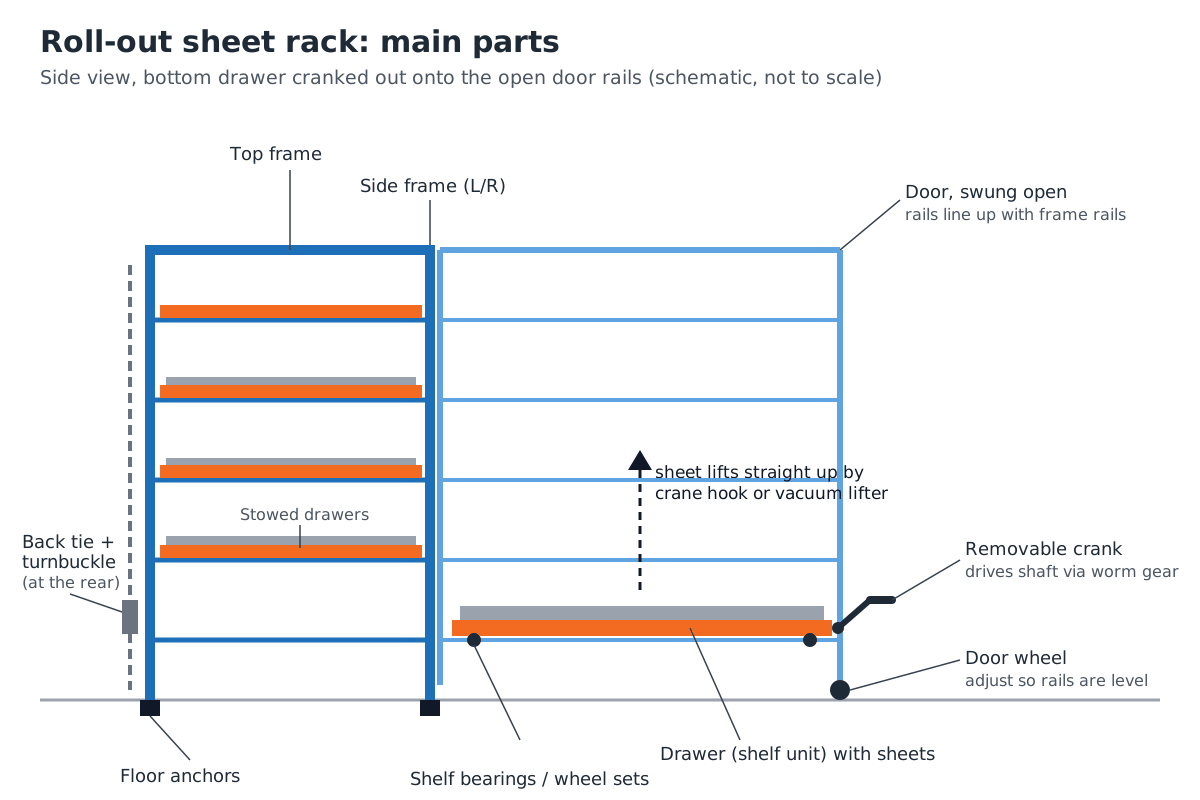
Main parts of a roll-out sheet rack, side view.
Roll-out sheet rack parts at a glance
| Part | What it does | What to check |
| Side frames, connecting shelves, back tie | Carry the rails and hold the rack square | Bolted kit that fits through your doors; back tie with a turnbuckle for squaring |
| Drawers (shelf units) | Hold the sheets, roll fully out | Rated load per drawer, inner size vs. your sheet size, lifting slots |
| Shelf bearings and wheels | Carry the loaded drawer along the rails | Smooth travel with a full load, no binding at the door joint |
| Crank and shaft | Turn a small hand force into drawer movement | Removable handle, effort at full load |
| Doors and door wheels | Swing open and extend the rails so the drawer clears the frame | Open-door depth, floor flatness in the swing path |
| Floor anchors | Hold the frame in place when a loaded drawer is rolled out | Anchor bolts included, fitted after the frame is square |
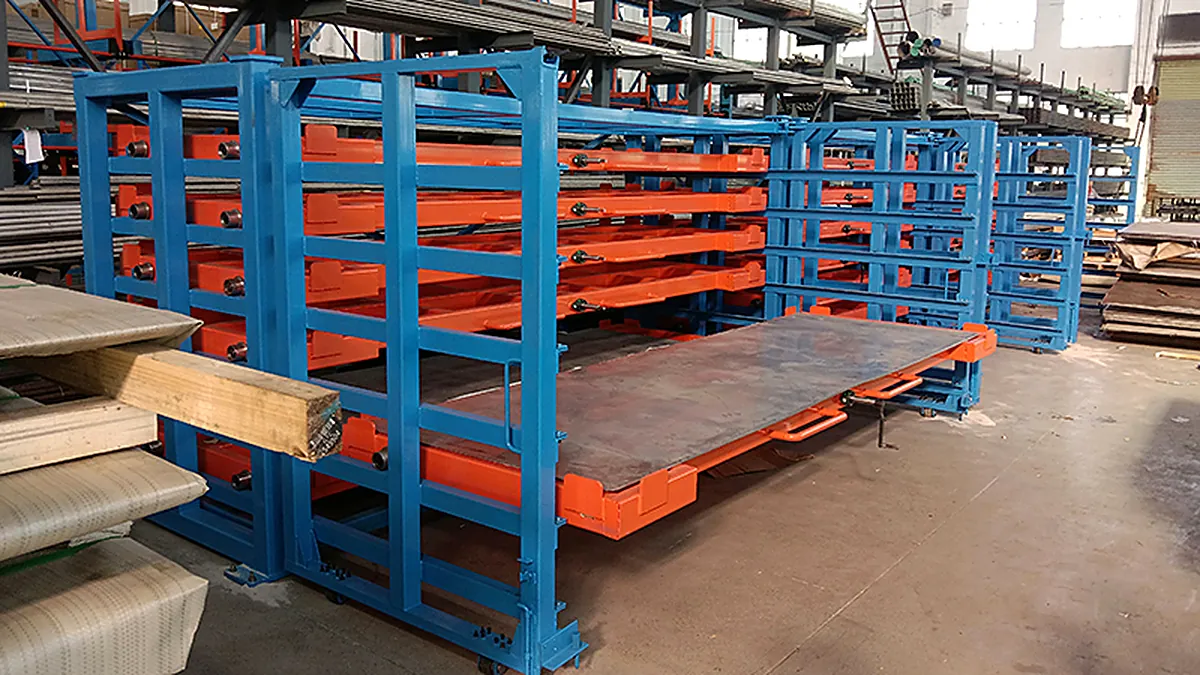
The drawer rolls completely clear of the frame, so the plate can be lifted straight up.
The frame: side frames, connecting shelves and back tie
The frame is two side frames joined by a connecting shelf at the bottom and a top frame or connecting shelf at the top. A back tie runs across the rear. On our racks, every frame joint uses six M10 bolts, and the installer leaves them loose until the back tie is fitted. The lower end of the back tie connects through a turnbuckle, which lets the installer tension it and bring the frame square before everything is tightened.
This matters more than it sounds. A frame that goes in slightly out of square makes every drawer run a little crooked, and you feel it as a drawer that drags halfway out. The frame ships as a bolted kit, so it fits through a normal shop door and goes together on site.
Drawers: what you actually load
Each drawer, which we call a shelf unit, is a welded steel frame with an open grid of crossmembers. Our standard 3,000 × 1,500 mm (about 5 × 10 ft) rack has drawers with a 3,100 × 1,580 mm (122 × 62 in) inner size, rated at 3,000 kg (6,600 lbs) each. The 6 m version takes 6,000 × 1,500 mm sheets at up to 5,000 kg (11,000 lbs) per drawer.
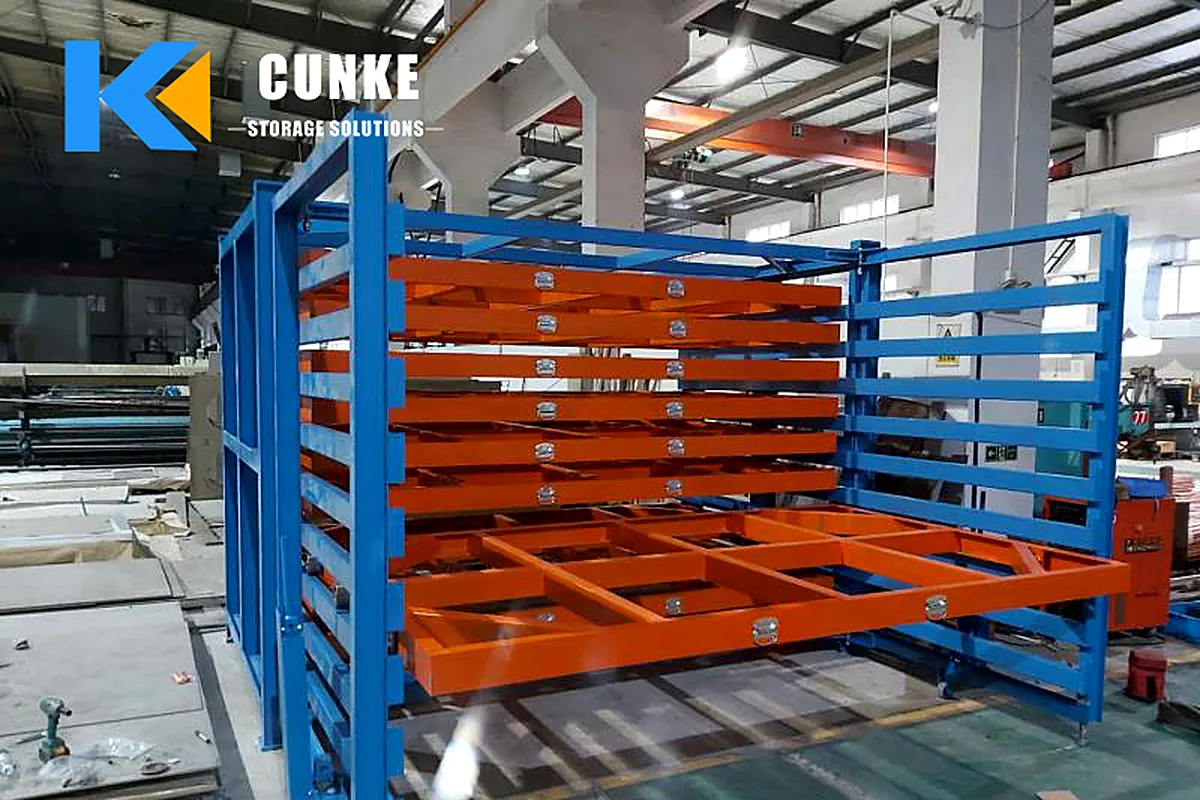
An empty drawer: a welded steel frame with an open grid of crossmembers.
How sheets get onto the drawer is designed into the drawer itself. For lifting chains with hooks, our drawers are wider at the ends than in the middle so the chains can be pulled back out. For straps or wire rope, a 40 mm attached beam leaves room for the strap to slide out. For forks, an 80 mm beam leaves room for the forks to slide out from under the bundle.
Weight runs out before height does
Most buyers pick drawer clearance by eye. Run the numbers first. Steel weighs about 7.85 kg per square meter for every millimeter of thickness, so a 1,500 × 3,000 mm sheet weighs about 35 kg per mm:
| Sheet (1,500 × 3,000 mm) | Weight per sheet | Sheets at 3,000 kg | Stack height |
| 3 mm (about 11 gauge) | 106 kg (234 lbs) | 28 | 84 mm (3.3 in) |
| 6 mm (about 1/4 in) | 212 kg (467 lbs) | 14 | 84 mm (3.3 in) |
| 10 mm (about 3/8 in) | 353 kg (778 lbs) | 8 | 80 mm (3.1 in) |
Whatever the thickness, a full 3,000 kg drawer of full-size sheets is only about 85 mm (3.3 in) tall. Our 3 m models come with drawer clearances from 100 mm (8 levels) to 250 mm (5 levels). On the 100 mm version, weight and height run out at about the same time. On the 250 mm version, the drawer reaches its rated load with roughly 165 mm (6.5 in) of space still empty.
That extra space isn’t wasted if you need it for wooden runners, a bundle still on its pallet, or room for a lifting magnet to get in. If you don’t, choose the version with more levels and keep the steel you would have stacked on top.
Bearings and wheels: where the load rides
The drawer rolls on shelf bearings and front and rear wheel sets that run in rails on the side frames. These are the parts that actually carry 3 tons back and forth, so they’re the ones to test before you sign off on an installation. A fully loaded drawer should roll out and back with an even effort. If it catches at the same point every time, check the joint between the door rails and the frame rails first, because the two have to be completely level.
Keep dust, cutting slag and oil off the rails, lubricate the slides, and check for worn wheels during routine inspections.
Crank and shaft: why one person can move 3 tons
This is the part that makes it a roll-out rack. A removable crank fits into a socket on the front of the drawer. Through a worm gear and gear reducer, the crank turns a shaft that rolls the drawer along its rails. On our racks, moving a fully loaded 3,000 kg drawer takes about 1.5 kg (3.3 lbs) of force on the handle.
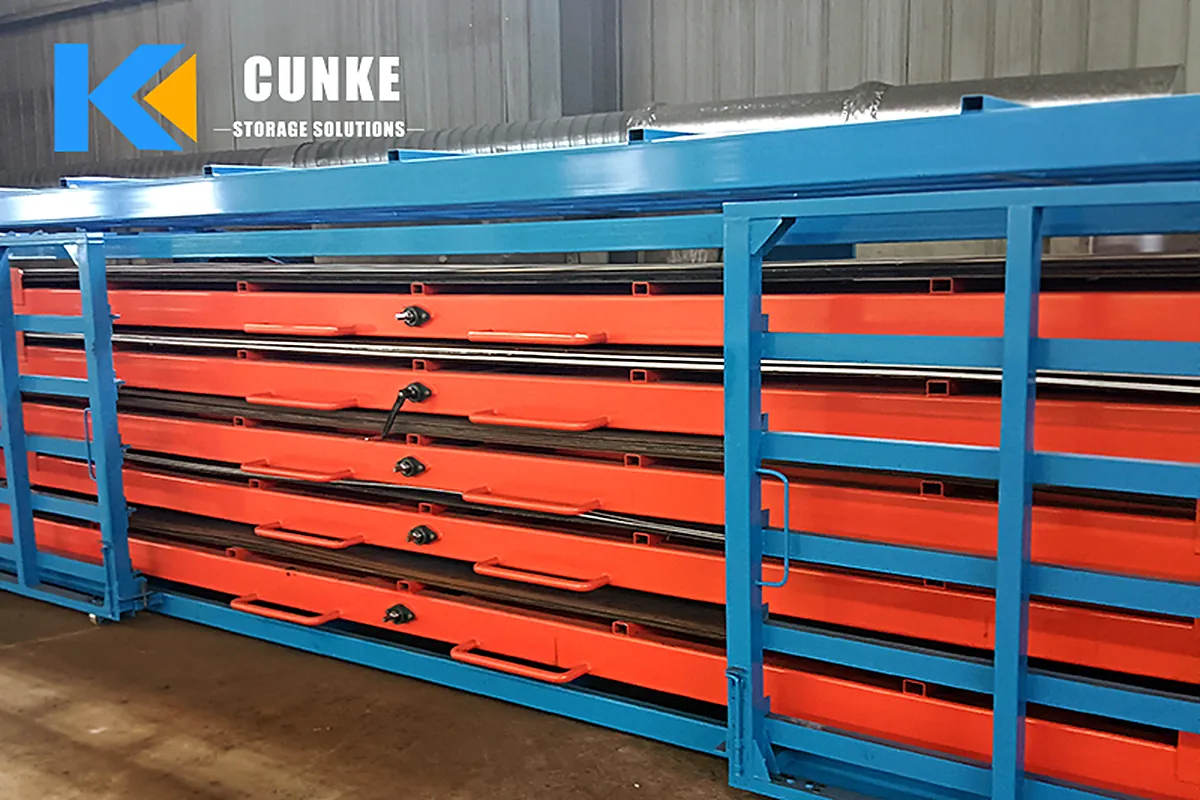
One removable crank serves every drawer. At a full 3,000 kg load it takes about 1.5 kg (3.3 lbs) of force.
The crank comes off for a reason. One handle serves every drawer, and with no handle left in a socket, nobody can bump a drawer open by walking past or catch a sleeve on it.
A pull out sheet metal rack skips the crank and gear set and is pulled by hand. That keeps it simpler and lets it fit up to 10 levels, but it limits the load: our pull-out racks are rated up to 1,000 kg (2,200 lbs) per level. When a level has to carry more than that, the crank-driven roll out sheet metal rack takes over, at 3,000 kg (6,600 lbs) per drawer on the 3 m models and 5,000 kg (11,000 lbs) on the 6 m models. Above that, a motorized sheet metal rack replaces the crank with a motor and remote, rated up to 8,000 kg (17,600 lbs) per level. If you’re weighing the first two against each other, our guide on choosing between a pull-out and a roll-out sheet metal rack walks through the load and effort numbers.
Doors and door wheels: the part that sets your floor plan
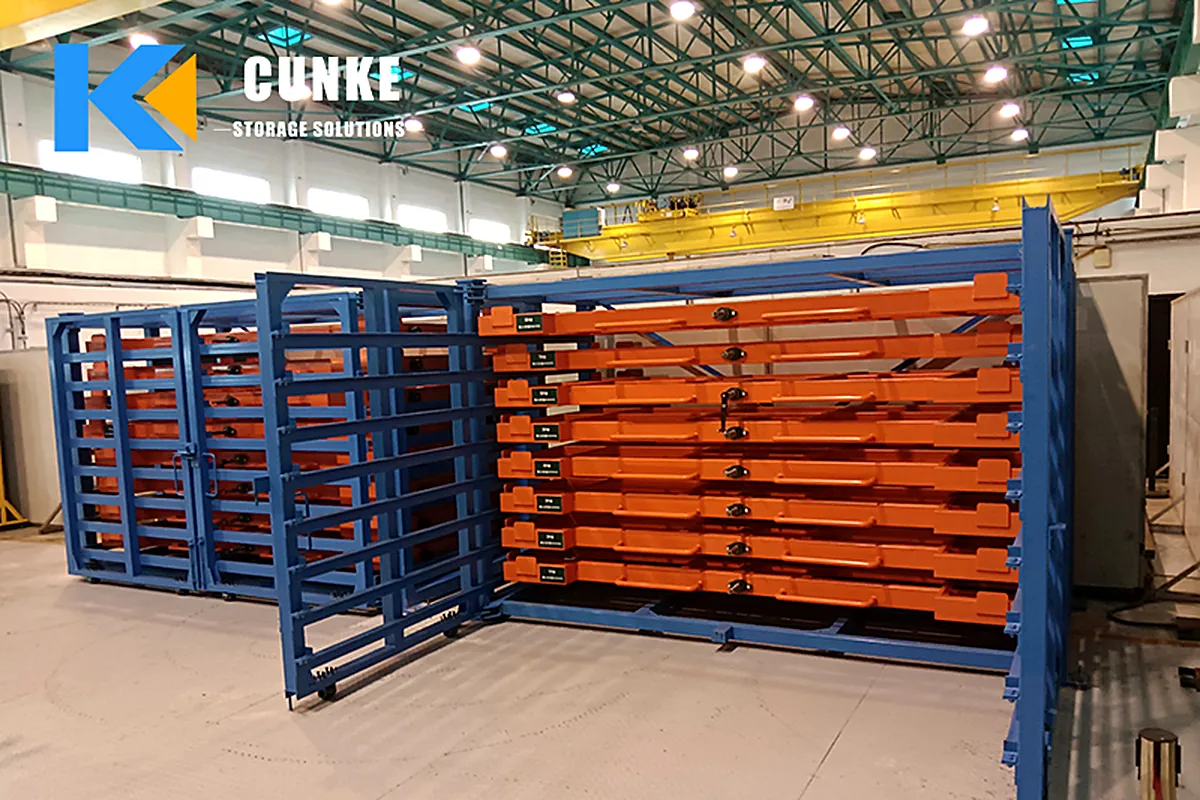
The front of the rack closes with two hinged doors. When you open them, each door swings out and its rails line up with the rails on the side frames. That lets the drawer roll completely outside the frame, so a crane hook or vacuum lifter can come straight down onto any sheet. The outer end of each open door sits on door wheels. During installation, the door wheels are adjusted until the door rails and frame rails are completely level.
Here is the number to plan around. Our standard 3 m roll-out rack is 1,990 mm (6.5 ft) deep with the doors closed and 3,400 mm (11.2 ft) deep with the doors open. Keep about 1,410 mm (4.6 ft) of floor clear in front of the rack, then add room for the person running the lifter.
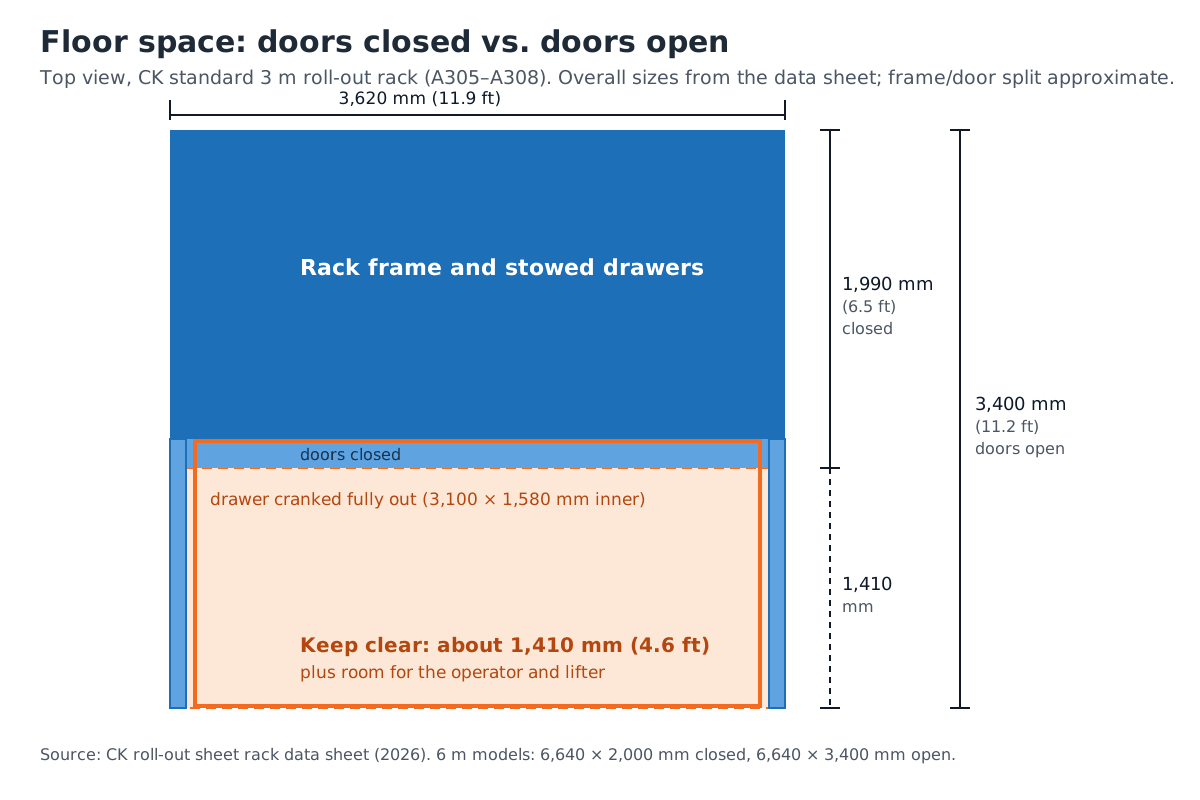
The floor in that swing zone matters too. If the floor dips where the door wheels sit, the door rails drop below the frame rails and the drawer bumps at the joint every time. Check that area with a level before the rack goes in.
Floor anchors
The anchors go in last, after the frame is square and the doors are set. Don’t skip them. A loaded drawer rolled fully out puts a lot of weight far in front of the frame.
OSHA’s general rule on material storage is that it “shall not create a hazard” and that stored material must be “stable and secure against sliding or collapse” (29 CFR 1910.176(b)). A rack that is bolted down, loaded within its rating and opened one drawer at a time is how you meet that in daily use.
Options that change the parts list
- Fixed top shelf: replaces the standard top frame with a shelf for parking sheets temporarily.
- Fork or strap slots: cut into the drawer so you can load bundles that arrive without a pallet.
- Double-sided access doors: load from one side, pick from the other.
- Motorized upgrade: a motor drive in place of the crank.
- Color: any standard RAL color, at no extra charge.
When a roll-out rack is the wrong set of parts
If you don’t have an overhead crane or a jib crane with a vacuum lifter, the drawer comes out but nothing lifts the sheet off it. Sort out the lifting first. If your heaviest level stays under 1,000 kg (2,200 lbs) and you change sheets often, a pull-out rack does the same job with fewer moving parts. If you move whole bundles in and out with a forklift and never pick single sheets, a forklift-loaded rack is the better fit.
FAQ
How much weight can each roll-out drawer hold?
Our standard 3 m roll-out drawers are rated at 3,000 kg (6,600 lbs), and the 6 m drawers at 5,000 kg (11,000 lbs). Most shops load about 3,000 kg per level. For heavier levels, a motorized rack is the next step up.
Do I need an overhead crane to use a roll-out sheet rack?
You need some way to lift sheets from above. An overhead crane works, and so does a jib crane with a vacuum lifter in shops without one. The rack only brings the drawer out to where the lifter can reach it.
What is the difference between pull-out and roll-out rack parts?
A roll-out rack adds a removable crank, a worm gear and gear reducer, and a drive shaft to each drawer. A pull-out rack has none of these, and the operator pulls the drawer by hand. The crank is what lets one person move a 3,000–5,000 kg drawer.
What maintenance do roll-out rack parts need?
Keep the rails clean and lubricate the slides. Check bolts, welds and wheel wear during routine inspections, and never load a drawer past its rated weight. Our article on extending the life of roll-out sheet metal racks has a fuller checklist.
Does a roll-out sheet rack come assembled?
No. It ships as a bolted kit with step-by-step manuals, 3D assembly demonstrations and installation videos. The frame is bolted loosely, squared with the back tie, then tightened, and the doors are leveled before the drawers go in.
Get the right set of parts for your shop
Send us your sheet sizes, the heaviest stack you plan to put on one level, what you lift with, and a photo of the floor where the rack will go. We’ll tell you which model fits, how much floor the open doors need, and send you a free 3D layout. Contact CK Storage.